
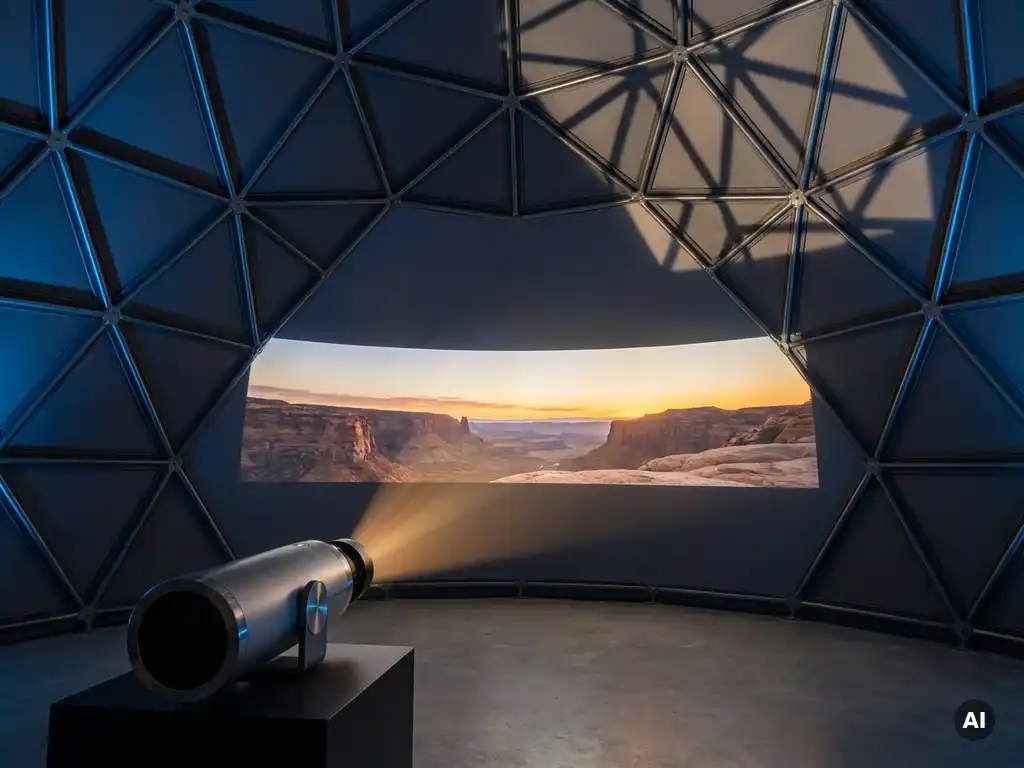
A complete 360 projection mapping setup requires high-lumen projectors (typically 10,000 lumens or more), dedicated media servers, edge blending software, and purpose-built projection surfaces such as domes, cylinders, or curved screens. The exact combination of hardware and software depends on the scale of the installation, the resolution required, and whether the experience is permanent or touring.
For large-scale immersive installations designed to surround audiences entirely, the technical stack goes well beyond a single projector and a laptop. Each component plays a critical role in delivering seamless, high-impact visuals that envelop viewers from every angle. The sections below break down each element of the system in detail.
What types of projectors work best for 360 projection mapping?
The best projectors for 360 projection mapping are high-brightness laser projectors with outputs of at least 10,000 lumens, though large-scale dome installations often require 20,000 lumens or more per unit. Laser light sources are preferred over lamp-based alternatives because they deliver consistent color accuracy, longer operational life, and significantly lower maintenance requirements in continuous-use environments.
For a full 360-degree immersive projection system, multiple projectors are almost always required. A single unit cannot cover an entire dome or cylindrical surface without distortion. The number of projectors depends on the diameter of the projection surface, the throw ratio of each unit, and the resolution target for the finished experience.
Key projector specifications to evaluate
When selecting projection mapping projectors for an immersive installation, the following specifications matter most:
- Brightness (lumens): Higher ambient light requires higher lumen output to maintain image visibility
- Resolution: 4K per projector is increasingly standard in professional setups; 1080p remains viable for smaller domes
- Contrast ratio: Affects the depth and richness of dark scenes, which are common in immersive storytelling
- Lens options: Short-throw and ultra-short-throw lenses allow projectors to be positioned closer to curved surfaces
- Connectivity: HDMI 2.0, DisplayPort, and SDI inputs are essential for high-bandwidth signal delivery
Projector placement in curved environments
In dome and cylindrical setups, projectors are typically mounted at the perimeter pointing inward, or positioned centrally with fisheye lenses for full-dome coverage. Each approach has trade-offs: perimeter mounting offers higher resolution but requires more units, while central fisheye configurations simplify cabling but can introduce optical distortion that must be corrected in software.
What software is used to control 360 projection mapping?
The most widely used software for controlling 360 projection mapping setups includes Disguise (d3), Watchout, Resolume Arena, and Notch. These platforms handle warping, blending, content playback, and synchronization across multiple projectors, and are the industry standard for professional immersive projection installations.
Each platform has a distinct strength. Disguise is favored for large-scale live events and touring productions because of its robust timeline-based workflow and real-time 3D previsualization. Watchout excels in fixed installations where reliability and scheduled playback are priorities. Resolume Arena is popular among VJs and interactive designers who need flexible, real-time content manipulation. Notch specializes in generative, real-time visual effects that respond to data inputs or live triggers.
Beyond these primary platforms, calibration tools such as Auto-Align from Scalable Display Technologies or Christie Twist are often used alongside the main software to automate geometric correction across multiple projector outputs. This layered approach, combining a primary playback platform with dedicated calibration tools, is common in professional 360 dome projection environments.
How does edge blending work in a 360 projection setup?
Edge blending in a 360 projection setup works by overlapping the edges of adjacent projector outputs and then gradually reducing the brightness of each overlapping zone so the transition becomes invisible to the human eye. The result is a single, seamless image across what would otherwise be visible seams between projector outputs.
In practice, each projector covers a slightly larger area than its designated segment of the surface. The overlapping region, typically between 10 and 20 percent of the image width, is processed by the projection mapping software, which applies a gradual luminance falloff called a gamma curve to both edges simultaneously. When two projectors share an overlap zone and both apply this falloff, their combined brightness matches the brightness of the non-overlapping areas, making the join imperceptible.
Achieving clean edge blending in a curved or dome environment is more complex than in flat projection because the surface geometry introduces additional distortion. Warping, the process of digitally deforming the projected image to match the physical curvature of the surface, must be applied before blending can be calibrated correctly. Professional immersive projection systems handle both warping and blending within the same software environment, often with the support of structured light scanning to automate the geometric correction process.
What servers and media playback hardware are required?
360 projection mapping setups require dedicated media servers capable of simultaneously driving multiple high-resolution video outputs in real time. Common choices include purpose-built hardware from manufacturers such as Disguise, Green Hippo, and Dataton, as well as high-specification custom workstations built around professional GPU arrays.
The processing demands of immersive projection are substantial. A single dome installation running four 4K projector outputs at 60 frames per second requires the server to decode, warp, blend, and output an enormous volume of pixel data with zero dropped frames. Consumer-grade hardware cannot meet this requirement reliably. Professional media servers are engineered specifically for this purpose, with redundant power supplies, multiple GPU slots, high-speed SSD RAID arrays for content storage, and dedicated video output cards.
Redundancy and backup systems
In professional and permanent installations, redundancy is not optional. A primary server failure during a live event or museum opening is operationally unacceptable. Most professional setups include a hot-standby server that mirrors the primary system and can take over within seconds if a failure occurs. Network synchronization protocols ensure both servers remain frame-accurate throughout the performance.
Signal distribution infrastructure
Beyond the servers themselves, the signal chain between server and projector matters significantly. Long cable runs in large venues introduce latency and signal degradation. Fibre-optic transmission systems, HDBaseT extenders, and professional AV matrix switchers are commonly used to maintain signal integrity across distances that would degrade standard HDMI or DisplayPort connections.
What surfaces and structures support 360 projection mapping?
The primary surfaces and structures used in 360 projection mapping are inflatable or rigid domes, cylindrical projection screens, geodesic structures, purpose-built projection tents, and architectural interiors such as circular rooms or vaulted ceilings. The surface material and geometry directly determine image quality, brightness efficiency, and the complexity of calibration required.
Inflatable domes are the most portable and widely used structure for touring immersive projection experiences. They can be deployed indoors or outdoors, assembled in a matter of hours, and are available in diameters ranging from a few metres to over 20 metres. The interior surface is coated with a high-gain projection material that maximizes brightness return from the projectors.
Rigid structures such as geodesic domes or purpose-built cylindrical rooms offer superior image stability and acoustic properties, making them the preferred choice for permanent installations in museums, science centres, and cultural venues. The trade-off is cost and installation complexity. Architectural surfaces, such as the interior of a rotunda or an existing curved ceiling, can also serve as projection canvases, though their irregular geometry typically requires extensive warping and calibration work.
Surface reflectivity is a critical factor regardless of structure type. Matte white surfaces with a gain rating close to 1.0 offer the widest viewing angle and most uniform brightness, which is essential when audiences are moving freely within the projection space rather than seated in fixed positions.
How much does a 360 projection mapping system cost?
The cost of a 360 projection mapping system varies considerably based on a combination of technical, logistical, and creative factors. Rather than a fixed price, the investment reflects the specific requirements of each project.
The primary cost drivers include:
- Number and specification of projectors: High-brightness laser projectors represent a significant portion of the hardware budget, and larger installations require more units
- Media server specification: Purpose-built professional servers carry a premium over general-purpose hardware, particularly when redundancy systems are included
- Surface and structure: Inflatable domes are more affordable than permanent rigid structures; custom architectural builds represent the highest structural investment
- Software licensing: Professional projection mapping software platforms operate on annual or perpetual license models, and costs scale with the number of outputs
- Content production: The immersive content itself, whether pre-rendered or real-time generative, is often as significant a cost as the hardware
- Installation, calibration, and operation: Skilled technical operators are required for setup, calibration, and live operation, particularly for event-based deployments
- Touring versus permanent: A permanent installation amortizes hardware costs over a longer operational life; a touring setup requires ruggedized flight cases, faster assembly systems, and often a dedicated technical crew
The scale of the audience, the duration of the installation, and the level of interactivity built into the experience all influence where a project lands on the investment spectrum. We work with clients across a wide range of budgets to design systems that maximize impact within realistic parameters.
What’s the difference between 360 projection mapping and a standard dome cinema?
The key difference between 360 projection mapping and a standard dome cinema is interactivity and flexibility. A dome cinema is a fixed, passive viewing experience where pre-rendered content plays on a hemispherical screen, typically for seated audiences. 360 projection mapping is a broader technical discipline that encompasses interactive, real-time, and architecturally adaptive experiences that can respond to audiences, data inputs, or live performance.
A traditional dome cinema, such as a planetarium or fulldome theatre, uses a single fisheye projector or a small array of projectors to display pre-rendered astronomical or educational content on a fixed hemispherical screen. The experience is linear, the audience is seated, and the content does not change based on who is in the room or what they are doing.
360 projection mapping, by contrast, treats the projection surface as a canvas that can be adapted, warped, and mapped to virtually any geometry, not just a standard dome. The content can be pre-rendered, generative, or live. The system can respond to sensor inputs, audience movement, sound levels, or external data feeds. The projection surface itself can be an irregular architectural space, a sculptural object, a product, or a custom-built structure designed specifically for the experience.
For organisations building immersive cultural or brand experiences, this distinction matters practically. A dome cinema requires audiences to adapt to a fixed format; a 360 projection mapping installation can be designed around the audience, the space, and the story being told. The result is an experience that feels genuinely tailored rather than templated, which is precisely why the discipline has become central to the most ambitious immersive installations being built today.
Whether you are designing a permanent museum installation, a touring brand activation, or an educational experience for thousands of visitors, the equipment decisions made at the start of a project define everything that follows. We bring together the technical expertise and creative vision to guide those decisions from first brief to final calibration. If you are ready to explore what a 360 projection mapping setup could look like for your project, we would welcome the conversation. Contact us to start.
Gerelateerde artikelen
- Which XR studio in Amsterdam creates custom experiences?
- What are some ideas for interactive museum exhibits?
- What are examples of immersive experiences?
- What does AR stand for in marketing?
- What exactly is experiential marketing?
- How does virtual reality impact society?
- How to create an immersive exhibition?
- Can spatial media increase foot traffic to physical locations?
- Is immersive the same as virtual reality?