
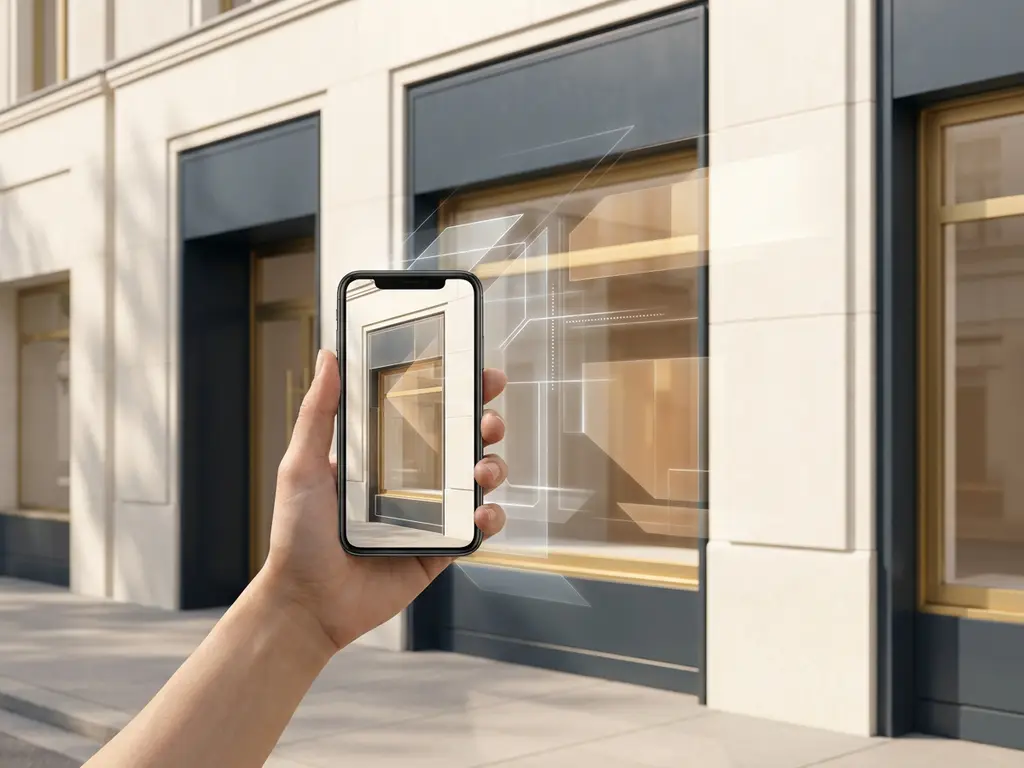
Yes, spatial media can meaningfully increase foot traffic to physical locations. When digital content is anchored to a specific place, whether through augmented reality, location-based experiences, or immersive installations, it gives people a compelling reason to show up in person that a social post or advertisement simply cannot replicate. The effect is strongest when the spatial media creates something that can only be experienced on-site. The questions below unpack exactly how this works, which formats perform best, and how organisations can measure the results.
How does spatial media draw people into physical spaces?
Spatial media draws people into physical spaces by attaching digital value to a specific location, making the place itself the destination rather than just a backdrop. When an experience can only be accessed by physically being somewhere, the location gains a pull that passive content cannot create. Curiosity, exclusivity, and the promise of something genuinely new are the core drivers.
Unlike a website or a social media campaign, spatial media is inherently place-bound. A geospatial AR layer placed on a city square, a 360-degree dome installation inside a museum, or an interactive AR portal at a brand event all require physical presence to engage with. That requirement is not a limitation. It is the mechanism. The experience becomes the reason to visit.
There is also a social dimension at work. Immersive, place-specific experiences are highly shareable. When someone encounters something unexpected and visually striking in a physical space, the instinct is to document it and share it. That organic content then reaches people who were not present, creating secondary pull toward the location. The physical space becomes a content engine in its own right.
Emotional resonance deepens this effect further. Multisensory experiences, those that engage not just sight and hearing but also spatial awareness, movement, and even smell or touch, create stronger memories than screen-based content. People associate those memories with the place where they had the experience, which increases the likelihood of return visits and word-of-mouth recommendations.
What types of spatial media are most effective for driving foot traffic?
The most effective types of spatial media for driving foot traffic are those that combine location-specificity with a strong reason to engage: geospatial AR, immersive installations, interactive 360-degree environments, and AR portals. Each format works because it creates an experience that is impossible to replicate remotely, anchoring the value directly to the physical site.
Geospatial AR and outdoor activations
Geospatial AR places digital content at precise geographic coordinates without requiring QR codes or physical markers. Passers-by discover layered content simply by pointing their phone at a location. This format works especially well for outdoor campaigns, city activations, and heritage trails because it transforms familiar streets or landmarks into discovery spaces. The surprise element is a powerful foot traffic driver.
Immersive installations and interactive environments
Physical installations, including interactive 360-degree domes, 4D cinema setups, and projection-mapped spaces, create environments that must be entered to be understood. These formats are particularly effective for museums, cultural institutions, and brand activations because they offer an experience that photographs and videos cannot fully convey. The gap between what people see shared online and what they know they are missing is a direct motivator for visiting.
AR portals and location-based VR
AR portals and location-based VR experiences place the gateway to another world at a specific physical address. This format has proven effective for tourism destinations, NGO awareness campaigns, and retail environments because it combines novelty with narrative. Visitors are not just looking at content. They are stepping through it, and that distinction matters enormously for driving attendance.
Why do immersive experiences outperform traditional advertising for physical attendance?
Immersive experiences outperform traditional advertising for physical attendance because they create intrinsic motivation rather than extrinsic persuasion. A billboard tells someone to visit. An immersive experience gives them a reason they generate themselves. The difference lies in agency: when people feel pulled toward something rather than pushed, conversion from awareness to physical presence is significantly higher.
Traditional advertising operates on repetition and reach. It plants a message and hopes it sticks long enough to influence behaviour. Immersive experiences operate on desire and exclusivity. When someone sees a spatial media activation shared by a friend, they do not just receive information about a place. They experience vicarious FOMO, the sense that something meaningful is happening somewhere, and they are not part of it yet.
There is also a memory dimension that advertising cannot match. Research in cognitive psychology consistently shows that multisensory, embodied experiences are retained far more effectively than information received passively. The forgetting curve, which describes how quickly people lose information absorbed through passive exposure, is dramatically flattened when learning or engagement involves active participation and sensory input. Immersive experiences create memories that persist, and persistent memories drive repeat visits and referrals.
Finally, immersive experiences generate authentic content. When visitors share their own documentation of an experience, that content carries social proof that no paid advertisement can replicate. The physical location becomes associated with something worth experiencing rather than something worth knowing about.
Which industries benefit most from spatial media foot traffic strategies?
The industries that benefit most from spatial media foot traffic strategies are museums and cultural institutions, retail and brand experiences, education, tourism, and NGOs or public sector organisations. These sectors share a common need: they depend on physical presence to deliver their core value, and they face growing competition from digital alternatives that offer convenience without requiring attendance.
Museums and cultural institutions are among the clearest beneficiaries. Declining visitor numbers and an ageing demographic are persistent challenges. Spatial media, whether AR layers over existing collections or fully immersive dome experiences, creates new reasons for younger audiences to visit and return. The technology enhances rather than replaces the artefacts, which aligns with the institutional need to preserve authenticity while expanding relevance.
Retail and brand environments gain from spatial media because physical retail increasingly needs to offer something that online shopping cannot. An AR activation in a flagship store, or an immersive brand experience at an event, transforms the location from a transaction point into a destination. Visitors come for the experience and engage with the brand as a result.
Education and NGOs benefit when their programmes require physical attendance, such as training centres, awareness campaigns, or community outreach events. Immersive experiences give these organisations a compelling reason to ask people to show up in person, and a powerful mechanism for the kind of empathy-building and behaviour change that only embodied experience can produce.
Tourism destinations and heritage sites use spatial media to extend their appeal beyond the artefact or landscape itself, adding narrative layers that make a visit richer and more memorable, which in turn drives reviews, recommendations, and return visits.
How can organisations measure whether spatial media increased foot traffic?
Organisations can measure whether spatial media increased foot traffic by combining direct attendance data with behavioural indicators and digital attribution. The most reliable approach uses a before-and-after comparison of visitor numbers, supplemented by data from the spatial media platform itself, such as activation events, session lengths, and geographic heat maps showing where engagement occurred.
For location-based AR and geospatial activations, the platform typically captures the number of unique users who triggered the experience, the duration of each session, and the precise location of engagement. Cross-referencing these figures with foot traffic counters or ticketing data at the physical location reveals whether spikes in digital engagement correspond to increases in physical attendance.
Indirect indicators also carry significant weight. Social media monitoring can track location-tagged posts, check-ins, and user-generated content associated with the activation. An increase in organic mentions tied to a specific location, particularly from people who were not previously engaged with the venue or brand, is a strong signal that spatial media is drawing new visitors.
For more controlled measurement, organisations can use dedicated entry points or QR-based check-ins tied to the spatial media experience, creating a direct link between digital engagement and physical arrival. Surveys at the point of entry, asking visitors how they heard about the experience, provide qualitative data that complements the quantitative picture. The combination of platform analytics, attendance counters, social listening, and visitor surveys gives a robust, multi-layered view of impact.
What does a spatial media activation look like in practice?
A spatial media activation in practice is a designed experience that attaches digital content to a specific physical location, creating an encounter that rewards presence. In its simplest form, it might be an AR layer over a museum exhibit that reveals hidden stories when a visitor points their phone at a painting. At its most complex, it is a fully custom immersive installation combining projection, spatial audio, scent, and interactive elements built around a specific narrative goal.
A typical activation begins with a clear objective: is the goal to attract new visitors, deepen engagement for existing ones, drive awareness of a cause, or create shareable brand moments? The format, whether geospatial AR, an interactive dome, a VR portal, or an AI-driven avatar, is chosen to serve that objective rather than as a technology showcase.
From there, the experience is designed around the physical space and the audience. Content is created, hardware is specified, and the activation is tested in situ before launch. For a brand event, this might mean a single-day AR activation at a product launch that draws attendees to a specific booth and generates hundreds of pieces of user-created content. For a museum, it might mean a permanent AR layer across a wing of the collection, accessible via a dedicated app that deepens the visitor journey over months.
We approach every activation from concept through to delivery, ensuring the technology serves the story rather than competing with it. The result is an experience that feels inevitable for the space it inhabits, not bolted on.
When should a location invest in spatial media over other engagement tools?
A location should invest in spatial media over other engagement tools when physical presence is central to its value proposition and when existing engagement tools have reached their ceiling. If a venue, brand, or organisation depends on people showing up, and if conventional advertising, email campaigns, or social content are no longer moving the needle on attendance, spatial media offers a qualitatively different mechanism for generating motivation to visit.
The strongest case for spatial media is when the experience itself is the product. Museums, cultural institutions, brand flagships, and educational centres are not selling information that can be delivered remotely. They are selling presence, atmosphere, and the kind of understanding that only comes from being somewhere. Spatial media amplifies exactly that value. It makes the location more worth visiting, not just more visible.
Budget and timeline considerations matter too. Spatial media activations vary considerably in scope and investment, depending on factors such as the complexity of the content, the technology platform, the duration of the activation, the degree of interactivity, and whether hardware needs to be custom-built or adapted from existing infrastructure. Organisations with a clear objective, a defined audience, and a physical space that needs to work harder will find the investment scales to their needs.
The right moment to invest is also when there is a narrative worth telling that cannot be told any other way. If the goal is empathy, behaviour change, deep learning, or genuine emotional connection, spatial media is not just one option among many. It is the format built for exactly that purpose. If you are ready to explore what a spatial media strategy could unlock for your location, we would welcome the conversation, reach out through our contact page and let us show you what becomes possible.
Gerelateerde artikelen
- What is immersive experience and how does it work?
- What are the benefits of experiential marketing?
- What is an example of multi sensory learning?
- Can AI make AR?
- What are the types of immersive experience?
- Is VR an immersive experience?
- What are the benefits of taking a virtual field trip in immersive virtual reality?
- What technologies are used in immersive experiences?
- How do you create VR content for marketing campaigns?