
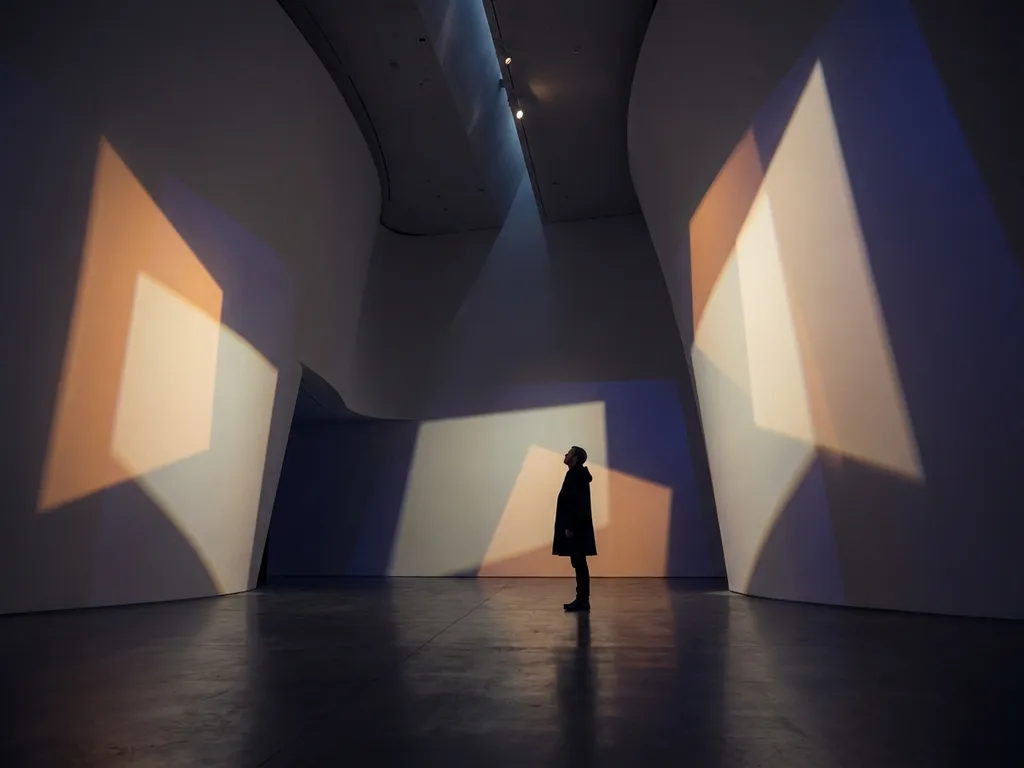
Creating an immersive exhibition means designing a physical or hybrid space where visitors do not simply observe, they participate, feel, and remember. The most effective immersive exhibitions combine spatial design, technology, and narrative into a single coherent experience that engages multiple senses at once. This article unpacks the key questions behind that process, from choosing the right technology to measuring real-world impact.
What makes an exhibition truly immersive?
An exhibition becomes truly immersive when it shifts the visitor from passive observer to active participant. This happens when the environment responds to presence, when narrative unfolds through exploration rather than explanation, and when more than two senses are engaged simultaneously. The result is an experience that feels lived rather than viewed.
The word immersive is often used loosely, but in exhibition design it has a precise meaning: the environment wraps around the visitor rather than presenting itself at a distance. A painting on a wall is content. A room where that painting’s world surrounds you, where you hear its soundscape and feel its atmosphere, is an immersive experience.
Several qualities define genuinely immersive exhibitions:
- Multisensory engagement, sound, scent, temperature, texture, and spatial design work together rather than relying on visuals alone
- Environmental coherence, every design element, from lighting to floor texture, reinforces the same world or narrative
- Agency and interaction, visitors make choices that affect what they encounter, creating a sense of personal ownership over the experience
- Emotional resonance, the experience connects to something the visitor already cares about, whether that is curiosity, empathy, or wonder
- Spatial narrative, the story is told through the space itself, not just through text panels or audio guides
The difference between an interactive and an immersive experience is worth clarifying here. Interactive means the visitor can respond to something. Immersive means the environment itself surrounds and responds to the visitor. The strongest exhibitions are both: they envelop visitors in a coherent world and give them meaningful ways to engage within it.
What types of technology are used in immersive exhibitions?
Immersive exhibitions draw on a broad toolkit of technologies, including virtual reality, augmented reality, mixed reality, projection mapping, spatial audio, interactive screens, and AI-driven personalization. The technology chosen depends on the story being told, the audience, the venue, and the level of interactivity required.
Extended reality: VR, AR, and MR
Extended reality (XR) is the umbrella term covering virtual reality (VR), augmented reality (AR), and mixed reality (MR). Each serves a different purpose in exhibition contexts.
Virtual reality places visitors inside a fully digital environment using a headset. It is particularly powerful for transporting audiences to places that cannot be physically recreated, the surface of another planet, a historical moment, or the perspective of another person. VR experiences can be passive, like a cinematic 360-degree film, or fully interactive, allowing visitors to explore and make decisions within the virtual world.
Augmented reality layers digital content over the physical world, typically through a smartphone or AR headset. In a museum context, AR can bring a sculpture to life, reveal the original colours of an ancient artefact, or open a portal into a related historical scene without altering the physical object itself. Geospatial AR can place content at precise outdoor coordinates, extending the exhibition beyond the building’s walls.
Mixed reality, particularly on hardware like the Apple Vision Pro, enables real-time interaction between virtual objects and the physical environment. A visitor can reach out and manipulate a digital artefact that appears to rest on the actual exhibition table in front of them. This represents the frontier of spatial computing in cultural spaces.
Projection, spatial audio, and physical installations
Not every immersive exhibition requires a headset. Large-scale projection mapping transforms walls, floors, and ceilings into dynamic canvases. Interactive 360-degree domes create shared immersive environments for groups of visitors without any wearable technology. Spatial audio systems place sound precisely in three-dimensional space, guiding attention and building atmosphere in ways that traditional stereo cannot.
Physical installations, including 4D cinemas that add scent, warmth, and haptic feedback, push immersion into the body itself. These multisensory layers are what separate a truly immersive exhibition from a high-quality audio-visual presentation.
AI adds another dimension entirely. AI-driven avatars and non-player characters (NPCs) can hold real-time conversations with visitors, adapting their responses based on what the visitor says or does. This creates a level of personalization that makes each visitor’s journey genuinely unique.
How do you choose the right immersive format for your exhibition?
The right immersive format is determined by four factors: the story you need to tell, the audience you are serving, the physical constraints of your venue, and the scale of your ambitions. There is no single best format, the most effective choice is always the one that serves the narrative most faithfully while matching the practical realities of the project.
Start with the story. If the goal is to transport visitors to an inaccessible place or time, VR offers the most complete sense of presence. If the goal is to enrich physical artefacts without removing them from their context, AR is the more appropriate tool. If the goal is to create a shared spectacle for large groups, projection-based installations or immersive domes are more scalable and accessible than individual headsets.
Consider the audience next. Younger visitors often arrive with high expectations for digital interactivity and respond well to gamified AR experiences. Older audiences or those less familiar with technology may find headset-based VR disorienting, making screen-based or projection formats a more inclusive choice. Educational audiences benefit from formats that allow them to make decisions and see consequences, reinforcing learning through active participation.
Venue constraints matter more than many exhibition designers initially expect. Ceiling height, floor space, lighting conditions, internet connectivity, and power infrastructure all shape which technologies are viable. A format that works brilliantly in a purpose-built studio may require significant adaptation in a heritage building with listed architectural features.
Finally, think about longevity and scalability. A format that can travel to multiple venues, be updated with new content, or be adapted for different audience sizes will deliver more long-term value than a bespoke installation designed for a single occasion.
How does storytelling work in an immersive exhibition?
In an immersive exhibition, storytelling is spatial rather than linear. Instead of guiding visitors through a fixed sequence of information, the narrative is embedded in the environment itself, in the objects they encounter, the sounds they hear, the choices they make, and the perspectives they inhabit. The visitor becomes a participant in the story rather than an audience for it.
This requires a fundamental shift in how content is structured. Traditional exhibition design often follows a chronological or thematic sequence, with text panels and captions doing the explanatory work. Immersive storytelling distributes that work across the entire sensory environment. A visitor might understand the emotional weight of a historical event not through a label, but through standing inside a spatial reconstruction of it, hearing the ambient sounds, and being invited to make a choice that mirrors the choices real people faced.
Perspective is one of the most powerful tools in immersive storytelling. When a visitor experiences a narrative from inside the viewpoint of another person, a refugee, a historical figure, a child, the empathic impact is qualitatively different from reading about that person’s experience. This is why immersive formats are particularly effective for exhibitions addressing social issues, historical injustice, or complex human experiences that resist easy explanation.
The most effective immersive narratives are also layered. A first-time visitor might engage with the surface story. A more curious visitor who explores further discovers additional depth, hidden content, branching narratives, or contextual detail that rewards attention. This layering respects the diversity of visitor motivations and ensures the experience remains meaningful across multiple visits.
What are the key stages of designing an immersive exhibition?
Designing an immersive exhibition typically moves through five stages: concept development, narrative and experience design, technical production, installation and testing, and post-launch evaluation. Each stage builds on the previous one, and the most successful projects treat these stages as iterative rather than strictly sequential.
- Concept development, Define the core question the exhibition is asking, the audience it is serving, and the emotional journey you want visitors to take. This stage establishes the creative brief and the strategic goals that every subsequent decision will be tested against.
- Narrative and experience design, Translate the concept into a spatial and sensory journey. This includes defining the visitor flow, identifying key moments of interaction and emotional impact, and selecting the technologies and formats that will carry the story.
- Technical production, Build the digital and physical components: 3D environments, interactive systems, audio design, physical installations, and any hardware infrastructure. This is the longest stage and requires close collaboration between creative, technical, and production teams.
- Installation and testing, Assemble the exhibition in the actual venue and test every element under real conditions. Immersive experiences are highly sensitive to environmental variables, lighting, acoustics, visitor traffic, and this stage often reveals adjustments that cannot be anticipated in a studio setting.
- Post-launch evaluation, Gather visitor feedback, analyse engagement data, and assess whether the experience is achieving its intended impact. Immersive exhibitions that are designed to run over time benefit enormously from this feedback loop, allowing content to be refined and updated.
Throughout all stages, co-creation with the commissioning institution is essential. The most meaningful immersive exhibitions emerge from genuine collaboration between the creative studio and the curators, educators, or communicators who hold deep knowledge of the subject matter and the audience.
How much does it cost to create an immersive exhibition?
The cost of creating an immersive exhibition varies considerably and depends on a combination of factors rather than a fixed price structure. Understanding what drives cost is more useful than any single figure, because the same narrative goal can often be achieved at very different investment levels depending on the choices made at each stage of the process.
The primary cost drivers include:
- Scale and duration, A temporary activation for a single event requires less infrastructure than a permanent installation designed to run for years. The longer the intended lifespan, the more investment in robust hardware, updateable content systems, and maintenance planning is justified.
- Technology complexity, A projection-based experience with pre-rendered content sits at a different cost level than a fully interactive VR environment with real-time AI personalization. More complex interactions require more development time and more sophisticated technical infrastructure.
- Customisation, Bespoke 3D environments, original spatial audio compositions, custom physical installations, and purpose-built hardware all carry higher costs than adaptations of existing assets or platforms.
- Number of simultaneous visitors, An experience designed for one visitor at a time has very different hardware and space requirements than one designed to serve hundreds of visitors per day across multiple simultaneous touchpoints.
- Content depth and interactivity, Branching narratives, multilingual personalization, and AI-driven responsiveness each add layers of development complexity that affect the overall investment.
The most productive approach to budgeting is to start with the impact you need to achieve and work backwards to the minimum viable experience that delivers it. A well-designed, focused immersive experience with a clear narrative and appropriate technology will consistently outperform an overbuilt one that spreads its budget across too many features.
How do you measure the impact of an immersive exhibition?
The impact of an immersive exhibition is measured across three dimensions: behavioural engagement during the experience, emotional and cognitive outcomes after it, and longer-term effects on the audience’s attitudes or actions. Effective measurement requires defining success criteria before the exhibition opens, not after.
Behavioural metrics are the most straightforward to collect. Time spent in the exhibition, interaction rates at specific touchpoints, visitor flow patterns, and return visit rates all provide quantitative data about how the experience is being used. Digital components generate this data naturally, while physical installations may require observation or sensor-based tracking.
Emotional and cognitive outcomes require more deliberate measurement. Pre- and post-visit surveys can assess shifts in awareness, understanding, or attitude toward the subject matter. For educational exhibitions, knowledge assessments before and after the experience reveal whether learning objectives have been met. For empathy-focused experiences, qualitative feedback and structured reflection activities often capture impact that numbers alone cannot.
Longer-term effects are the hardest to measure but often the most meaningful. Did visitors take a specific action after leaving, donating, sharing, changing a behaviour, seeking further information? Did the exhibition generate media coverage or social sharing that extended its reach beyond physical visitors? Did it attract new audience segments to the institution?
The most rigorous approach combines quantitative data with qualitative insight, and builds in evaluation touchpoints at multiple intervals: immediately after the visit, one month later, and at the close of the exhibition run. This longitudinal view reveals whether the experience created a lasting impression or a momentary one, which is ultimately the distinction that matters most in immersive exhibition design.
If you are ready to explore what an immersive exhibition could look like for your institution or project, we would be glad to think through the possibilities with you. Contact us to start the conversation.
Gerelateerde artikelen
- What are examples of immersive experiences?
- What is the primary goal of experiential marketing?
- How much does augmented reality cost?
- What can provide immersive training experiences?
- How do I create an immersive experience?
- How to create a virtual reality experience?
- Which is an example of immersive experience technology?
- Can spatial media increase foot traffic to physical locations?
- How do you align immersive experiences with brand identity?