
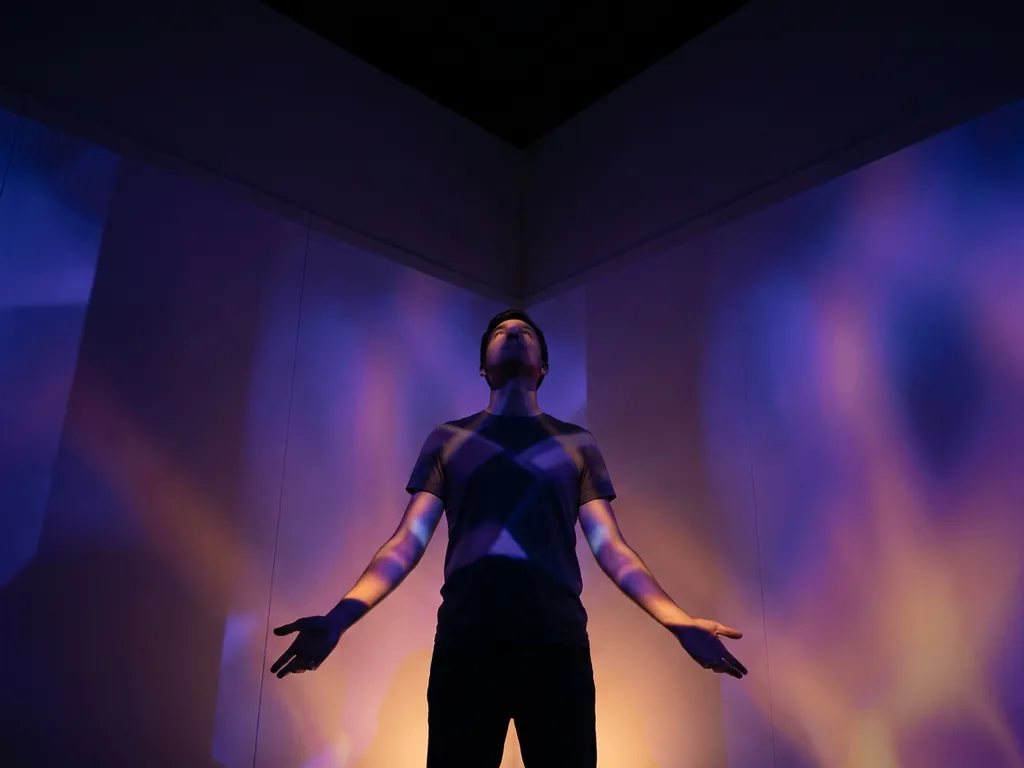
Immersive experience technology refers to any tool or system that surrounds a person in a digitally or physically constructed environment, engaging multiple senses to create a sense of presence. Examples include virtual reality headsets, augmented reality overlays, 360-degree projection domes, interactive installations, and AI-driven spatial environments. These technologies share one defining quality: they shift the audience from passive observer to active participant.
The range of immersive technologies is broader than most people expect, spanning everything from a museum visitor stepping into a VR reconstruction of an ancient city to a shopper encountering a holographic product display in a retail space. What unites them is the deliberate design of an environment that draws people in, holds their attention, and leaves a lasting impression. The sections below unpack the most important questions around immersive experience technology, from the foundational definitions to the practical decisions organizations face when choosing between formats.
What counts as immersive experience technology?
Immersive experience technology is any hardware, software, or spatial system designed to place a person inside a constructed sensory environment rather than presenting content to them. This includes virtual reality (VR), augmented reality (AR), mixed reality (MR), 360-degree projection systems, interactive installations, haptic feedback systems, spatial audio, and AI-driven environments. The defining criterion is engagement depth, not a specific device.
The term covers an intentionally wide spectrum. At one end, a 360-degree video viewed through a headset qualifies because it surrounds the viewer completely. At the other end, a multi-room installation combining scent, sound, projection, and physical props qualifies because it activates multiple senses simultaneously and removes the frame that separates audience from content.
What does not count as immersive experience technology is standard screen-based media, even when the content is compelling. A documentary on a flat screen, a website, or a slideshow presentation all keep the viewer at a distance. Immersive technology collapses that distance. The moment a person feels present inside the content rather than in front of it, the threshold has been crossed.
Extended reality, or XR, has become the umbrella term that covers VR, AR, and MR together. Spatial computing, a term increasingly used in 2026, refers to the broader field of computing that understands and responds to three-dimensional physical space, which is the technical foundation beneath most immersive platforms.
What are the most widely used types of immersive technology today?
The most widely used types of immersive technology today are virtual reality (VR), augmented reality (AR), mixed reality (MR), 360-degree projection environments, and interactive digital installations. VR and AR dominate in terms of adoption volume, while large-format projection and multi-sensory installations are the preferred formats for high-impact public and cultural experiences.
Each format serves different contexts and audience sizes:
- Virtual Reality (VR): Users wear a headset that replaces their entire visual field with a computer-generated or filmed environment. VR is used for training simulations, educational experiences, cinematic storytelling, and location-based entertainment. It delivers the highest sense of presence of any current technology.
- Augmented Reality (AR): Digital content is layered onto the real world through a smartphone, tablet, or AR glasses. AR is widely used for brand activations, retail, education, and cultural experiences because it requires no specialist equipment beyond a mobile device.
- Mixed Reality (MR): Virtual objects interact with the real physical environment in real time. Devices like Apple Vision Pro represent the current frontier of MR, enabling experiences where digital and physical elements coexist and respond to each other.
- 360-Degree Projection Domes and Environments: Custom-built spaces where audiences are surrounded by projected content on all surfaces. These are scalable to groups of hundreds or thousands and are commonly used in museums, festivals, and corporate events.
- Interactive Installations: Physical spaces equipped with sensors, screens, haptics, scent, or sound that respond to visitor movement and behavior. These are particularly effective for public awareness campaigns and cultural exhibitions.
The choice between these formats typically depends on audience size, portability requirements, budget, and the depth of immersion the experience demands.
How does augmented reality differ from virtual reality as an immersive technology?
The key difference between augmented reality and virtual reality is what the user sees: AR adds digital content to the real world, while VR replaces the real world entirely. In AR, you remain aware of your physical surroundings with digital layers placed on top. In VR, a headset blocks out the physical environment and substitutes a fully constructed digital one.
This distinction has significant practical consequences for how each technology is deployed.
Augmented Reality: Accessible and Context-Aware
AR runs on devices most people already carry, making it far more accessible at scale. A museum visitor can point their phone at a painting and see an AR layer animate the artwork with historical context. A brand can trigger an AR experience from a poster, a product package, or a physical location coordinate without requiring any specialist hardware. AR keeps users grounded in their real environment, which makes it suitable for public spaces, retail, and outdoor activations where full immersion would be impractical or unsafe.
Virtual Reality: Deep Immersion and Full Presence
VR demands more from the user, who must wear a headset and, in most cases, remain stationary or within a defined physical area. In return, it delivers a level of presence that no other current technology matches. When someone stands inside a VR reconstruction of a refugee camp, or practices a surgical procedure in a simulated operating theatre, the sense of actually being there is qualitatively different from watching it on a screen. This depth of presence is why VR is particularly powerful for empathy-building, high-stakes training, and experiences where emotional impact is the primary goal.
Mixed reality sits between the two: it keeps the real world visible but allows virtual objects to behave as if they physically exist within it, responding to surfaces, lighting, and the user’s position in space.
What industries use immersive experience technology the most?
The industries that use immersive experience technology most extensively are education and training, cultural heritage and museums, marketing and brand experience, healthcare, defense and emergency services, and entertainment. Each sector adopts immersive technology for distinct reasons, but all share the same core driver: the need to create understanding or engagement that conventional media cannot achieve.
In education, immersive technology addresses one of the oldest challenges in learning: how to make abstract or distant concepts feel real and relevant. Students who walk through a virtual representation of the human circulatory system, or who experience the perspective of a historical figure through a VR simulation, retain information more effectively than those who read the same content on a page.
In museums and cultural institutions, immersive technology is being used to reverse declining visitor numbers, attract younger audiences, and give new life to collections that risk feeling static. AR layers can animate artifacts, VR can reconstruct lost historical environments, and interactive installations can transform passive viewing into participatory discovery.
In marketing and brand experience, immersive activations solve the attention problem. In a media landscape saturated with passive advertising, a physical experience that engages multiple senses creates genuine emotional memory and generates organic sharing. Brand managers use AR activations, VR brand films, and interactive installations to build the kind of connection that a banner advertisement cannot.
NGOs and public sector organizations use immersive technology to communicate complex social issues in ways that generate empathy and motivate action. Placing a donor inside the lived reality of a humanitarian crisis, rather than showing them statistics about it, produces measurably different emotional and behavioral responses.
How does AI enhance immersive experiences?
AI enhances immersive experiences by enabling personalization, real-time responsiveness, and scalable interactivity that static content cannot provide. Rather than delivering the same experience to every visitor, AI-driven systems can adapt the narrative, language, pacing, and content of an immersive environment based on who is experiencing it and how they are responding.
The most visible application of AI in immersive environments is the AI avatar or non-player character (NPC): a virtual character capable of holding a real-time conversation with a visitor, answering questions, adjusting its communication style, and guiding the experience dynamically. This transforms a one-way presentation into a genuine dialogue, which is particularly valuable in educational and public awareness contexts where visitors arrive with different levels of prior knowledge.
Beyond conversational AI, machine learning systems can analyze visitor behavior within an immersive environment and adjust what happens next. A training simulation might increase its difficulty level based on how confidently a learner is responding. A brand experience might shift its narrative focus based on which elements are generating the most engagement. This kind of adaptive experience is impossible with pre-produced linear content.
We integrate AI-driven personalization across our immersive projects precisely because it allows a single experience to serve diverse audiences effectively, whether that means adapting to different languages, learning styles, or emotional states in real time.
What is the difference between location-based and portable immersive experiences?
Location-based immersive experiences are fixed installations designed for a specific physical space, while portable immersive experiences are designed to be deployed, transported, and operated across multiple venues. The distinction affects design complexity, production cost, scalability, and the type of sensory depth that is achievable.
A location-based experience is built into or around a permanent or semi-permanent physical environment. A 360-degree projection dome installed in a museum, a multi-room sensory installation at a cultural venue, or a VR cinema built into a brand experience center are all location-based. Because the environment is fixed, designers can engineer every element of the space, including acoustics, lighting, scent, temperature, and physical props, to work together precisely. The result is typically a deeper, more controlled sensory experience. The trade-off is that the audience must travel to the location.
A portable immersive experience is designed to travel. Mobile VR setups with synchronized headsets, AR activations triggered by a smartphone app, and modular interactive installations that can be assembled and disassembled across different venues all fall into this category. Portable formats prioritize accessibility and reach over environmental control. They are the right choice when the goal is to bring the experience to the audience rather than the reverse, which is common for touring exhibitions, roadshow campaigns, and school outreach programs.
Many organizations use both in combination: a flagship location-based installation that delivers the deepest experience for engaged audiences, paired with a portable version that extends reach to communities that cannot access the main venue.
When should organizations choose immersive technology over traditional media?
Organizations should choose immersive technology over traditional media when the goal is to generate genuine emotional engagement, build empathy, change behavior, or create a memory that lasts beyond the moment of consumption. If the objective is simply to inform or broadcast at scale, traditional media is often more efficient. But when the content needs to be felt, not just seen, immersive technology is the stronger choice.
Several specific conditions consistently favor immersive over traditional approaches:
- The subject is difficult to convey through description alone. Complex social issues, abstract scientific concepts, historical events, and high-stakes professional skills all benefit from being experienced rather than explained. Immersive technology closes the gap between knowing something intellectually and understanding it viscerally.
- The audience is disengaged or hard to reach. Young people who are unmoved by traditional classroom instruction, donors who have become desensitized to statistics, or consumers who scroll past conventional advertising are all more likely to engage when the medium itself demands their physical and emotional participation.
- The desired outcome is behavior change, not just awareness. Research consistently shows that multisensory experiences produce stronger memory encoding and more durable attitude shifts than passive media. When the goal is to change what someone does, not just what they know, immersive formats outperform.
- The brand or institution needs to differentiate. In crowded markets and competitive cultural landscapes, an immersive experience creates a category of one. It is inherently shareable, physically memorable, and difficult to replicate with a standard media budget.
The practical question is not whether immersive technology is more powerful than traditional media, because in the right context it consistently is. The practical question is whether the investment is proportionate to the goal. Factors that shape this include the scale of the audience, the complexity of the experience, the hardware required, and the degree of customization involved. If you are weighing whether an immersive approach is right for your next project, we welcome the conversation. Contact us to explore what is possible.
Gerelateerde artikelen
- How much does it cost to build an interactive museum?
- What are the benefits of multisensory learning?
- What are the challenges of creating immersive experiences?
- What are the types of immersive technology?
- How much to build an immersive room?
- How do immersive experiences help brands connect with Gen Z?
- What is immersive and interactive media?
- What are the principles of good spatial design?
- What is experiential marketing?