
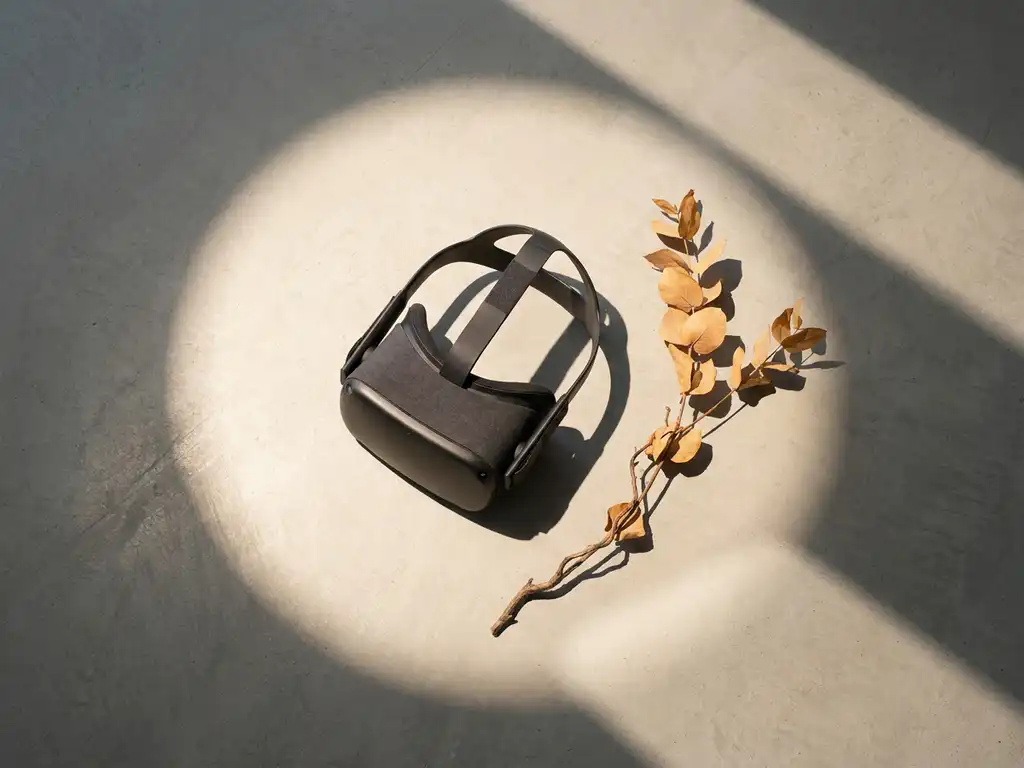
Immersive and interactive media are formats that place the audience inside the experience rather than in front of it. Instead of watching content on a screen, participants enter, explore, and influence it, through physical space, digital technology, or a combination of both. These formats span everything from virtual reality and augmented reality to interactive installations, 360-degree environments, and AI-driven storytelling.
What makes this category distinct is not just the technology involved, but the underlying design philosophy: experiences are built around human perception, emotion, and agency rather than passive consumption. As a result, they tend to create deeper understanding, stronger emotional connection, and more lasting memory than traditional media formats.
The questions below unpack the full picture, from foundational definitions to the hardware, creators, and real-world applications shaping this field in 2026.
How does immersive media differ from traditional media?
Traditional media delivers content to an audience from a fixed point: a screen, a page, a stage. Immersive media surrounds the audience with content, placing them inside the narrative or environment. The fundamental difference is presence: immersive media is designed so that participants feel they are somewhere, not just watching something from the outside.
Traditional formats like television, print, and standard digital advertising rely on the audience’s willingness to pay attention. Immersive media earns attention by activating multiple senses simultaneously: sight, sound, touch, smell, and spatial awareness. This multisensory engagement is not decorative; it directly affects how information is processed and retained. When the brain receives input across several sensory channels at once, memory encoding becomes significantly stronger than it does through single-channel formats.
There is also a fundamental shift in agency. In traditional media, the audience receives a fixed sequence of content. In immersive media, the audience often influences what happens next, through movement, choice, or interaction. This transforms the relationship between message and receiver from broadcast to dialogue.
What are the main types of immersive and interactive media?
The main types of immersive and interactive media include virtual reality (VR), augmented reality (AR), mixed reality (MR), 360-degree experiences, interactive installations, spatial computing environments, and AI-driven interactive content. Each type differs in how it blends the digital and physical worlds and how much agency it gives the participant.
Virtual Reality (VR)
VR replaces the physical environment entirely with a digitally created world. Participants wear a headset that tracks their movements and adjusts the visual field in real time, creating a convincing sense of presence in a virtual space. VR can be passive, like a cinematic 360-degree film, or fully interactive, allowing users to manipulate objects, navigate environments, and make decisions that affect outcomes. It is widely used in education, training, brand storytelling, and therapeutic applications.
Augmented Reality (AR)
AR layers digital content onto the real world, viewed through a smartphone, tablet, or AR glasses. Unlike VR, it does not replace the physical environment: it enhances it. AR activations can bring a museum exhibit to life, animate a product label, or place a virtual building on a real street corner. The technology ranges from simple image-tracking to sophisticated geospatial AR that anchors content to precise GPS coordinates without requiring QR codes.
Mixed Reality and Spatial Computing
Mixed reality blends virtual and physical elements so that digital objects interact with the real environment in real time. A virtual character can sit on a real chair; a digital overlay can respond to a physical wall. Spatial computing platforms like Apple Vision Pro represent the current frontier of this category, enabling seamless real-time interaction between the two worlds. This is the domain where immersive media is evolving fastest in 2026.
Interactive Installations and 360-Degree Environments
These are physical spaces transformed through projection, sound, scent, and responsive technology. A 360-degree dome can surround hundreds of visitors with synchronized imagery and audio. A 4D cinema adds physical sensation, warmth, movement, scent, to a visual experience. Interactive screens respond to the presence and behavior of passersby. These formats are particularly powerful in public settings, museums, and large-scale events where shared experience matters.
What is the difference between immersive and interactive media?
Immersive media surrounds the audience with an environment designed to create a sense of presence and emotional depth. Interactive media gives the audience agency to influence or direct what happens. The two often overlap, but they are not the same thing: an experience can be immersive without being interactive, and interactive without being fully immersive.
A cinematic VR film, for example, is deeply immersive: it places the viewer inside a story, but may offer no choices or controls. Conversely, a touchscreen quiz at a museum is interactive but not particularly immersive. The most powerful experiences combine both qualities: they create a strong sense of presence while giving participants meaningful control over their journey through it.
The distinction matters for design purposes. Immersive design focuses on sensory environment, spatial narrative, and emotional atmosphere. Interactive design focuses on decision architecture, feedback loops, and participant agency. When both are built intentionally into a single experience, the result is something that neither traditional media nor basic interactivity can achieve on its own.
Where is immersive and interactive media used today?
In 2026, immersive and interactive media are used across education, cultural institutions, brand marketing, healthcare, NGOs, government communication, entertainment, and real estate. The technology has moved well beyond novelty applications and is now embedded in serious professional contexts where measurable impact is the goal.
In education, schools and universities use VR and AR to teach subjects that are difficult to convey through text alone: anatomy, history, environmental science, and social empathy. Learners can walk through a historical event, explore the inside of a cell, or experience life from another person’s perspective. These experiential learning formats address the well-documented challenge of passive learning and motivation loss in traditional classroom settings.
Museums and cultural institutions use AR layers, interactive installations, and immersive domes to deepen visitor engagement and attract younger audiences. Rather than replacing physical collections, these technologies add interpretive depth, revealing the story behind an artifact, animating a static painting, or transporting a visitor to the original context of a historical object.
Brands and marketing teams use immersive activations at events, in retail environments, and at product launches to create experiences that generate genuine emotional connection rather than passive exposure. NGOs and public sector organizations use location-based VR and interactive storytelling to build empathy around complex social issues and motivate behavioral change. The common thread across all these applications is the same: immersive media works because it transforms information into felt experience.
How does AI enhance immersive and interactive media experiences?
AI enhances immersive and interactive media by enabling personalization, real-time responsiveness, and conversational interaction within an experience. Rather than delivering the same content to every participant, AI-driven systems adapt the narrative, pacing, language, and difficulty level based on who the participant is and how they are engaging.
One of the most significant applications is AI avatars and non-player characters (NPCs) that hold real-time conversations with participants. Instead of following a scripted dialogue tree, these virtual characters can respond to open-ended questions, adjust their tone, and guide participants through complex topics in a natural, responsive way. This is transforming educational and training applications, where a learner can ask follow-up questions and receive contextually relevant answers from a virtual instructor.
AI also enables adaptive learning pathways. In an immersive educational experience, the system can detect whether a participant is struggling or excelling and adjust the content accordingly, presenting additional context, changing the challenge level, or offering a different narrative route. This kind of personalization at scale was previously impossible in physical or traditional digital formats.
Beyond personalization, AI contributes to the creation process itself, accelerating 3D asset generation, enabling real-time environment rendering, and supporting the development of more complex interactive logic without exponentially increasing production time.
What hardware is used to deliver immersive media experiences?
The hardware used to deliver immersive media experiences includes VR headsets, AR glasses, spatial computing devices, projection systems, haptic feedback tools, scent delivery systems, motion tracking sensors, and large-format interactive screens. The right hardware depends entirely on the context, audience, and goals of the experience.
For individual or small-group VR experiences, standalone headsets are the most common delivery mechanism. They are self-contained, portable, and capable of running high-quality interactive content without requiring a connected computer. For large groups, events, museums, or educational institutions, synchronized headset systems allow dozens or even hundreds of participants to share the same virtual environment simultaneously.
AR experiences are most commonly delivered through smartphones and tablets, making them highly accessible without requiring dedicated hardware. Geospatial AR and image-tracking applications run on standard consumer devices, lowering the barrier to reach significantly. More advanced AR and mixed reality applications use purpose-built headsets like Apple Vision Pro, which enable real-time spatial interaction at a level that phone-based AR cannot match.
Physical installations rely on a different hardware stack: high-lumen projection systems, spatial audio rigs, motion sensors, interactive floor and wall surfaces, and environmental controls for temperature, scent, and haptic feedback. These components, when designed together, create the kind of full-body sensory experience that no screen-based medium can replicate.
What’s the difference between location-based and remote immersive media?
Location-based immersive media requires participants to be physically present at a specific venue or installation. Remote immersive media delivers the experience to participants wherever they are, typically through a personal device. The key difference is whether the physical environment is part of the experience design or incidental to it.
Location-based experiences, such as interactive domes, 4D cinemas, AR treasure hunts, and VR pods, use the physical space as an active ingredient. The architecture, the movement through it, the shared presence of other participants, and the environmental sensory elements all contribute to the impact. These experiences tend to be more powerful in terms of emotional depth and sensory richness, but they require participants to travel to the experience and are limited in the number of people they can reach at any given time.
Remote immersive media, such as a VR experience delivered via a headset at home, an AR activation triggered through a smartphone app, or an interactive digital narrative accessed online, sacrifices some of the environmental richness in exchange for scale and accessibility. A single experience can reach participants across dozens of countries simultaneously, making remote formats particularly valuable for NGOs, global brands, and educational programs that need broad reach.
Many of the most effective immersive programs in 2026 combine both approaches: a flagship location-based installation that generates high-impact engagement, supported by a remote version that extends the reach to audiences who cannot attend in person.
Who creates immersive and interactive media experiences?
Immersive and interactive media experiences are created by specialist studios that combine creative direction, spatial design, software development, hardware integration, and storytelling under one roof. The production process is genuinely multidisciplinary: it requires expertise that spans film, architecture, game development, UX design, and sensory engineering simultaneously.
A full-service immersive studio brings together concept developers, 3D artists, experience designers, software engineers, VR/AR developers, sound designers, and project managers. Depending on the scope of the project, specialists in scent design, haptic engineering, or spatial audio may also be involved. This is not a process that can be assembled from separate vendors without significant coordination overhead: the components of an immersive experience are interdependent in ways that require a unified creative and technical vision from the outset.
The production timeline for an immersive experience varies considerably based on complexity, hardware requirements, and the degree of interactivity. A straightforward AR activation for a product launch might take weeks. A fully custom VR training simulation or a large-scale interactive installation for a museum can take many months of development, testing, and refinement. The factors that influence both timeline and investment include the number of simultaneous users, the degree of personalization required, the physical scale of the installation, and whether the experience needs to be deployed across multiple venues.
We at Rooftop Immersive work across this entire spectrum, from concept to delivery, for clients in education, culture, brand marketing, and the public sector. If you are exploring what an immersive experience could do for your organization, we would be glad to think through it with you. Contact us to start the conversation.
Gerelateerde artikelen
- How do you adapt a visitor show for different audiences?
- What are the benefits of experiential marketing?
- How can I use augmented reality?
- Why is experiential marketing key to winning over Gen Z?
- How does virtual reality impact society?
- Who is the leader in augmented reality?
- What is the difference between interactive and immersive theatre?
- How do immersive experiences improve experiential marketing?
- What are the principles of good spatial design?