
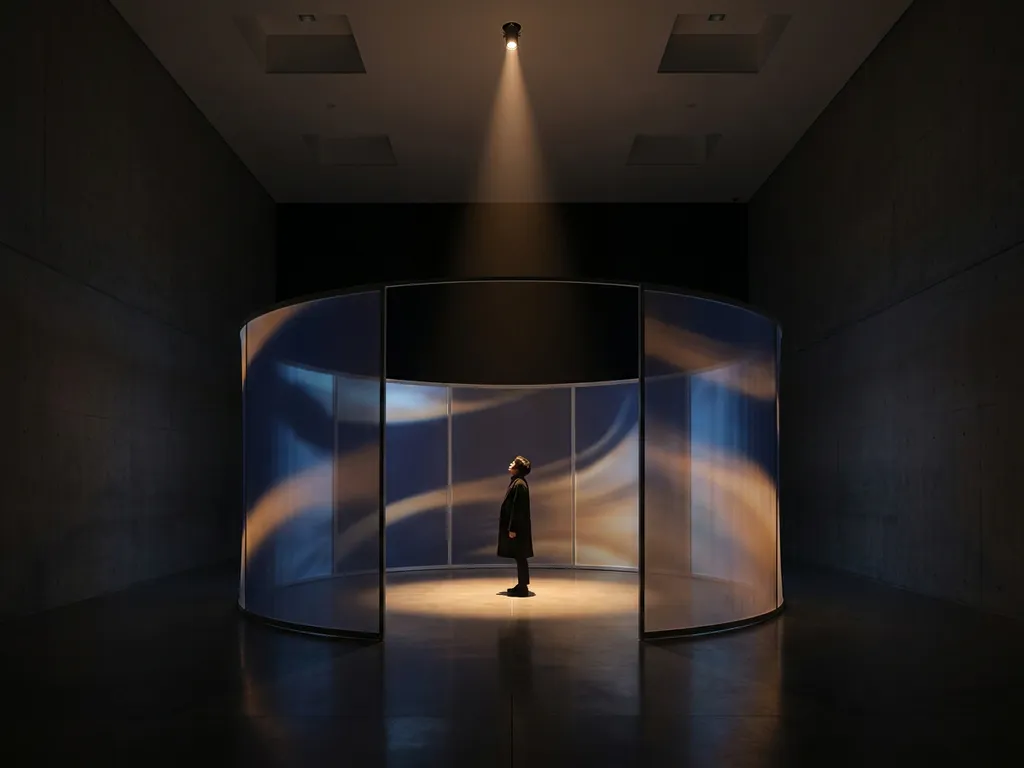
Immersive experiences improve experiential marketing by replacing passive observation with active participation, creating multisensory moments that audiences remember long after the campaign ends. When people physically engage with a brand environment rather than simply viewing an advertisement, emotional memory forms more deeply and brand associations become more durable. The questions below unpack exactly how and why this works, and what it means for the brands and creators building these experiences today.
What makes an experience truly ‘immersive’ in a marketing context?
An experience is truly immersive in a marketing context when it surrounds the audience completely enough that their attention shifts from the outside world to the created environment. Immersion is not a single feature but a combination of sensory depth, spatial presence, and narrative coherence working together to make participants feel they are inside a story rather than watching it from a distance.
The word immersive is used loosely in marketing, but its meaning becomes precise when you examine what it actually requires. A standard pop-up stand is not immersive. A 360-degree environment where visitors can walk, hear, smell, and interact with responsive content is. The distinction lies in how many sensory channels are activated simultaneously and how completely the environment replaces the participant’s ambient context.
In practice, the elements that make an experience genuinely immersive include:
- Spatial enclosure – the environment wraps around the visitor rather than sitting in front of them
- Multisensory engagement – sound, touch, scent, and movement are layered alongside visuals
- Interactivity – the experience responds to the participant’s choices or presence
- Narrative coherence – every element serves a consistent story or emotional arc
- Presence – the psychological sensation of genuinely being somewhere else
The difference between immersive and merely interactive is also worth clarifying. An interactive experience responds to input. An immersive experience envelops the person making that input. The most powerful brand activations combine both: they respond to participants while surrounding them in a world that feels complete and intentional.
How do immersive experiences create stronger emotional connections with audiences?
Immersive experiences create stronger emotional connections because multisensory engagement activates memory formation more powerfully than single-channel media. When the brain processes information through multiple senses simultaneously, the experience is encoded more deeply, recalled more vividly, and linked more strongly to the emotions felt in that moment.
This is not simply a theory of engagement, it reflects how human memory actually works. Information delivered through reading or viewing alone tends to fade quickly. This is sometimes called the forgetting curve: without reinforcement or emotional charge, most content is lost within days. Immersive experiences interrupt that curve by attaching information to physical sensation, spatial memory, and emotional state, all of which are far more durable.
The mechanism is straightforward. When a visitor walks through a brand environment that uses scent, sound, temperature, and visual storytelling together, each sensory layer creates an additional memory anchor. The smell of a particular material, the texture of a surface, the sound of a score timed to a narrative reveal, these details become retrieval cues that bring the entire experience back to mind long after it ends.
For brands, this translates into something measurable: higher recall, stronger sentiment, and more authentic word-of-mouth. People share experiences they felt, not campaigns they saw. When a brand creates a moment that participants genuinely lived through, advocacy follows naturally because the story belongs to the person who experienced it.
What types of immersive technologies are used in experiential marketing campaigns?
Experiential marketing campaigns draw on a wide range of immersive technologies, including augmented reality, virtual reality, mixed reality, spatial projection, interactive screens, AI-driven avatars, and multisensory installations. The right technology depends on the campaign’s goals, audience size, physical setting, and the depth of immersion required.
The most commonly deployed technologies in brand activations today include:
- Augmented Reality (AR) – overlays digital content onto the physical world via smartphone or headset, enabling product visualization, interactive posters, and location-based storytelling without requiring dedicated spaces
- Virtual Reality (VR) – places participants inside fully digital environments using headsets, ideal for deep narrative experiences, product simulations, or transporting audiences to places they cannot physically visit
- 360-degree projection domes – wrap audiences in panoramic visuals and spatial audio for group experiences at events, exhibitions, or brand installations
- Anamorphic 3D animation – creates the illusion of three-dimensional objects emerging from flat screens, delivering high-impact visual moments in outdoor or event settings
- AI avatars and interactive characters – virtual hosts or brand representatives that hold real-time conversations with visitors, personalizing the experience at scale
- 4D sensory environments – combine scent, heat, vibration, and movement with audiovisual content for complete multisensory immersion
- Digital twins – photorealistic 3D replicas of physical products or spaces that allow audiences to explore, configure, or interact with objects that are not physically present
What makes immersive experience production distinctive is that these technologies rarely operate in isolation. The most effective campaigns layer several of them into a coherent environment where each element reinforces the others. The result is not a collection of technology features but a single, unified experience that feels purposeful from entry to exit.
How do brands measure the ROI of immersive experiential campaigns?
Brands measure the ROI of immersive experiential campaigns through a combination of engagement metrics, sentiment data, earned media value, and downstream behavioral indicators such as purchase intent, brand recall, and advocacy. Because immersive experiences operate across physical and digital touchpoints, measurement requires a broader framework than traditional campaign analytics.
The challenge with experiential ROI is that its value is distributed across time and channels. The immediate metrics – footfall, dwell time, social shares, and on-site interactions – capture the activation’s reach. But the deeper return often appears later: in brand tracking studies, repeat purchase behavior, and the quality of organic content that participants create and share.
Practical measurement approaches include:
- Engagement depth – how long participants spend in the experience and which elements they interact with most
- Social amplification – organic posts, stories, and videos generated by participants, measured by reach and sentiment
- Brand recall surveys – pre- and post-experience testing to quantify shifts in awareness, association, and preference
- Behavioral conversion – tracking whether participants take a desired next step, such as signing up, scanning, purchasing, or visiting a website
- Net Promoter and sentiment scoring – capturing emotional response immediately after the experience to assess quality of connection
One of the advantages of technology-driven immersive experiences is that interaction data can be captured in real time. When participants engage with AR activations, interactive screens, or AI-driven characters, every interaction generates data that informs both measurement and future optimization.
What’s the difference between AR, VR, and mixed reality in brand activations?
AR, VR, and mixed reality differ in how they relate the digital and physical worlds. AR adds digital content to the real environment. VR replaces the real environment entirely with a digital one. Mixed reality blends both so that digital and physical objects coexist and interact in real time. Each serves a different purpose in brand activations depending on the desired level of immersion and the physical context.
Augmented Reality in brand activations
AR is the most accessible of the three because it works through devices most people already carry. A smartphone camera becomes the window through which digital content appears layered over the real world. In brand activations, AR is used for product visualization, interactive packaging, event activations, outdoor campaigns with geospatial content, and AR portals that transport users to branded environments. Its strength is reach: AR experiences can be deployed at scale without requiring dedicated hardware or controlled spaces.
Virtual Reality in brand activations
VR delivers the deepest level of immersion by removing the participant from their physical surroundings entirely. Wearing a headset, they enter a fully constructed digital world where the brand controls every sensory input. This makes VR particularly powerful for storytelling, empathy-building, product simulation, and experiences that need to transport audiences to places they cannot physically reach. The trade-off is logistical: VR requires hardware, controlled environments, and typically a one-at-a-time or small-group format, though synchronized VR cinema setups can serve groups of up to 200 people simultaneously.
Mixed reality in brand activations
Mixed reality, sometimes delivered through devices like the Apple Vision Pro, allows digital content to interact with physical objects in real time. A virtual product can sit on a real table. A digital character can respond to the physical layout of a room. For brands, this opens possibilities for showroom experiences, interactive product demonstrations, and environments where the physical and digital genuinely coexist rather than simply appearing side by side. Mixed reality is the newest frontier in spatial computing and is rapidly becoming a serious tool for premium brand experiences.
When should a brand choose an immersive experience over a traditional campaign?
A brand should choose an immersive experience over a traditional campaign when the goal requires emotional depth, behavioral change, or a level of memorability that passive media cannot achieve. If the objective is reach alone, traditional channels may suffice. But when the brand needs to shift perception, build genuine connection, or create something audiences will actively share and remember, immersion delivers what advertising cannot.
Specific situations where immersive experiences outperform traditional campaigns include:
- Launching a product that needs to be felt or experienced to be understood
- Rebuilding or repositioning brand perception after a period of change
- Reaching audiences who have become desensitized to digital advertising
- Creating content that participants will organically share, extending earned media value
- Communicating complex ideas, values, or social missions that resist simplification into a thirty-second spot
- Building community and loyalty among existing customers through exclusive, high-value experiences
The decision also depends on the audience. Younger audiences in particular have grown up in an overloaded screen culture. They are increasingly skilled at filtering out passive advertising and increasingly drawn to experiences that give them something to do, feel, and share. For brands targeting these audiences, an immersive activation is not a premium option but a strategic necessity.
Budget is a real consideration, and immersive experiences involve multiple layers of production: spatial design, technology integration, content creation, and operational delivery. The cost reflects the complexity of those layers and the longevity of the asset being built. A well-designed immersive installation can be adapted, toured, and redeployed across multiple events and locations, which changes the cost-per-engagement calculation significantly compared to a single campaign burst.
How does AI personalization enhance immersive marketing experiences?
AI personalization enhances immersive marketing experiences by adapting the content, pace, language, and narrative of the experience to each individual participant in real time. Rather than delivering the same fixed journey to every visitor, an AI-enhanced immersive experience reads behavioral signals and adjusts what it shows, says, or offers based on who is engaging and how.
In practice, this means an immersive brand environment can greet a visitor in their preferred language, adjust the complexity of its storytelling based on how they interact, offer different product pathways based on expressed preferences, and respond to emotional cues detected through interaction patterns. AI avatars and non-player characters can hold genuine conversations rather than running scripted loops, making each visitor’s experience feel unique and personally relevant.
The marketing implications are significant. Personalization at scale has long been the ambition of digital marketing, but it has historically been limited to content recommendations and email subject lines. AI-driven immersive experiences bring that personalization into physical space, where the emotional stakes are higher and the impact is more lasting. A visitor who feels that an experience was designed for them specifically is far more likely to form a strong brand association, share the moment, and return.
We build AI personalization directly into our immersive experiences, allowing each journey to adapt to the individual without requiring manual customization for every participant. This is what makes immersive experiences genuinely scalable: the environment is built once, but it speaks differently to everyone who enters it. If you are ready to explore what this could look like for your brand or organization, we would love to hear from you, contact us to start the conversation.
Gerelateerde artikelen
- What is the relationship between sensory experience learning and retention?
- What is immersive and interactive media?
- Can immersive experiences reduce anxiety?
- Why is immersive art so popular?
- Is immersive the same as virtual reality?
- What is an example of an immersive experience?
- What equipment is needed for 360-degree content creation?
- How do you measure success in experiential marketing?
- What technology is used in immersive installations?