
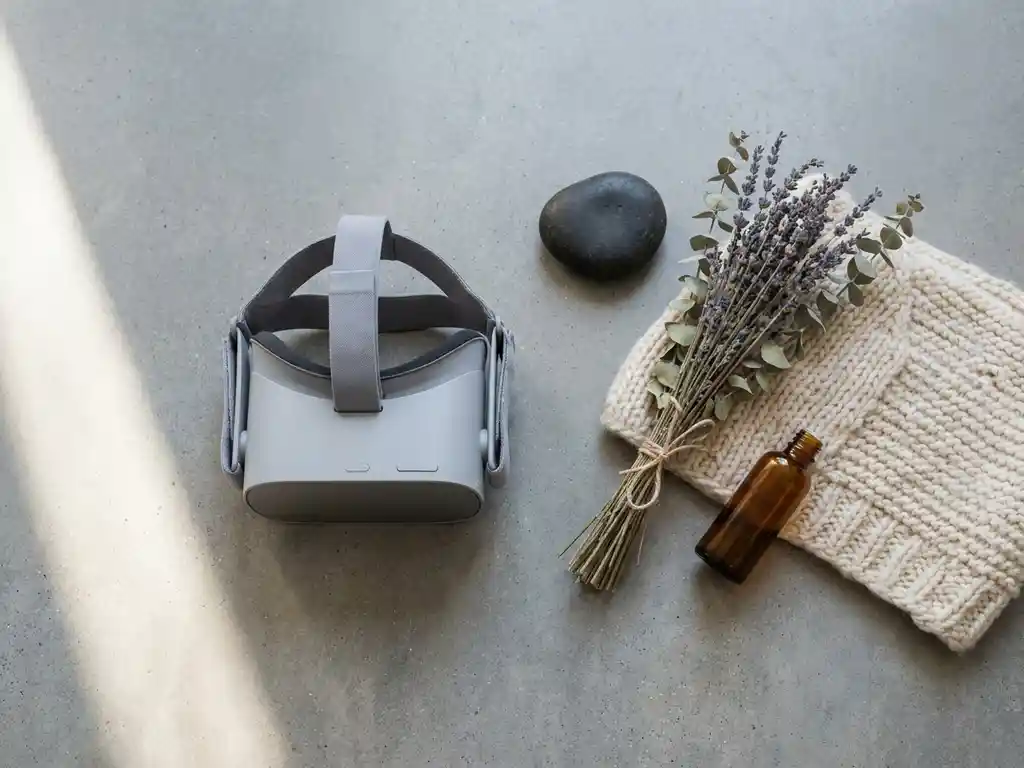
Immersive and virtual reality are not the same thing. Virtual reality is one specific technology that can create an immersive experience, but immersive experience design is a far broader discipline that includes augmented reality, mixed reality, multisensory installations, spatial storytelling, and more. Think of VR as one powerful instrument in a much larger orchestra.
The confusion is understandable. VR headsets are the most visible face of immersive technology, and they genuinely do deliver a deep sense of presence and absorption. But reducing “immersive” to “VR” is a bit like reducing “film” to “IMAX”: the format is extraordinary, yet the art form extends well beyond any single delivery mechanism. For organisations evaluating how to engage audiences in 2026, understanding this distinction is not just semantic: it shapes every creative and strategic decision that follows.
What does ‘immersive’ actually mean in experience design?
In experience design, immersive describes any environment or encounter that absorbs a participant so fully that their attention, emotion, and sense of presence shift away from the outside world and into the designed experience. An immersive experience engages multiple senses simultaneously, encourages active participation, and creates a felt sense of “being there” rather than merely observing from a distance.
The word comes from the Latin immergere, to plunge into, and that physical metaphor is instructive. A truly immersive experience does not present content at you; it surrounds you with it. This is why the immersive definition in professional design practice goes well beyond screens and speakers. It encompasses the spatial layout of a room, the temperature and scent in the air, the texture underfoot, the timing of sound cues, and the way a story unfolds in response to what a visitor does next.
What makes an experience immersive, then, is not any single technology but a combination of design principles:
- Sensory depth — engaging sight, sound, touch, smell, and even taste where appropriate
- Spatial presence — placing the participant inside the story rather than in front of it
- Agency and interaction — giving people meaningful choices that shape what happens
- Narrative coherence — ensuring every element serves a unified story or emotional arc
- Emotional resonance — connecting the experience to something the participant genuinely cares about
This is why immersive experience design is as much a creative discipline as a technical one. The technology is the canvas; the storytelling is the art. An experience can be technically sophisticated and still feel hollow if those design principles are absent, and conversely, a relatively low-tech installation can feel profoundly immersive when those principles are applied with care.
What is virtual reality and what makes it distinct?
Virtual reality (VR) is a technology that replaces a user’s visual and auditory field entirely with a computer-generated environment, typically delivered through a head-mounted display. By blocking out the physical world and tracking head movement in real time, VR creates a powerful illusion of presence inside a digital space: the sense that you are genuinely located somewhere else.
What makes VR distinct from other immersive formats is the completeness of that visual replacement. Unlike augmented reality, which layers digital content onto the real world, or a projection installation, which surrounds you but still exists within your physical environment, VR severs the visual connection to your actual surroundings entirely. This creates an unusually high degree of psychological presence: the feeling of “being there” is measurably stronger in VR than in most other media formats.
VR experiences broadly fall into two categories:
- Passive VR — cinematic 360-degree video experiences where the viewer watches a story unfold around them, with limited or no interactivity. These are particularly effective for empathy-building, journalism, and documentary storytelling.
- Interactive VR — fully navigable virtual environments where users make choices, complete tasks, or engage with characters and objects. These are the foundation of training simulations, educational experiences, and entertainment applications.
VR also scales in interesting ways. A single person with a standalone headset is one format. A synchronised group of 200 people in a shared VR cinema is another. Location-based VR installations — physical pods or rooms equipped with headsets and haptic elements — sit somewhere between the two, combining the immersive depth of VR with the social and spatial qualities of a physical installation.
Is VR always immersive, and is immersive always VR?
VR is not always immersive in any meaningful sense, and immersive experiences absolutely do not require VR. The two concepts overlap significantly but are not interchangeable. A poorly designed VR experience can feel disengaging and alienating, while a thoughtfully crafted physical installation without a single screen can be profoundly absorbing.
VR creates the conditions for immersion: it removes visual distractions and places the participant inside a digital world, but it does not guarantee immersion. If the narrative is weak, the interaction design is clunky, or the content fails to connect emotionally, the headset becomes a barrier rather than a portal. Motion sickness, technical friction, and the social isolation of wearing a device can all work against the immersive intent.
On the other side of the equation, some of the most deeply immersive experiences ever created have used no VR technology at all. Theatrical installations, multisensory museum exhibitions, interactive domes, and 4D cinema environments can achieve extraordinary levels of absorption through spatial design, sound engineering, scent, and live performance. The difference between immersive and interactive is also worth noting here: interactivity means the participant can influence the experience, while immersion refers to the depth of absorption. An experience can be highly immersive without being interactive, and interactive without feeling truly immersive.
What other technologies create immersive experiences?
Beyond VR, a wide range of technologies can create genuinely immersive experiences, often in ways that are more accessible, more social, or more suitable for specific contexts. The field of extended reality (XR) encompasses VR, augmented reality (AR), and mixed reality (MR), but immersive experience design extends even further into physical and spatial technologies.
Augmented reality (AR)
AR overlays digital content onto the real world through a smartphone, tablet, or AR headset. Rather than replacing the physical environment, it enriches it, making a museum exhibit come alive, transforming a printed poster into a moving image, or placing a virtual architect’s model onto a real building site. AR is inherently social and accessible because it does not require specialised hardware beyond a smartphone, making it one of the most scalable immersive technologies available.
Mixed reality (MR) and spatial computing
Mixed reality goes a step further than AR by enabling real-time interaction between virtual objects and the physical environment. With devices like the Apple Vision Pro, virtual content does not just sit on top of the real world: it responds to it, anchors to surfaces, and behaves as if it genuinely occupies physical space. Spatial computing is the broader term for this category of technology, and it represents one of the most significant frontiers in immersive experience design in 2026.
360-degree projections and interactive domes
Projection-based immersive environments — from large-scale 360-degree domes to multi-wall projection rooms — surround audiences with imagery and sound without requiring any wearable technology. These formats are highly social, accommodating groups from small gatherings to thousands of visitors simultaneously. They are widely used in museums, festivals, and educational settings precisely because they combine deep sensory impact with open, shared participation.
4D and multisensory installations
Adding physical sensation — wind, temperature, scent, vibration, and haptic feedback — to visual and audio experiences produces what experience designers call 4D or multisensory immersion. These installations engage the body directly, not just the eyes and ears, which research in cognitive science consistently links to deeper emotional processing and stronger memory formation.
Which is better for engagement — immersive experiences or VR?
Neither is categorically better for engagement. The right format depends entirely on the goal, the audience, the context, and the story being told. What the evidence consistently shows is that immersive formats of all kinds significantly outperform passive, screen-based media for emotional engagement, information retention, and behaviour change, and that multisensory, participatory experiences tend to be the most effective of all.
VR has a particular advantage in situations where the goal is to create empathy or presence, to make someone feel what it is like to be in a place or situation they cannot physically access. It is hard to replicate the visceral impact of standing inside a war zone, a coral reef, or a historical event in any other medium. For training simulations where consequences need to feel real, VR’s sense of presence is genuinely difficult to match.
But VR also has real limitations for group engagement. Headsets isolate participants from one another, which can work against the social and communal dimensions of learning and brand experience. For events, exhibitions, and public campaigns where shared emotion and collective response matter, large-format projection environments, AR activations, or multisensory installations often create stronger group engagement precisely because they are experienced together rather than alone.
The most effective immersive experiences frequently combine formats, using VR for individual depth, AR for social accessibility, and physical installation for atmosphere and shared presence. The question is not which technology wins, but which combination of tools best serves the specific human outcome you are trying to create.
When should an organisation choose VR over other immersive formats?
An organisation should choose VR when the experience requires complete environmental replacement, a high degree of individual presence, or the simulation of situations that cannot be recreated physically. VR is the strongest choice when the goal is deep empathy, high-stakes training, or transporting individuals to places or moments that are otherwise inaccessible.
Specific scenarios where VR is the right tool include:
- Training and simulation — where learners need to practise high-stakes decisions in realistic environments without real-world consequences
- Empathy and perspective-taking — where the goal is to make someone genuinely feel another person’s reality, such as in humanitarian campaigns or social impact programmes
- Remote or inaccessible environments — where the subject matter exists somewhere the audience cannot travel, from historical settings to hazardous locations
- Focused individual journeys — where a personalised, uninterrupted narrative experience is more valuable than a shared group one
- Location-based entertainment — where a physical venue can support the logistics of headsets and the experience is designed for sequential individual or small-group participation
Conversely, VR is likely not the right primary format when accessibility is a priority, when the audience is very young or very large, when social sharing is central to the campaign goal, or when the experience needs to work across multiple venues without intensive technical support.
The most strategic approach is to think about immersive technology as a toolkit rather than a binary choice. We work with organisations across education, culture, and brand experience to identify exactly which combination of VR, AR, mixed reality, and physical installation will deliver the deepest impact for their specific audience and objective. If you are weighing up your options and want to think through what would work best for your project, we would love to help: contact us and let us start that conversation together.
Gerelateerde artikelen
- How much does it cost to build an interactive museum?
- Which companies use augmented reality?
- Can AI make AR?
- What can provide immersive training experiences?
- Why do people like immersive experiences?
- What are the benefits of immersive learning?
- How do I measure the success of an AR marketing campaign?
- What are dome installations?
- How can I create shareable brand moments without requiring app downloads?