
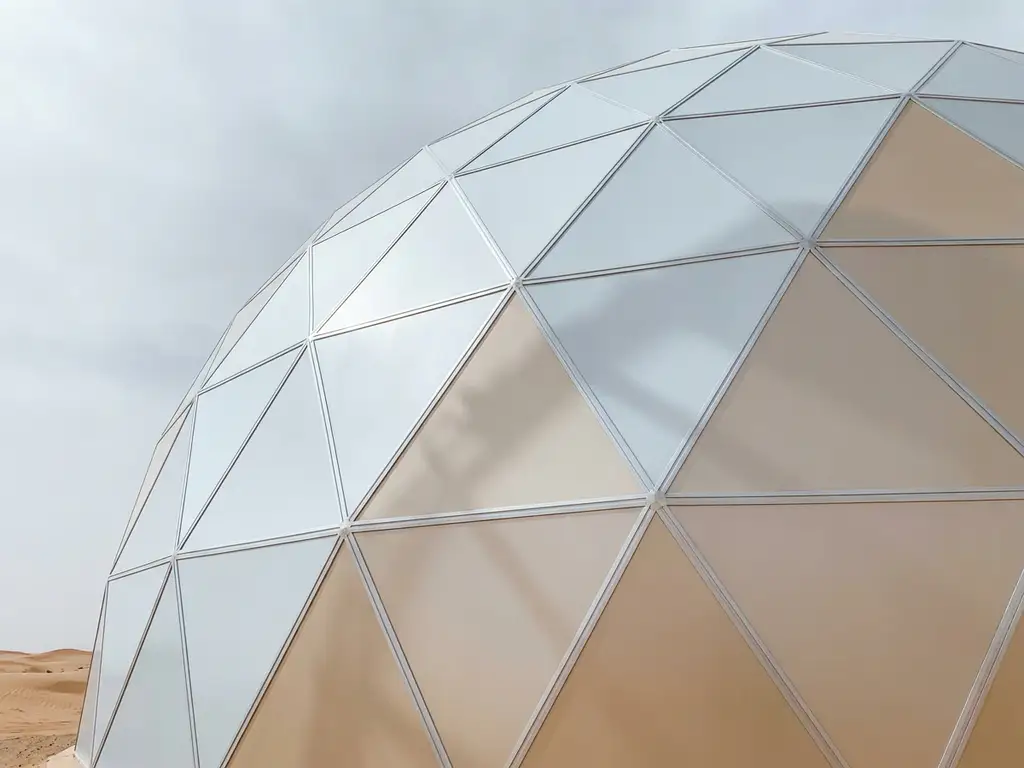
A dome installation is an immersive projection environment where visual content is mapped across the curved interior surface of a spherical or hemispherical structure, surrounding viewers with 360-degree imagery, sound, and sometimes multisensory elements. Unlike a flat screen or even a wide-format cinema, a dome wraps the entire field of vision, creating a sensation of being inside the content rather than watching it from a distance. The sections below answer the most common questions about how dome installations work, what they can show, where they appear, and what it takes to build one.
How do dome installations actually work?
A dome installation works by projecting content onto the curved inner surface of a dome structure using multiple synchronized projectors, a fisheye lens system, or a combination of both. Specialized software warps and blends the projected images in real time so that the content appears seamless and geometrically accurate across the curved surface, regardless of where a viewer is standing or sitting inside.
The technical foundation involves three core components working together. First, the dome structure itself, which can be a permanent architectural feature or a portable inflatable shell, defines the projection surface. Second, the projection system uses either a single fisheye projector aimed at a central mirror or several high-brightness projectors positioned around the dome’s perimeter, each covering a segment of the surface. Third, the media server runs dome-specific software that handles edge blending, warp correction, and content synchronization, ensuring that what appears as a single continuous image is actually multiple overlapping projections stitched together invisibly.
Audio design plays an equally important role. Spatial sound systems, often using object-based audio formats, are calibrated to match the visual immersion so that sounds appear to originate from the direction viewers are looking. In more advanced installations, additional sensory layers such as scent diffusion, temperature variation, or haptic elements can be layered in, transforming a visual experience into a fully multisensory environment.
What types of content can be shown inside a dome?
Dome installations can display almost any type of visual content, provided it has been produced or adapted for the dome’s curved geometry. This includes fulldome films, real-time rendered environments, live data visualizations, scientific simulations, abstract art, and interactive experiences. The key requirement is that the content is either created natively in a dome format or converted using projection mapping software.
Fulldome films are the most established content category, with a global library of productions covering astronomy, natural history, cultural heritage, and artistic expression. These are pre-rendered videos exported in equirectangular or fisheye formats that projection systems can interpret directly.
Real-time rendered content, built in game engines such as Unreal Engine or Unity, opens up a different range of possibilities. Because the environment is generated live, it can respond to inputs, change based on audience interaction, or adapt to data feeds. This is particularly relevant for educational simulations where learners need to explore a scenario rather than simply watch it unfold.
Live performance content, including concerts, theatrical productions, and brand activations, can also be staged inside a dome, with the projection surface acting as a dynamic backdrop that reacts to the performance in real time. The result is a format that sits somewhere between cinema, theatre, and architecture.
What’s the difference between a dome installation and a regular projection room?
The fundamental difference between a dome installation and a regular projection room is the geometry of the viewing surface. A standard projection room presents content on a flat or gently curved screen in front of the audience, preserving a clear distinction between viewer and image. A dome surrounds the audience on all sides and overhead, collapsing that distinction and placing viewers inside the visual environment.
This geometric difference produces a qualitatively different psychological experience. In a conventional cinema or lecture hall, the audience remains spatially separate from the content, which is perceived as an object being observed. Inside a dome, peripheral vision is fully engaged, the horizon disappears, and the brain interprets the surrounding imagery as environmental rather than representational. This is why dome environments are consistently described as more emotionally immersive than flat-screen equivalents, even when showing similar content.
Practically, dome installations also require fundamentally different content production pipelines, projection hardware, and acoustic design. A standard projector and screen setup cannot be repurposed for a dome without significant adaptation. Conversely, fulldome content does not translate directly to flat screens without losing the spatial qualities that make it effective.
Where are dome installations typically used?
Dome installations are used across a wide range of sectors wherever deep audience engagement, spatial storytelling, or large-group immersion is the objective. The most established context is the planetarium, where dome projection has been used for decades to simulate the night sky and explore astronomical phenomena. But the application landscape has expanded considerably beyond science education.
- Museums and cultural institutions use domes to create immersive exhibition spaces that bring historical events, natural environments, or artistic worlds to life at a scale impossible on a conventional screen.
- Event and festival producers deploy portable inflatable domes as standalone attraction spaces, offering audiences a distinct experiential layer within a larger event.
- Brands and marketing teams use dome environments for product launches, experiential campaigns, and trade show activations where standing out from surrounding noise is essential.
- Educational institutions and NGOs use dome-based experiences to teach complex subjects, from climate science to human rights issues, by placing learners inside the scenario rather than presenting it to them.
- Entertainment venues operate permanent dome cinemas as destination experiences, offering content that simply cannot be replicated at home or on a mobile device.
The portability of modern inflatable dome structures has significantly broadened the geographic reach of dome installations. What was once confined to purpose-built planetariums can now be deployed in school gymnasiums, public squares, conference centers, and outdoor festival sites.
How many people can experience a dome installation at once?
The capacity of a dome installation depends directly on the diameter of the dome structure. Small portable domes designed for intimate or educational settings typically accommodate between 10 and 30 people at a time. Mid-size domes used for events, exhibitions, or brand activations generally seat between 50 and 150 people. Large permanent or semi-permanent dome structures can host several hundred to over a thousand visitors per session.
Seating configuration also affects capacity and experience quality. Tilted or reclining seating arranged in concentric rings, as seen in most planetariums, allows everyone a clear view of the overhead projection. Flat-floor configurations, more common in portable event domes, offer greater flexibility for standing audiences or mixed seating arrangements but require content designed to work across multiple viewing angles simultaneously.
For large-scale applications, our Interactive 360 Domes are engineered to serve audiences ranging from intimate groups up to thousands of visitors across extended event runs, with content and hardware scaled to match the venue and audience profile.
Can dome installations be interactive?
Yes, dome installations can be fully interactive. While the earliest dome environments were passive viewing experiences, modern dome installations increasingly incorporate real-time interaction through touchscreens, motion sensors, voice commands, audience voting systems, or handheld controllers. The projection environment responds to these inputs, changing the content, direction, or narrative based on what participants do.
Interactive dome experiences are particularly valuable in educational contexts, where passive observation has limited learning impact. When a group of students can collectively navigate a simulated ecosystem, vote on decisions that change the scenario, or physically point at elements they want to explore, the experience shifts from observation to participation. Research in learning design consistently supports the idea that active engagement deepens retention and understanding far more effectively than passive consumption.
In brand and marketing contexts, interactivity transforms a dome from a spectacle into a conversation. Audiences become co-creators of the experience rather than recipients of a message, which generates stronger emotional association and more shareable moments. AI-driven personalization can take this further, adapting the dome’s content in real time based on audience demographics, language, or behavioral signals gathered during the experience itself.
How much does a dome installation cost?
The cost of a dome installation varies considerably depending on a combination of structural, technical, and creative factors rather than a single fixed price point. Understanding what drives those costs helps organizations plan realistically and make informed decisions about scope.
The main factors that influence the investment include:
- Dome size and structure type – Portable inflatable domes are significantly less expensive than custom-built permanent structures. Larger domes require more projection hardware and more complex installation logistics.
- Projection and audio systems – The number of projectors, their brightness and resolution, and the sophistication of the spatial audio setup all affect hardware costs. High-resolution systems capable of serving large audiences require substantially more investment than entry-level configurations.
- Content production – Custom fulldome content created from scratch, especially real-time rendered or interactive content, requires considerably more production effort than licensing existing fulldome films or adapting existing assets.
- Interactivity and AI integration – Adding interactive layers, audience response systems, or AI-driven personalization increases both development time and technical complexity.
- Duration and deployment model – A one-time event deployment has different cost implications than a long-term installation designed to run continuously for months or years. Ongoing content updates, maintenance, and operator training are additional considerations for permanent setups.
- Location and logistics – Installation in a purpose-built venue is typically more straightforward than deploying in a non-standard space, and international or multi-venue deployments add logistical complexity.
The most effective approach to scoping a dome installation is to start with a clear brief around audience size, content objectives, and deployment context, then work with a production partner to design a system that meets those goals within the available budget. If you are exploring what a dome installation could look like for your project, we would be glad to help you map out the possibilities, feel free to contact us to start that conversation.
Gerelateerde artikelen
- What are some examples of projection mapping?
- What makes immersive experiences memorable?
- Can you give me an example of an immersive learning experience?
- What is the difference between brand activation and brand experience?
- What are the types of immersive technology?
- What is interactive storytelling?
- What equipment is needed for 360-degree content creation?
- What makes an immersive experience?
- What are the technical requirements for immersive installations?