
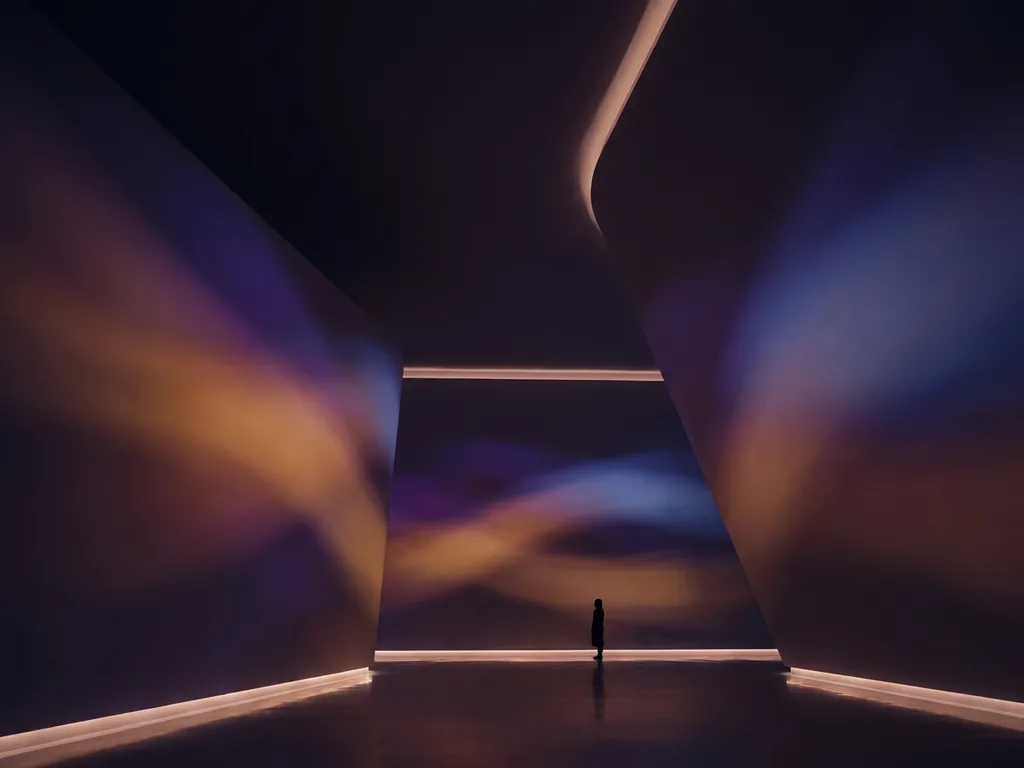
An immersive experience is one that surrounds participants in a designed environment, physical, digital, or both, so completely that they stop observing and start living inside the story. A well-known example is a walk-through VR installation where visitors explore a historical event from the inside, or a 4D cinema that adds scent, temperature, and movement to a film. These experiences work because they engage multiple senses simultaneously, which deepens emotional connection and long-term memory retention far beyond what a screen or poster can achieve.
Whether you are a museum curator, a brand manager, or an educator, immersive experiences are reshaping how people learn, feel, and act. The questions below unpack what makes them work, how they are built, and why they consistently outperform traditional media.
What makes an experience truly immersive?
An experience becomes truly immersive when it removes the psychological distance between the participant and the content. This happens through multisensory engagement, spatial presence, and narrative agency, the feeling that you are not watching something happen but that you are inside it. The more senses involved and the more choices a participant can make, the deeper the sense of immersion.
Three core ingredients drive genuine immersion:
- Multisensory design: Immersive experiences go beyond sight and sound to include touch, scent, temperature, and spatial movement. When your body receives multiple consistent signals pointing to the same environment, your brain accepts that environment as real.
- Narrative coherence: The story or concept must hold together across every element of the space. A powerful visual paired with a contradictory sound or an out-of-place physical prop breaks the spell immediately.
- Participant agency: When people can make choices, move freely, or influence outcomes, they shift from passive audience to active protagonist. This shift is what separates an immersive experience from a very good film.
The immersive definition, at its core, is about full absorption. The word comes from the Latin immergere, meaning to plunge into. A truly immersive experience plunges participants into a world designed to hold their complete attention and emotional engagement.
What are the most well-known examples of immersive experiences?
The most well-known examples of immersive experiences span entertainment, education, and brand activation. They include location-based VR installations, interactive museum exhibitions, 360-degree dome projections, AR-powered city activations, and multisensory 4D cinemas. What they share is the ability to place the participant inside the content rather than in front of it.
Cultural and museum examples
Museums have become some of the most ambitious producers of immersive content. Exhibitions that allow visitors to step inside a Van Gogh painting through floor-to-ceiling projections, or to walk through a reconstructed ancient city using augmented reality overlays, have drawn millions of visitors globally. These experiences succeed because they make heritage emotionally accessible rather than intellectually distant.
Brand and marketing examples
Brands like Porsche have used spatial AR activations to let customers interact with vehicle models in three dimensions before a car even reaches the showroom floor. Pop-up installations at trade fairs and product launches now routinely incorporate AR portals, holographic presenters, and interactive screens that respond to visitor behavior in real time. These are not novelty acts, they are engineered to create memorable emotional associations with a product or brand identity.
Education and social impact examples
Organizations such as UNICEF have deployed VR experiences that place donors and policymakers inside the daily reality of children affected by conflict or poverty. The impact on empathy and subsequent action is measurable and significant. Similarly, training simulations for medical professionals, emergency responders, and corporate teams use interactive VR to replicate high-stakes scenarios safely and repeatably.
How do immersive experiences differ from traditional entertainment?
The key difference between immersive experiences and traditional entertainment is the role of the audience. Traditional entertainment positions people as observers, they sit, watch, and receive. Immersive experiences position people as participants, they move, choose, and contribute to what unfolds. This distinction is not cosmetic; it fundamentally changes how the brain processes and retains the content.
Traditional media delivers information in a linear sequence that the audience follows passively. Immersive formats create an environment the participant navigates on their own terms. This shift from passive consumption to active participation is what the phrase difference between immersive and interactive often tries to capture, though in the best immersive designs, the two are inseparable.
There is also a spatial dimension that traditional entertainment cannot replicate. A film, a billboard, or a podcast occupies a flat plane in front of you. An immersive experience occupies the space around you, below you, and above you. That spatial presence triggers a fundamentally different psychological and physiological response.
What technologies power immersive experiences?
Immersive experiences are powered by a combination of extended reality (XR) technologies, spatial computing, projection systems, sensory hardware, and AI-driven personalization. XR is the umbrella term that covers augmented reality (AR), virtual reality (VR), and mixed reality (MR), each offering a different relationship between the digital and physical worlds.
AR, VR, and MR explained
Augmented reality overlays digital content onto the real world, a visitor pointing a phone at a museum exhibit sees animated layers appear over the physical object. Virtual reality replaces the real world entirely with a digital environment experienced through a headset. Mixed reality, exemplified by platforms like Apple Vision Pro, allows digital and physical objects to coexist and interact in real time, enabling a participant to reach out and manipulate a virtual object that appears to sit on a real table.
Spatial computing and 360-degree environments
Spatial computing refers to technology that understands and responds to three-dimensional space, it is the engine behind many next-generation immersive installations. A 360-degree experience wraps the participant in projected or rendered content from every angle, eliminating the visual boundaries that remind a viewer they are in a room. Dome installations, for example, project synchronized content across a hemispherical surface, creating the sensation of being inside a landscape, a storm, or a data visualization.
Sensory hardware, scent diffusers, haptic suits, directional audio systems, and temperature controls, layers physical sensation onto digital content. AI adds personalization, adjusting language, pacing, narrative paths, and difficulty levels based on real-time participant behavior.
Where are immersive experiences most commonly used?
Immersive experiences are most commonly used in museums and cultural institutions, education and training, brand marketing and experiential campaigns, public awareness and NGO communications, and live events and exhibitions. Each sector uses immersive technology to solve a specific engagement problem that traditional formats have failed to address.
- Museums and cultural institutions: Digital layers revitalize collections, attract younger audiences, and make complex heritage stories emotionally accessible.
- Education and training: VR and AR simulations allow learners to practice skills, explore environments, and experience scenarios that would be impossible, dangerous, or prohibitively expensive in the real world.
- Brand marketing: Experiential activations at events, retail spaces, and public locations create shareable moments that extend a campaign’s reach far beyond its physical footprint.
- NGOs and public sector: Immersive storytelling builds empathy around social issues, climate change, refugee displacement, public health, in ways that statistics and reports cannot.
- Live events and exhibitions: 360-degree domes, 4D cinemas, and interactive installations transform passive event attendance into participatory experiences that audiences remember and discuss.
How effective are immersive experiences compared to traditional media?
Immersive experiences consistently outperform traditional media on the metrics that matter most: emotional engagement, information retention, and behavior change. The reason is rooted in how human memory works. The brain encodes experiences more deeply when multiple senses are involved and when the person plays an active role rather than a passive one.
The forgetting curve, the well-documented pattern by which people lose most of what they learn within days of passive exposure, is significantly flattened when learning or storytelling happens through experience. When participants move through a space, make decisions, and feel physical or emotional responses, the memory trace is stronger and longer-lasting.
Multisensory experience affects memory by creating multiple retrieval pathways. A scent, a spatial memory, a physical gesture, or a sound can each independently trigger recall of the full experience. This is why a brand activation that incorporates smell and touch alongside visuals is recalled more vividly weeks later than a digital advertisement seen dozens of times.
For education, the impact of immersive experiences translates directly into measurable learning outcomes, faster skill acquisition, higher test scores, and greater ability to apply knowledge in novel situations. For NGOs and public campaigns, immersive formats have demonstrated stronger shifts in attitude and stated intention to act compared to video or print equivalents.
What should you look for in an immersive experience partner?
The right immersive experience partner combines creative vision, technical capability, and a genuine understanding of your audience and objectives. Technology alone does not create impact, the story, the spatial design, and the sensory logic must all serve the same goal. Look for a partner who treats technology as a tool for meaning, not as the headline act.
Key qualities to evaluate include:
- End-to-end capability: The partner should be able to take a project from concept through design, production, and delivery without fragmenting responsibility across multiple vendors. Fragmentation introduces inconsistency and risk.
- Multisensory design expertise: A partner who only works with screens and headsets is working with a fraction of the available palette. Scent, spatial audio, haptics, and physical environment design are as important as the digital layer.
- Sector understanding: An immersive experience for a museum has different ethical, curatorial, and audience considerations than one for a product launch. The partner should demonstrate fluency in your specific context.
- AI and personalization capability: In 2026, the most effective immersive experiences adapt in real time to the individual participant, adjusting language, pacing, or narrative path based on behavior. This requires both technical infrastructure and thoughtful design.
- Proven track record across scales: The ability to deliver for a major commercial brand and for a nonprofit organization with entirely different budgets and constraints signals genuine versatility and problem-solving depth.
We design immersive experiences that work across all of these dimensions, from the sensory architecture of a physical installation to the AI layer that makes each visitor’s journey feel personal. If you are ready to move beyond passive communication and create something that genuinely stays with people, we would love to hear what you are building. Contact us to start the conversation.
Gerelateerde artikelen
- What's the difference between immersive and interactive?
- What does XR stand for?
- What are five applications of virtual reality?
- What is experiential marketing theory?
- How does experiential marketing differ from traditional marketing?
- What is the primary goal of experiential marketing?
- What are the benefits of immersive learning?
- Is VR an immersive experience?
- Which is an example of immersive experience technology?