
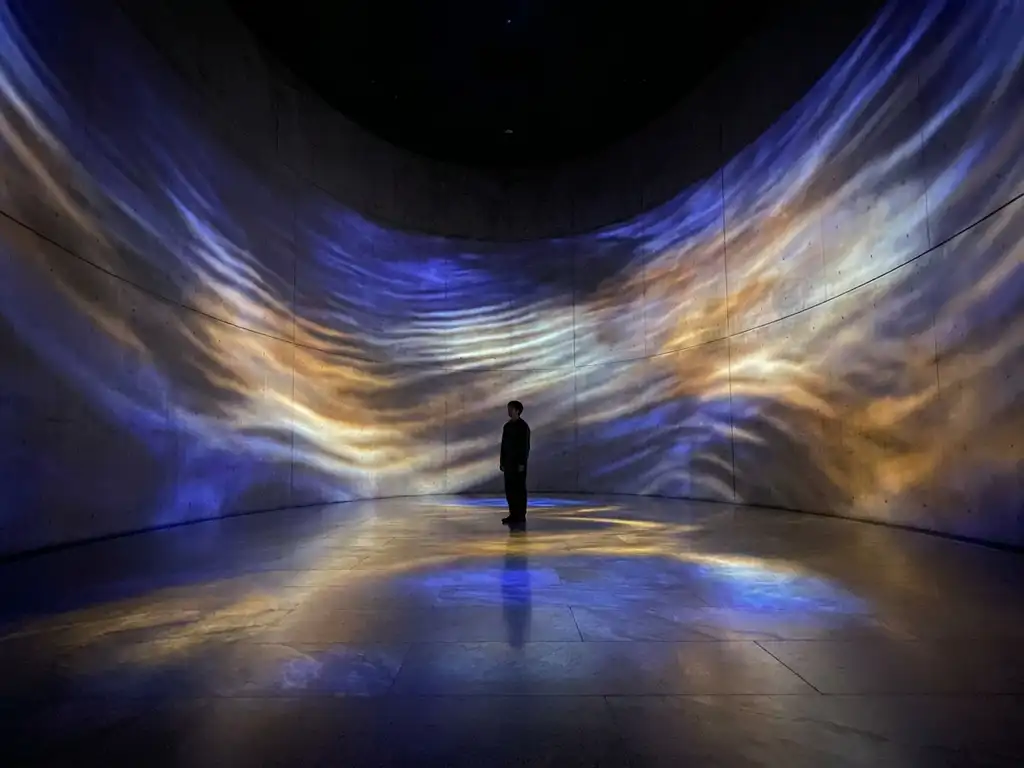
Immersive art is popular because it transforms passive observation into active, full-body participation. Instead of standing at a distance from a canvas or sculpture, visitors step inside the artwork itself. This shift from viewing to experiencing creates a far stronger emotional and sensory response, making the encounter more memorable, more shareable, and more personally meaningful than a traditional gallery visit.
The rise of immersive art reflects a broader cultural hunger for experiences that feel real and significant in an era saturated with flat, scrollable content. Across museums, brand activations, and public installations, audiences are voting with their feet, choosing environments that engage all their senses over those that engage only their eyes.
Below, we unpack the key questions driving this phenomenon, from what actually makes an experience immersive to whether this movement has genuine staying power.
What makes an art experience truly ‘immersive’?
An art experience is truly immersive when it surrounds the visitor completely, engaging multiple senses simultaneously and dissolving the boundary between observer and artwork. True immersion goes beyond large projections or dramatic lighting. It requires spatial depth, sensory layering, and a design logic that invites the visitor to become part of the work rather than stand apart from it.
Several qualities distinguish genuinely immersive art from spectacle alone:
- Multisensory engagement: Sound, scent, temperature, texture, and movement work together to create a coherent environment rather than a single visual effect.
- Spatial envelopment: The experience fills the visitor’s entire field of perception, not just a wall or a screen in front of them.
- Interactivity or agency: Whether through physical movement, touch, or choice, visitors influence what happens around them, making each encounter feel personal.
- Narrative coherence: The strongest immersive works are guided by a story or concept that gives the sensory elements meaning, transforming stimulation into genuine emotional resonance.
The difference between immersive and interactive is worth clarifying here. An interactive experience responds to input; an immersive one envelops you entirely. The most powerful immersive art achieves both, but immersion is the broader condition, and interactivity is one of the tools that deepens it.
Why do people find immersive art more engaging than traditional exhibitions?
People find immersive art more engaging than traditional exhibitions because it activates the brain and body in ways that passive viewing simply cannot. When multiple senses are stimulated at once, the brain encodes the experience more deeply. This is why people remember experiences far better than they remember information presented to them on a wall panel or a screen.
Cognitive science offers a useful lens here. The forgetting curve, the well-documented pattern by which we rapidly lose information received passively, is significantly flattened when learning or perception involves physical presence, movement, and emotional activation. Immersive art environments trigger this deeper encoding naturally.
There is also an emotional dimension that traditional exhibitions struggle to replicate. Standing in front of a painting, however beautiful, keeps the visitor at a psychological distance. Stepping inside a recreated environment, hearing the ambient sounds of another world, or feeling the temperature shift as you move through a space: these details collapse that distance. The result is empathy rather than appreciation, connection rather than admiration.
For cultural institutions, this distinction matters enormously. Visitors who feel genuinely moved by an experience are more likely to return, recommend the venue to others, and develop a lasting relationship with the institution behind it.
How did social media accelerate the rise of immersive art?
Social media accelerated the rise of immersive art by turning visitors into content creators and exhibitions into viral destinations. When an environment is visually spectacular and physically engaging, people photograph and film themselves inside it. That content, shared across Instagram, TikTok, and similar platforms, functions as organic word-of-mouth marketing at a scale no traditional advertising budget can replicate.
This dynamic created a powerful feedback loop. Immersive exhibitions that generated striking visitor content attracted larger audiences, which generated more content, which attracted still more visitors. Venues that understood this dynamic began designing with the shareable moment in mind, engineering specific zones or visual compositions that almost guarantee compelling photographs.
However, the most enduring immersive experiences are not simply designed to be photographed. They are designed to be felt. The social media dimension amplifies reach, but the depth of the experience determines whether that reach translates into genuine cultural impact or merely a brief spike in online engagement. The exhibitions that have achieved both, genuine emotional depth alongside viral visibility, represent the highest expression of what immersive art can accomplish.
What role does technology play in immersive art’s popularity?
Technology is the primary enabler of immersive art at scale, providing the tools to create environments that were previously impossible to build, sustain, or distribute. Advances in projection mapping, spatial audio, augmented reality, virtual reality, and real-time rendering have dramatically expanded what artists, designers, and institutions can create within a physical space.
How extended reality and spatial computing have changed the field
Extended reality (XR), the umbrella term covering augmented reality (AR), virtual reality (VR), and mixed reality (MR), has opened entirely new categories of immersive experience. AR overlays digital content onto the physical world, allowing a museum visitor to point a device at a painting and watch it animate, or step through an AR portal into a different era. VR removes the physical environment entirely, placing visitors inside a fully rendered world where they can move, interact, and explore. Mixed reality, exemplified by platforms like Apple Vision Pro, blends real and virtual elements in real time, creating layered experiences that respond dynamically to physical surroundings.
How 360-degree environments and multisensory design extend the experience
Beyond headsets, large-scale immersive installations rely on 360-degree projection systems, spatial audio arrays, and environmental controls for scent, temperature, and haptic feedback. These tools allow designers to construct complete sensory worlds within a physical space. When all of these layers are orchestrated together, the result is a 4D experience that engages the whole body, not just the eyes. This is precisely the kind of multisensory experience that makes the difference between a memorable visit and a genuinely transformative one.
Technology, in this context, is not the point. It is the means by which meaningful stories and emotional environments are brought to life at a scale and fidelity that moves people.
Who is the typical audience for immersive art exhibitions?
The typical audience for immersive art exhibitions is broader and more diverse than many cultural institutions expect. While younger adults, particularly those in their twenties and thirties who grew up with digital media, represent the most visible segment, immersive experiences consistently attract families, older adults seeking novelty, and audiences who rarely visit traditional galleries or museums.
This breadth is one of immersive art’s most strategically significant qualities. By removing the implicit barrier of art-world knowledge and replacing it with sensory participation, immersive exhibitions lower the threshold for engagement. You do not need to understand art history to feel moved by walking through a room of light and sound that responds to your presence.
For cultural institutions facing declining visitor numbers and aging audiences, this is a compelling opportunity. Immersive experiences have demonstrated a consistent ability to bring in visitors who would not otherwise cross the threshold, including younger demographics, school groups, and communities that have historically felt excluded from traditional cultural spaces.
Brand and marketing audiences have noticed the same pattern. Immersive activations generate engagement across demographic segments that passive advertising consistently fails to reach, making them a powerful tool for building genuine, cross-generational brand connection.
How are museums and cultural institutions responding to the immersive art trend?
Museums and cultural institutions are responding to the immersive art trend by integrating digital and spatial technologies into their existing collections, commissioning original immersive works, and in some cases building entirely new venues designed around the immersive experience model. The response ranges from cautious experimentation to wholesale reinvention of the visitor journey.
The most thoughtful institutional responses share a common principle: technology should enhance the story of a collection, not compete with it. AR layers that animate historical artifacts, VR experiences that place visitors inside a documented historical event, and spatial audio installations that give voice to archival material all serve the institution’s core mission while dramatically expanding its emotional reach.
We work closely with museums and cultural institutions to develop experiences that respect this principle. The goal is never spectacle for its own sake. It is to find the point where a collection’s deepest story meets the technology best suited to tell it, and to build an experience that makes that story impossible to forget.
Institutions that approach immersive integration with this clarity tend to achieve the strongest outcomes: increased visitor numbers, stronger engagement from younger audiences, and a renewed sense of institutional relevance that extends well beyond the exhibition itself.
Is the popularity of immersive art a lasting shift or a passing trend?
The popularity of immersive art represents a lasting structural shift in how people expect to engage with culture, not a passing trend. The underlying drivers, the human preference for multisensory experience, the neuroscience of embodied memory, and the cultural move away from passive consumption, are not temporary. They reflect deep and durable changes in audience expectations that will continue to shape cultural, educational, and brand experiences for years to come.
Trends in art and culture do come and go, and specific formats within immersive art will evolve. The particular aesthetic of large-scale projection mapping that dominated the early 2020s will give way to new forms as technology advances. But the appetite for experiences that surround, engage, and emotionally activate the visitor is not a fad. It is a response to a genuine gap that traditional media and traditional exhibition formats have struggled to fill.
By 2026, immersive experience design has moved well beyond novelty. It is now a recognized discipline with its own design principles, critical frameworks, and institutional infrastructure. Educational institutions use immersive formats to teach complex subjects more effectively. NGOs use them to build empathy around issues that statistics alone cannot convey. Brands use them to create the kind of emotional connection that no banner advertisement can manufacture. Each of these applications is driven by measurable outcomes, not aesthetic fashion.
The question for cultural leaders, educators, and brand strategists is no longer whether immersive experiences are worth investing in. It is how to build them with the depth, integrity, and creative ambition that transforms a compelling environment into a genuinely meaningful one. If you are ready to explore what that looks like for your institution or project, we would love to hear from you. Contact us to start the conversation.
Gerelateerde artikelen
- What kind of technology is used in museums?
- What are the benefits of integrating immersive technologies with STEM education?
- What is the strongest trigger to memory?
- What are experiential marketing techniques?
- What are the types of immersive experience?
- Which is an example of immersive experience technology?
- How do I measure the success of an AR marketing campaign?
- How to create an immersive experience?
- How do 360-degree experiences work in marketing?