
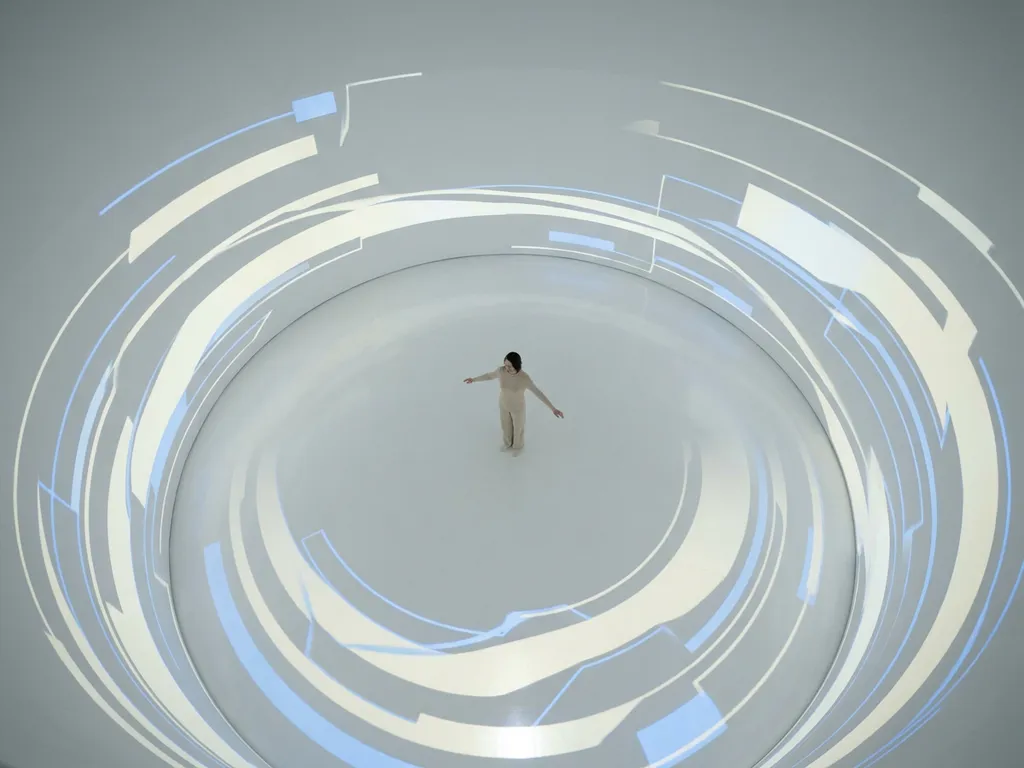
A 360-degree marketing experience places the audience at the center of a fully surrounding environment, whether physical, digital, or both, allowing them to look, move, and engage in every direction rather than passively watching a flat screen. These experiences work by triggering a sense of presence, the feeling of actually being somewhere, which activates deeper emotional processing and stronger memory formation than conventional advertising. The sections below unpack how these experiences are built, what formats exist, and how brands can use them strategically.
What actually happens inside a 360-degree marketing experience?
Inside a 360-degree marketing experience, a viewer or participant is surrounded by content on all sides, creating the perceptual sensation of being inside a scene rather than looking at one. The brain interprets this spatial immersion as presence, which shifts the audience from passive observer to active participant and significantly deepens emotional engagement and information retention.
The mechanics vary by format, but the core principle is consistent: content fills the entire field of view, and the audience controls where they look. In a headset-based experience, head-tracking sensors update the visual perspective in real time as the user turns their head. In a dome or large-format projection environment, the image wraps around the physical space so that every direction offers a continuation of the narrative.
What makes this powerful in a marketing context is the way it bypasses the psychological distance that traditional advertising creates. When someone watches a 30-second commercial, they know they are watching an advertisement. When they are standing inside a brand story, surrounded by sound, visuals, and sometimes even scent or tactile elements, the experience feels personal and real. Brands that use 360-degree formats are not just communicating a message; they are creating a memory.
Multisensory design amplifies this effect further. When sight, sound, and spatial awareness align, the brain encodes the experience more richly. Add scent or physical sensation, as we do in our most immersive installations, and the recall and emotional resonance increase substantially. This is why experiential formats consistently outperform passive media when it comes to lasting brand impact.
What types of 360-degree experiences are used in marketing?
The most common types of 360-degree experiences used in marketing include 360-degree video, interactive virtual reality, dome projections, location-based VR activations, and augmented reality environments. Each format serves different campaign objectives, audience sizes, and budget structures, ranging from scalable digital content to bespoke physical installations.
360-degree video
This is the most accessible entry point. Filmed with omnidirectional camera rigs or rendered in real-time engines like Unreal Engine, 360-degree video allows viewers to look around a scene freely. It works on smartphones, headsets, and embedded web players, making it easy to distribute across digital channels. Brands use it for product launches, behind-the-scenes storytelling, destination marketing, and cause-driven campaigns.
Interactive VR and location-based experiences
Interactive VR goes further by allowing the audience to make choices, trigger events, or physically move through a virtual space. Location-based experiences take this into shared physical venues, where groups of people use synchronized headsets to move through a branded world together. These formats work exceptionally well for high-impact activations at events, trade shows, and flagship retail environments.
Dome and large-format projection
Interactive 360-degree domes create fully surrounding visual environments for audiences of dozens to thousands of people simultaneously. They are used at festivals, corporate events, and museum installations where scale and spectacle matter. The shared nature of the experience makes it inherently social, which amplifies word-of-mouth and organic reach.
Augmented reality overlays
AR formats extend 360-degree thinking into the physical world by layering digital content onto real environments. Geospatial AR, AR portals, and AR activations allow brands to turn any location into an immersive touchpoint without requiring a dedicated venue or headset infrastructure. These formats are increasingly popular for outdoor campaigns and product launches.
How do 360-degree experiences increase audience engagement?
360-degree experiences increase audience engagement by creating a sense of presence that activates emotional investment, curiosity, and agency. When people feel they are inside a story rather than watching it, they explore longer, pay closer attention, and form stronger emotional connections with the content and the brand behind it.
The engagement mechanism is rooted in how the brain responds to spatial environments. Passive media consumption is processed largely by the visual cortex, but immersive environments engage spatial memory, emotional processing, and even motor systems when the viewer physically turns or moves. This broader neural engagement is why people remember immersive experiences more vividly and for longer than they remember advertisements.
Agency is another critical factor. In a 360-degree environment, the viewer chooses where to look and what to explore. This sense of control transforms the audience relationship from recipient to participant. Brands that design for this agency, building in discoverable details, narrative branches, or interactive moments, see significantly higher dwell time and return engagement compared to linear content.
Social dynamics also play a role. Shared immersive experiences, whether in a dome, at a live event, or through a synchronized VR session, create collective moments that people discuss and share. The social amplification that follows a genuinely memorable experience extends reach far beyond the initial audience.
What’s the difference between 360-degree video and interactive VR in marketing?
360-degree video is a pre-rendered or pre-filmed environment where the viewer can look in any direction but cannot interact with or change what happens. Interactive VR allows the user to make choices, move through space, trigger events, and influence the narrative. The key distinction is agency: 360-degree video offers freedom of gaze, while interactive VR offers freedom of action.
For marketing purposes, this distinction shapes what each format can achieve. 360-degree video excels at emotional storytelling, destination experiences, and brand immersion where the narrative is fixed and the goal is to transport the viewer. It is relatively straightforward to distribute across platforms including YouTube, social media, and branded microsites, which makes it well suited to broad-reach campaigns.
Interactive VR is better suited to situations where the brand wants the audience to do something: explore a product, make a decision, complete a simulation, or experience a scenario from multiple perspectives. The interactivity creates a much deeper sense of involvement, which is particularly valuable for high-consideration purchases, training contexts, or campaigns where behavior change is the objective.
The production requirements also differ meaningfully. 360-degree video can be produced with camera rigs and post-production workflows similar to traditional filmmaking. Interactive VR requires real-time 3D development, typically in Unreal Engine or Unity, with additional design work for user experience, interaction logic, and performance optimization. This makes interactive VR more resource-intensive but also more powerful when the campaign objective justifies it.
How do brands measure the ROI of 360-degree campaigns?
Brands measure the ROI of 360-degree campaigns by tracking a combination of engagement metrics, behavioral data, and downstream business outcomes. Unlike traditional advertising where impressions and click-through rates dominate, immersive experiences generate richer data including dwell time, interaction frequency, spatial attention patterns, and emotional response indicators.
Within headset and interactive environments, it is possible to track exactly where users look, which elements they engage with, how long they spend in each zone, and at what point they exit. This spatial analytics data gives brands a level of audience insight that flat-screen formats cannot provide. It reveals not just whether someone saw the content, but whether they were genuinely engaged with it.
Beyond in-experience data, brands measure ROI through downstream indicators such as brand recall surveys, net promoter scores collected immediately after the experience, conversion rates for audiences who participated versus those who did not, and social sharing volumes. For experiences deployed at events or in physical spaces, foot traffic, queue length, and media coverage also contribute to the overall value calculation.
It is worth noting that the ROI of immersive experiences often extends beyond the immediate campaign window. A well-designed 360-degree activation generates earned media, social content created by participants, and long-term brand associations that continue to influence perception. Measuring only the immediate campaign metrics underestimates the full return.
What industries benefit most from 360-degree marketing?
The industries that benefit most from 360-degree marketing are those where emotional connection, spatial understanding, or experiential proof points are central to the buying or engagement decision. These include tourism and hospitality, real estate and architecture, education and training, consumer goods and luxury brands, cultural institutions, and NGOs working on social impact campaigns.
Tourism and real estate benefit directly from the ability of 360-degree formats to transport people to places they cannot physically visit during the decision-making process. A prospective buyer who walks through a virtual property, or a traveler who experiences a destination before booking, arrives at the decision with significantly more confidence and emotional investment.
Education and training sectors benefit from the way immersive formats make abstract or complex subjects tangible. Medical training, safety procedures, historical events, and scientific phenomena are all categories where being inside the experience accelerates understanding in ways that textbooks and videos cannot replicate.
For consumer brands, particularly in luxury, automotive, and lifestyle sectors, 360-degree activations create the kind of premium, memorable brand moments that differentiate in a saturated market. The experience itself becomes part of the brand story. Cultural institutions, including museums and heritage organizations, use immersive formats to attract younger audiences and extend the reach of their collections beyond physical walls.
NGOs and public sector organizations find 360-degree formats particularly effective for empathy-building campaigns, where placing an audience inside the lived experience of another person or community generates emotional understanding that statistics and reports cannot achieve.
What does it cost to produce a 360-degree marketing experience?
The cost of producing a 360-degree marketing experience varies widely and is shaped by several interconnected factors: the format chosen, the level of interactivity required, the production quality, the duration of the experience, the number of deployment locations, and whether bespoke physical infrastructure is needed. There is no single price point because no two briefs are identical.
Format is the first major cost driver. A 360-degree video shot on location with post-production polish sits at a different investment level than a fully interactive VR experience built in a real-time 3D engine with custom interaction design. Dome installations and location-based experiences that require physical construction, hardware procurement, and on-site technical management represent a further step up in complexity and investment.
Interactivity and personalization add development time. An experience where users can make choices, trigger different narrative paths, or receive AI-driven personalized content requires significantly more design and engineering work than a linear 360-degree film. The depth of that interactivity directly influences the production timeline and resource requirements.
Deployment scale matters too. A single-venue activation has different logistics and cost implications than an experience designed to travel across multiple cities or be distributed globally through digital platforms. Hardware, licensing, localization, and ongoing technical support all factor into the total investment when an experience needs to scale.
The most useful approach for any brand is to start with a clear objective and audience size, then work with a production partner to scope the format and depth of experience that delivers the best return for that specific goal. A well-scoped immersive experience, regardless of budget level, will consistently outperform a generic campaign in terms of emotional impact and audience recall.
How should brands get started with immersive 360 marketing?
Brands should start with immersive 360 marketing by defining a clear objective before choosing a format. The most common mistake is leading with the technology rather than the audience need. Start by identifying what you want the audience to feel, understand, or do differently after the experience, then work backwards to the format that best achieves that outcome.
The next step is identifying the right context for deployment. Where will the audience encounter this experience? At a live event, in a retail environment, through a digital platform, or in a dedicated installation space? The deployment context shapes every subsequent decision about format, hardware, content design, and production scope.
From there, the creative brief should define the narrative core. Immersive experiences live or die on storytelling. The technology is the delivery mechanism; the story is what creates the emotional connection. Brands that invest in a strong narrative foundation, one that is specific, human, and emotionally resonant, consistently produce experiences that outperform those built around spectacle alone.
Partnering with an experienced immersive studio early in the process is critical. The intersection of spatial design, real-time technology, narrative craft, and audience psychology is complex, and the decisions made in the early concept phase have a disproportionate impact on the final experience. A studio that works from concept to completion, combining creative direction, technical production, and strategic thinking under one roof, will deliver both a better experience and a more efficient production process.
If you are exploring what a 360-degree experience could look like for your brand, campaign, or institution, we would be glad to think through it with you. Contact us to start the conversation.
Gerelateerde artikelen
- What is an immersive display?
- Can you give me an example of an immersive learning experience?
- What are the benefits of experiential marketing?
- Can AI make AR?
- Can immersive experiences reduce anxiety?
- Is VR bad for kids with ADHD?
- What is an example of an immersive experience?
- How do you align immersive experiences with brand identity?
- Should I use AR filters for my product launch?