
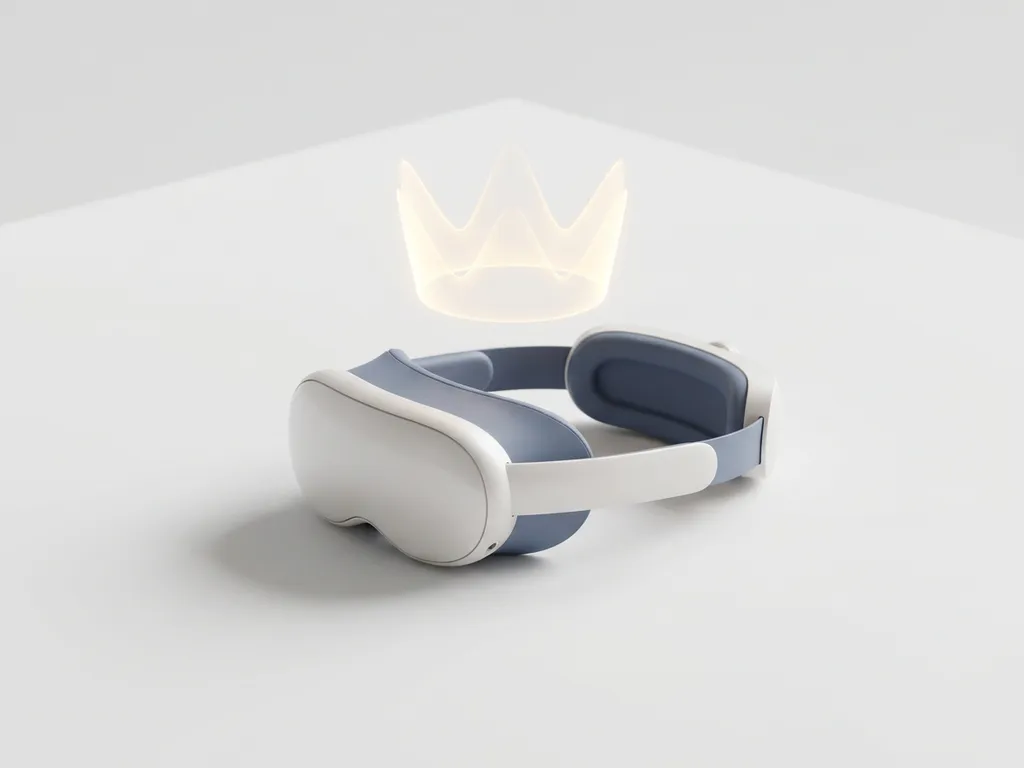
No single company leads augmented reality across every dimension. In 2026, leadership depends on the segment: Apple dominates consumer AR hardware, Microsoft holds ground in enterprise headsets, Meta drives social and mobile AR at scale, and Google anchors the developer ecosystem through its ARCore platform. The most accurate answer is that AR leadership is fragmented, with different players commanding different parts of the market.
This fragmentation reflects how broad augmented reality has become as a technology category. Whether you measure leadership by hardware sales, developer adoption, enterprise deployment, or creative application, a different name rises to the top. The sections below break down each dimension so you can identify which company leads in the area that matters most to you.
Which companies dominate the augmented reality market?
The augmented reality market in 2026 is dominated by five major players: Apple, Meta, Microsoft, Google, and Snap. Each holds a distinct position. Apple leads in premium consumer hardware through Vision Pro. Meta commands the widest social AR reach through its Ray-Ban smart glasses and Instagram filters. Microsoft owns enterprise AR deployments via HoloLens. Google controls the mobile AR development layer through ARCore. Snap remains the most active platform for consumer-facing AR creative tools.
Beyond these five, a second tier of significant players shapes the landscape. Niantic continues to define location-based AR through its geospatial mapping technology. PTC and Scope AR serve industrial and manufacturing clients with enterprise AR software. ByteDance has accelerated AR feature development inside TikTok, reaching younger audiences at extraordinary scale. Qualcomm, while not a consumer brand, underpins much of the hardware through its Snapdragon XR chipsets.
What makes this market particularly dynamic is that dominance in one area does not translate to dominance in another. A brand manager evaluating AR for a product launch will encounter a very different competitive landscape than an educational institution building immersive learning experiences. The platforms that matter most depend entirely on the use case, the audience, and the delivery environment.
What makes a company a leader in augmented reality?
A company earns AR leadership through a combination of hardware capability, developer ecosystem strength, content scale, and real-world deployment track record. No single metric defines leadership. The most credible AR leaders in 2026 score highly across at least three of these dimensions simultaneously, making them difficult to displace even when a competitor excels in one area.
Hardware capability matters because the quality of the AR experience is ultimately constrained by the device. Field of view, display brightness, spatial tracking accuracy, and battery life all determine whether an AR experience feels genuinely immersive or merely functional. Companies that control their own silicon, such as Apple with its M-series chips, have a structural advantage here.
Developer ecosystem strength determines the breadth and quality of content available on a platform. A platform with millions of developers produces more diverse, polished, and innovative applications than one with a smaller community, regardless of how capable the underlying hardware is. This is why Google’s ARCore and Apple’s ARKit remain foundational even as newer hardware platforms emerge.
Real-world deployment at scale is the third pillar. A company that has shipped AR experiences to hospitals, factories, schools, and retail environments carries credibility that no product announcement or demo can replicate. This track record is what separates genuine AR leaders from well-funded aspirants.
Is Apple or Microsoft leading in AR hardware?
Apple and Microsoft lead in AR hardware for different markets. Apple’s Vision Pro leads in consumer and creative professional hardware, offering the highest display quality and spatial computing capability available to a general audience. Microsoft’s HoloLens 2 leads in enterprise and industrial AR, particularly in environments where hands-free operation, ruggedised performance, and integration with business software are the priority.
Apple Vision Pro: spatial computing for consumers and creatives
Apple entered the spatial computing market with Vision Pro positioned not as a niche device but as a new computing platform. Its micro-OLED displays deliver visual fidelity that no competing headset matched at launch. The device runs a full operating system, supports spatial video capture, and integrates seamlessly with the broader Apple ecosystem. For immersive experiences, entertainment, and creative applications, Vision Pro has set a hardware benchmark that competitors are actively working toward.
Microsoft HoloLens 2: purpose-built for enterprise
HoloLens 2 was designed from the ground up for industrial and enterprise environments. Its holographic display overlays digital information onto physical workspaces with enough precision to guide assembly line workers, assist surgeons, and train technicians on complex machinery. Microsoft has paired the hardware with its Dynamics 365 Guides and Remote Assist software, creating an end-to-end enterprise AR stack. Where Apple targets the broadest possible audience, Microsoft targets the highest-value enterprise deployments.
The honest answer for anyone choosing between them is that the question rarely arises in practice. The two devices serve fundamentally different needs, price points, and deployment contexts. A museum designing a visitor experience will gravitate toward Apple’s ecosystem. A manufacturing company training engineers will gravitate toward Microsoft’s.
Who leads augmented reality in the enterprise sector?
Microsoft leads the enterprise AR sector, followed closely by PTC with its Vuforia platform and Scope AR. Microsoft’s advantage comes from its combination of HoloLens hardware, enterprise software integration through Microsoft 365 and Azure, and a global partner network capable of deploying AR solutions at scale across industries including manufacturing, healthcare, logistics, and defence.
PTC’s Vuforia platform is particularly strong in industrial AR, where it powers step-by-step work instructions, remote expert guidance, and quality inspection workflows. Unlike Microsoft, PTC is device-agnostic, meaning its software runs on HoloLens, tablets, and smartphones, giving enterprise customers flexibility in their hardware choices.
What drives enterprise AR adoption is not novelty but measurable operational value. Companies deploy AR when it reduces training time, lowers error rates, decreases the need for on-site expert travel, or accelerates complex assembly. The enterprise AR leaders are those who can demonstrate this value clearly and integrate their solutions into existing enterprise IT infrastructure without significant friction.
Which platform has the largest AR developer ecosystem?
Google’s ARCore and Apple’s ARKit together host the largest AR developer ecosystems in the world, with ARCore holding a slight edge in total reach due to Android’s global device dominance. However, Apple’s ARKit commands a stronger position among professional developers building high-quality, monetised AR applications, because iOS users tend to engage more deeply and spend more within apps.
Meta’s Spark AR platform deserves mention as the largest ecosystem specifically for social AR content creation. With hundreds of millions of AR filters and effects created by independent developers and brands on Instagram and Facebook, Spark AR represents a different kind of scale: not depth of application, but extraordinary breadth of casual, everyday AR interaction.
Snap’s Lens Studio has cultivated a particularly creative developer community. Snap invested early in giving creators sophisticated tools, and the result is a platform known for pushing the boundaries of what AR filters and lenses can do. For brands and agencies targeting younger audiences through creative AR content, Snap’s ecosystem remains highly relevant.
The practical implication for anyone building AR experiences is that platform choice should follow audience. A campaign targeting Android users globally points toward ARCore. A premium brand experience for iOS users points toward ARKit. A social campaign targeting Gen Z points toward Snap or Meta. There is no single platform that maximises reach and depth simultaneously.
How is augmented reality leadership expected to shift by 2030?
By 2030, AR leadership is expected to shift away from hardware-defined dominance toward platform and content ecosystem control. As AR glasses become lighter, more affordable, and more socially acceptable to wear in public, the hardware barrier will lower significantly. The companies that control the operating systems, developer tools, and content distribution layers will hold the most durable competitive positions.
Apple is widely expected to release a lighter, more consumer-accessible version of its spatial computing hardware before 2030, which could dramatically accelerate mainstream adoption. If that happens, ARKit and the broader Apple developer ecosystem would gain an enormous advantage simply through installed base scale.
Meta’s long-term strategy centres on replacing the smartphone with smart glasses as the primary computing interface. Its investment in both hardware through Ray-Ban Meta glasses and software through its AR development platforms signals a company betting its future on AR becoming as ubiquitous as mobile. Whether that bet pays off by 2030 depends on how quickly hardware miniaturisation and battery technology advance.
What is less uncertain is the direction of travel for AR applications themselves. Immersive experiences that blend physical and digital environments are moving from novelty to expectation across education, retail, cultural institutions, and marketing. The organisations building expertise in spatial storytelling, multisensory design, and AI-driven personalisation now are positioning themselves ahead of a curve that will only steepen as the hardware matures. We at Rooftop Immersive are already designing experiences that anticipate this shift, combining AR, spatial computing, and sensory design to create encounters that work today and scale into the platforms of tomorrow. If you want to explore what that could mean for your organisation, we would love to hear from you through our contact page.
Gerelateerde artikelen
- What is immersive dome projection?
- What is XR vs VR vs AR?
- Why is immersive art so popular?
- What are the different types of immersive experiences?
- What are dome installations?
- How do you align immersive experiences with brand identity?
- How do you create VR content for marketing campaigns?
- What is immersive learning?
- Are immersive and experiential the same?