
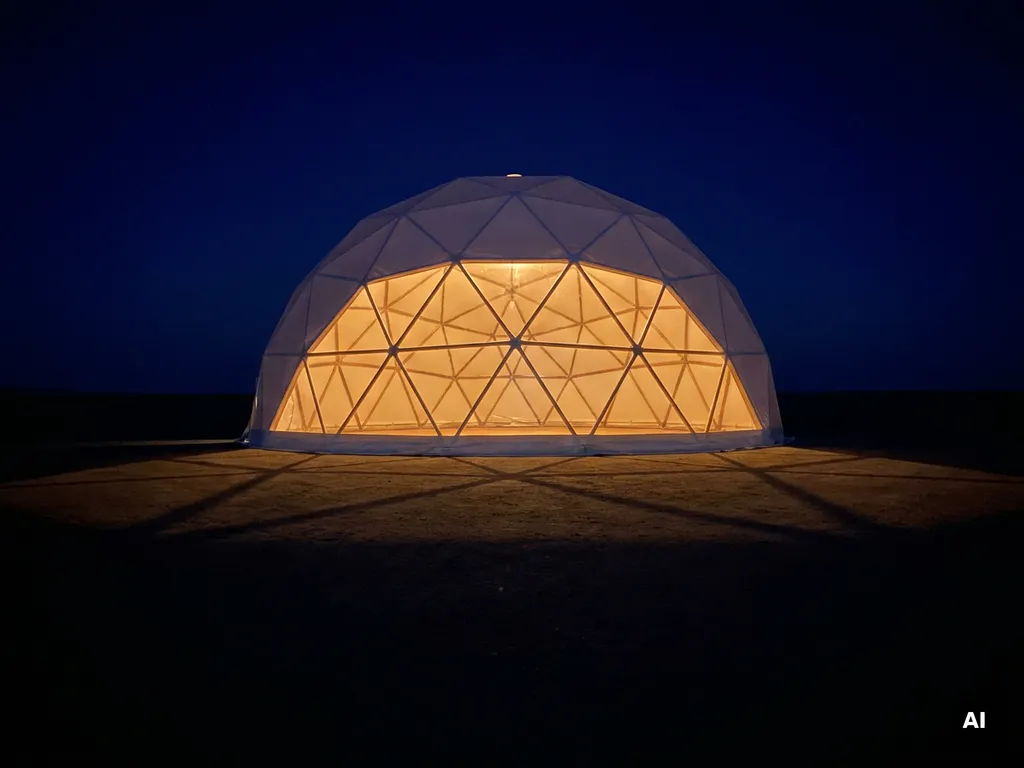
Immersive dome projection is a large-scale audiovisual technology that wraps imagery across the interior curved surface of a dome-shaped structure, surrounding viewers with a seamless, 360-degree visual environment. Unlike flat screens or even curved cinema formats, dome projection envelops the entire field of vision, creating a sense of complete spatial presence. The sections below unpack how the technology works, what formats exist, who uses it, and what it takes to produce a dome experience.
How does dome projection actually work?
Dome projection works by using one or more high-powered projectors to cast imagery onto the interior concave surface of a dome, creating a seamless wraparound visual field. The content is rendered using a fisheye or fulldome projection format, which pre-distorts the image so that it appears geometrically correct once reflected or projected onto the curved surface. The result is a fully immersive visual environment that fills the viewer’s peripheral vision as well as their central line of sight.
At its core, a dome projection system relies on three components working in harmony: the projection hardware, the content pipeline, and the dome structure itself. The projectors are either mounted at the center of the dome pointing outward, or positioned at the base pointing upward toward a mirror that redirects the image across the full interior surface. Multi-projector setups blend their outputs using edge-blending software, which digitally stitches adjacent projections together so the seams become invisible.
The content itself is typically rendered in fulldome format, a circular frame that maps directly onto the dome’s geometry. Modern rendering engines handle real-time or pre-rendered content in this format, allowing for everything from cinematic storytelling to live data visualizations. The synchronization of audio, which is usually delivered through a spatial or surround-sound system embedded in the dome structure, completes the sensory experience and anchors viewers inside the environment.
What types of dome projection systems exist?
Dome projection systems fall into three main categories based on their physical configuration: single-projector fisheye systems, multi-projector blended arrays, and mirror-based single-projector setups. Each type suits different dome sizes, content requirements, and production budgets, so the right choice depends on the intended use and audience scale.
Single-projector fisheye systems
These systems use one projector fitted with a specialized fisheye lens that casts a circular image covering the entire dome surface in a single throw. They are compact, cost-effective, and well-suited to smaller portable domes used for events, educational tours, or temporary installations. Resolution is the main trade-off: a single projector distributes its pixel count across a very large surface area, which can reduce image sharpness in larger domes.
Multi-projector blended systems
Larger, permanent installations typically use multiple projectors arranged around the dome perimeter. Each projector covers a segment of the surface, and edge-blending software merges the outputs into a single continuous image. This approach delivers significantly higher resolution and brightness, making it the standard for professional fulldome cinemas, science centers, and high-end brand experiences. The complexity of calibration and the cost of hardware are higher, but the visual quality is substantially greater.
Mirror-based single-projector systems
A single projector aimed downward at a convex mirror placed at the dome’s center reflects the image outward across the full interior surface. This configuration is popular for mid-sized inflatable or portable domes because it simplifies rigging and reduces the number of devices that need to be transported and aligned. Image quality sits between the fisheye and multi-projector approaches, making it a practical middle ground for touring productions and event-based dome experiences.
What content works best in a dome projection environment?
Content that exploits the full 360-degree field of view works best in a dome projection environment. This includes immersive narratives where the environment itself is part of the story, data visualizations that benefit from spatial scale, and experiences designed to generate a strong sense of presence or movement. Flat or screen-formatted content adapted for the dome rarely performs as well as content built specifically for the fulldome format.
The dome rewards content that places viewers inside a world rather than in front of one. Astronomy and space exploration have historically dominated fulldome programming precisely because the format mirrors how we experience the night sky. But the creative range extends far beyond planetarium content. Environmental storytelling, historical reconstructions, branded sensory journeys, and educational simulations all translate powerfully into the dome format when designed from the ground up with the curved canvas in mind.
Motion and spatial audio are equally important. Content that uses sound directionally, so that audio appears to come from specific points in the dome, amplifies the sense of immersion. Movement through environments, whether flying over a landscape or descending into a coral reef, triggers a visceral physical response that flat screens cannot replicate. The most effective dome content combines a clear narrative arc with spatial design choices that would be impossible in any other format.
How many people can a projection dome accommodate?
A projection dome can accommodate anywhere from a handful of people in a small portable unit to several hundred in a large permanent structure. Capacity depends primarily on dome diameter: compact inflatable domes of five to eight meters in diameter typically seat between fifteen and fifty people, while large-format domes of twenty meters or more can host audiences of several hundred simultaneously.
For event and exhibition contexts, capacity planning also involves considering the viewing geometry. In a tilted-horizon dome, where the screen is angled rather than fully overhead, more viewers can achieve a comfortable sightline without craning their necks. Fully hemispherical domes, where the projection covers the entire overhead surface, work well for smaller groups where everyone can lie back or recline. The seating arrangement, whether fixed tiered seats, reclining chairs, or open floor space, significantly affects how many people can comfortably experience the content at one time.
We design our dome experiences to scale with the audience, from intimate educational sessions to large-scale event installations accommodating groups of up to two hundred people simultaneously, ensuring the experience remains coherent and impactful regardless of group size.
What’s the difference between dome projection and a planetarium?
A planetarium is a specific type of dome projection venue dedicated primarily to astronomical education, using a specialized star projector or fulldome digital system to simulate the night sky. Dome projection is the broader technology category that encompasses any use of a curved dome surface for immersive visual content, including but not limited to planetarium programming. All planetariums use dome projection, but not all dome projection is a planetarium.
The distinction matters practically. Planetariums are permanent institutions with fixed infrastructure, curated educational programming, and audiences who arrive with specific expectations around astronomy and science. A dome projection system, by contrast, can be deployed in a temporary inflatable structure at a music festival, inside a museum gallery, at a corporate event, or as a standalone installation in a public square. The content can range from branded storytelling to immersive art to training simulations.
The technology underpinning both is increasingly similar. Modern digital planetariums use the same fulldome rendering pipelines and projection hardware as high-end commercial dome experiences. What differentiates them is purpose, programming, and context rather than the underlying projection system. This convergence has made it easier for cultural institutions and brands alike to commission dome experiences without needing a permanent planetarium infrastructure.
Where is immersive dome projection used today?
In 2026, immersive dome projection is used across a wide range of sectors, including cultural institutions, education, live events, brand activations, and public awareness campaigns. The technology has moved well beyond its origins in science centers and planetariums, becoming a versatile tool for any context where deep audience engagement and spatial storytelling are priorities.
- Museums and cultural institutions use dome cinemas to bring collections and historical narratives to life, attracting younger audiences and extending the emotional reach of their exhibitions.
- Educational programs deploy portable domes in schools and universities to make abstract subjects, from biology to geography to history, tangible and experiential.
- Brands and marketing teams commission dome installations for product launches, trade shows, and experiential campaigns where creating a memorable, shareable moment is the primary goal.
- NGOs and public sector organizations use the dome format for awareness campaigns, placing audiences inside environments or situations that build genuine empathy for complex social or environmental issues.
- Entertainment and live events incorporate dome projection into festivals, touring shows, and immersive theater productions to create environments that audiences cannot experience anywhere else.
The portability of inflatable dome systems has been a significant driver of this expansion. A dome experience that once required a permanent building can now be transported, inflated, and operational within hours, making the technology accessible to a far broader range of venues and budgets than was possible even a decade ago.
How much does a dome projection experience cost to produce?
The cost of producing a dome projection experience varies considerably depending on several interconnected factors, and there is no single price point that applies across all projects. Understanding what drives cost is the most useful starting point for any organization exploring the format.
The key factors that shape production cost include:
- Dome size and type – Larger domes require more powerful projectors, more complex rigging, and higher installation effort. Permanent structures carry different cost profiles than portable inflatable systems.
- Content creation – Custom fulldome content developed from scratch, particularly photorealistic or interactive content, requires significant creative and technical production time. Licensing existing fulldome content is a lower-cost alternative where it fits the brief.
- Interactivity – Adding interactive elements, such as real-time audience response, gesture control, or AI-driven personalization, introduces additional development complexity and hardware requirements.
- Duration and deployment – A one-off event installation has a different cost structure than a traveling exhibition that runs across multiple venues over an extended period.
- Audio and sensory integration – Spatial audio systems, scent delivery, haptic elements, and other sensory layers each add to the overall production investment but also deepen the audience experience significantly.
- Operational support – On-site technical management, content updates, and audience facilitation during the run of an experience all factor into the total cost of delivery.
The most effective approach to budgeting a dome projection project is to start with a clear articulation of the experience goals and audience context, then work backward to identify which components are essential and where flexibility exists. If you are exploring what a dome experience could look like for your organization, we would be glad to help you think through the possibilities. Feel free to contact us and start the conversation.
Gerelateerde artikelen
- What is an example of an immersive experience?
- Can installation art be interactive?
- What are the key components of a VR system?
- What is an example of experiential marketing?
- What exactly is experiential marketing?
- What are the disadvantages of augmented reality?
- How to attract people in an exhibition?
- How to make an exhibition stand stand out?
- How do immersive experiences increase brand engagement?