
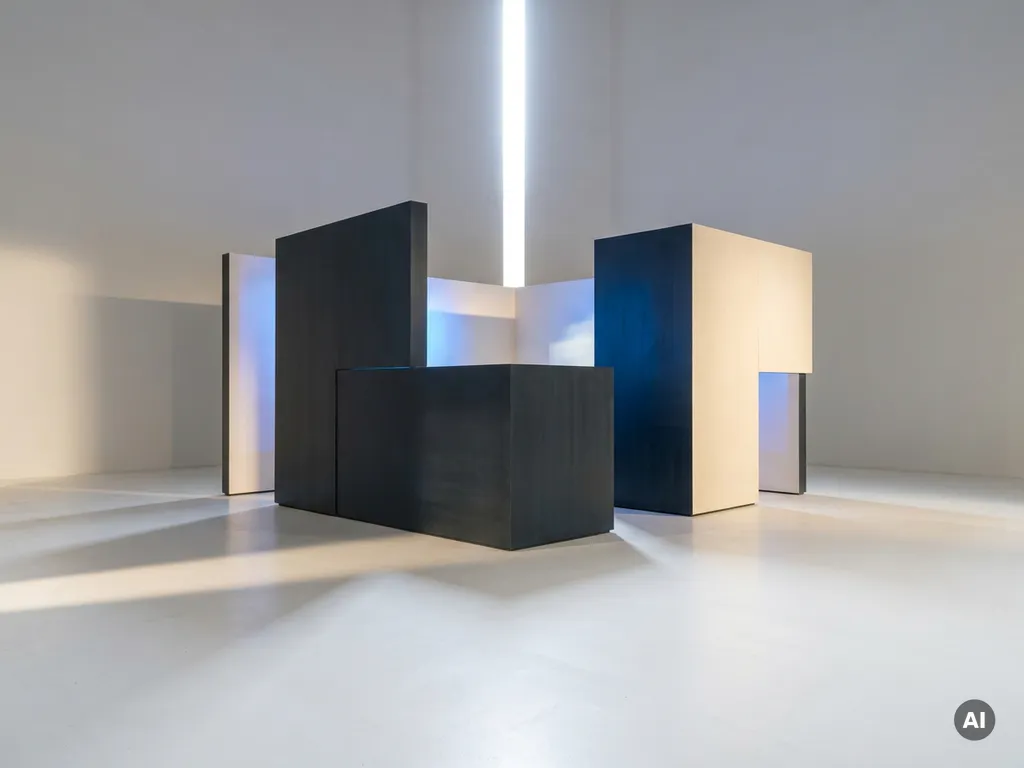
An exhibition stand stands out when it gives visitors a reason to stop, engage, and remember, and that reason must be immediate, sensory, and clear. In a trade show environment crowded with competing displays, the stands that win attention are those that create an experience rather than simply present information. The sections below answer the most important questions about exhibition stand design, immersive technology, storytelling, and measuring success.
What makes visitors stop at an exhibition stand?
Visitors stop at an exhibition stand when something unexpected breaks their visual or sensory routine. The human brain is wired to notice contrast and novelty, so a stand that looks, sounds, or feels different from everything around it will naturally pull people in. The trigger can be movement, light, sound, a striking visual, or the promise of an experience rather than a sales pitch.
Beyond the initial hook, the stand needs a clear and immediate signal of relevance. Visitors make split-second decisions about whether something is worth their time. If the purpose of the stand is not obvious within the first few seconds, most people will walk on. Effective exhibition stand engagement combines an attention-grabbing element with a clear, human-centered message that answers the visitor’s unspoken question: “What’s in this for me?”
Physical accessibility also matters. Open floor plans, inviting entry points, and visible activity inside the stand reduce the social friction of stepping in. Stands that feel like closed-off rooms or sales traps discourage spontaneous engagement, while those that feel open and participatory attract curious passersby.
What are the most effective exhibition stand design strategies?
The most effective exhibition stand design strategies prioritize experience over information, clarity over complexity, and emotion over specification. A stand that tells a story through its spatial layout, materials, and visual identity will outperform one that simply displays products on shelves or projects a slideshow on a screen.
Key design strategies that consistently deliver results include:
- Focal point design: Every strong stand has one dominant visual or experiential anchor that draws the eye from a distance. This could be a large-format display, a live demonstration, or an immersive installation.
- Layered engagement zones: Design the stand in layers, a broad attention zone visible from the aisle, an engagement zone where visitors interact, and a deeper conversation zone for qualified leads or longer discussions.
- Brand coherence: Every material, color, texture, and sound should reinforce the same brand story. Inconsistency creates cognitive noise and weakens recall.
- Human-scale design: Oversized graphics and towering structures can impress from a distance, but the close-up experience must feel personal and proportionate to the human body.
- Clear calls to action: Visitors should always know what they are invited to do next, touch this, watch this, speak to someone, try something.
Trade show booth ideas that work across sectors share one common thread: they put the visitor’s experience at the center of every design decision, not the exhibitor’s need to display information.
How does immersive technology transform an exhibition stand?
Immersive technology transforms an exhibition stand from a static display into a living environment that visitors can enter, explore, and interact with. Technologies such as augmented reality, virtual reality, interactive projection, and AI-driven experiences replace passive viewing with active participation, dramatically increasing dwell time and emotional impact.
An immersive exhibition stand can transport visitors to a different location, scale, or time period entirely. An AR portal, for example, can let a visitor step through a doorway into a virtual environment, a rainforest, a factory floor, a historical moment, without leaving the trade show hall. A VR experience can place a visitor inside a product, a brand story, or a social issue in a way that no brochure or video ever could.
The measurable effect of immersive technology on exhibition stand performance is significant. Visitors who interact with an immersive element spend more time at the stand, are more likely to share the experience on social media, and recall the brand more accurately after the event. For brands and institutions looking to make a lasting impression, immersive technology shifts the stand from a point of contact to a point of transformation.
We design and build these kinds of experiences end-to-end, from concept through to on-site delivery, for brands, museums, NGOs, and educational institutions. You can explore some of our completed immersive projects to see how this works in practice.
What’s the difference between an interactive stand and a passive display?
An interactive exhibition stand invites visitors to take an action, touch, choose, respond, or participate, while a passive display presents content for visitors to observe without influencing it. The difference is not just technological; it is psychological. Interaction creates agency, and agency creates investment. When visitors feel they are shaping an experience, they engage more deeply and remember it more vividly.
A passive display might include a video loop, printed panels, or a product on a plinth. These formats communicate efficiently, but they do not create a two-way relationship. Visitors remain spectators, and spectators are easy to forget.
An interactive stand, by contrast, might use touchscreens that respond to visitor choices, AR experiences triggered by a gesture or a scan, AI avatars that hold real-time conversations, or physical installations that change based on visitor input. Each of these formats makes the visitor a participant rather than an audience member. The result is longer engagement, stronger emotional connection, and significantly higher recall after the event ends.
The choice between interactive and passive is not purely a budget question, it is a strategic one. The more complex or abstract the message, the more an interactive format earns its place.
How can multisensory design improve exhibition stand performance?
Multisensory design improves exhibition stand performance by engaging more of the brain simultaneously, which deepens emotional response and strengthens memory formation. When a stand appeals only to sight and sound, it competes on the same terms as every screen and banner in the hall. When it adds scent, temperature, texture, or spatial movement, it creates an experience that is genuinely difficult to ignore or forget.
Research in cognitive science consistently shows that memories formed through multiple sensory channels are more durable and more emotionally charged than those formed through a single channel. A visitor who smells fresh pine while watching a sustainability film, or who feels the vibration of machinery while exploring an engineering brand, will form a richer and more lasting association than one who simply watches a video.
Practical multisensory elements that translate well into exhibition stand design include:
- Scent diffusion: Brand-specific or context-appropriate aromas that reinforce the narrative and create atmospheric immersion
- Spatial audio: Directional sound design that creates distinct zones within the stand and guides visitor movement
- Tactile materials: Surfaces, objects, and textures that invite touch and communicate quality through physical contact
- Temperature and airflow: Subtle environmental cues that reinforce the world being created inside the stand
At Rooftop Immersive, we design with all the senses, not just eyes and ears, because we believe that genuine immersion requires the whole body, not just the visual cortex.
What role does storytelling play in exhibition stand success?
Storytelling is the structural foundation of a successful exhibition stand. Without a clear narrative, even the most technically sophisticated stand becomes a collection of disconnected elements. Story gives visitors a reason to move through the space, a framework for understanding what they are experiencing, and an emotional thread that connects the brand or institution to something meaningful in their own lives.
The most effective exhibition stands tell a story with a beginning, middle, and end, often mapped directly onto the physical journey through the space. Visitors enter at a point of tension or curiosity, move through an experience that builds understanding or emotion, and leave with a resolution: a feeling, a decision, a memory, or a call to action.
Storytelling also determines what technology to use and how. The story should drive the technology choice, not the other way around. An AR portal makes sense when the story involves crossing a threshold into a different world. A VR experience makes sense when the story requires full immersion in a perspective that cannot be physically replicated. When technology serves the story, visitors feel the experience. When technology leads, visitors feel the demo.
For brands and institutions with complex messages, sustainability commitments, social impact programs, technical innovations, storytelling through an immersive stand is often the most efficient path to genuine understanding and emotional buy-in from visitors.
How do you measure whether an exhibition stand was successful?
An exhibition stand’s success is measured by combining quantitative engagement data with qualitative indicators of impact, dwell time, lead quality, social reach, and post-event recall. No single metric tells the full story, but together they reveal whether the stand achieved its strategic objectives, not just its attendance numbers.
The right metrics depend on the stand’s primary goal. For brand awareness campaigns, reach and social sharing matter most. For lead generation, the quality and conversion rate of conversations is the key indicator. For educational or NGO stands, behavioral intent and comprehension scores are more meaningful than footfall alone.
Useful measurement approaches include:
- Dwell time tracking: How long visitors spend inside the stand, which correlates directly with depth of engagement
- Interaction rates: What percentage of visitors who enter the stand engage with an interactive element
- Lead capture quality: Not just how many contacts were collected, but how qualified and motivated those contacts are
- Social amplification: Organic sharing, tagging, and mentions generated by visitors during and after the event
- Post-event surveys: Recall accuracy, emotional response, and likelihood of taking a next step
- Net Promoter Score (NPS): Whether visitors would recommend the experience to others, a strong proxy for genuine impact
Setting clear objectives before the event is essential, because measurement without a benchmark is just data. Defining what success looks like in advance, and designing the stand experience to produce those specific outcomes, is what separates strategic exhibition stand design from creative guesswork.
If you are planning an exhibition stand that needs to do more than fill a floor space, we would love to help you design something genuinely memorable. Contact us to start the conversation about what an immersive, story-driven stand could look like for your brand, institution, or campaign.
Gerelateerde artikelen
- How to create immersive experiences?
- Is XR training expensive?
- What is an example of immersive experience?
- What is immersive entertainment?
- What does XR stand for?
- What are the 4 types of memory in the brain?
- How big is the immersive experience market?
- What are branded immersive experiences?
- What is the ROI of immersive brand activations?