
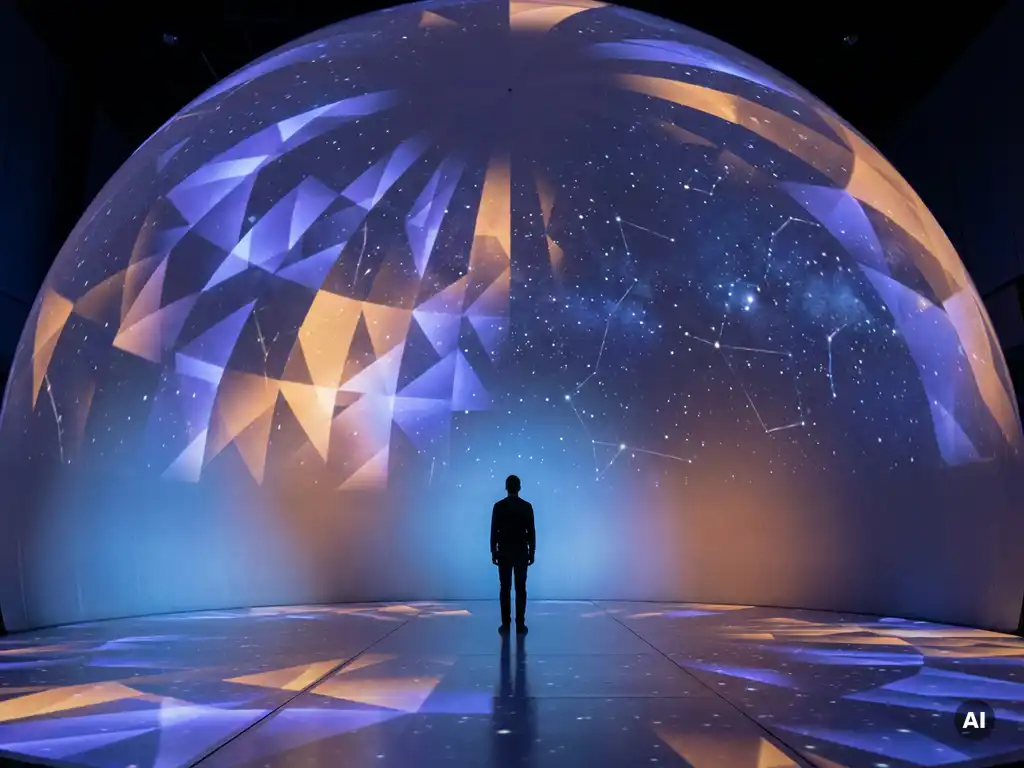
An immersive experience is one that surrounds participants in a multi-sensory environment designed to draw them fully into a story, place, or concept, engaging not just sight and sound, but touch, smell, movement, and emotion. The defining quality is presence: the feeling of actually being somewhere, rather than simply observing it. From walk-through art installations and VR training simulations to scent-filled 4D cinemas and AR-powered museum galleries, immersive experiences span a wide range of formats and industries. The sections below unpack the most important questions around what immersive experiences are, how they work, and why they matter.
What makes an experience truly immersive?
An experience becomes truly immersive when it removes the psychological distance between a person and the content they are engaging with. This happens through a combination of multi-sensory stimulation, spatial design, and narrative coherence, all working together to create a state of presence where the participant stops being an audience member and starts being a participant inside the story.
Several core qualities define genuine immersion. First, the environment must respond to the person within it, whether through reactive visuals, spatial audio that shifts with movement, or physical elements like temperature and scent. Second, the narrative must be strong enough to carry emotional weight. Technology alone does not create immersion; it is the storytelling that gives the technology meaning. Third, the experience must be designed with intention across every sensory channel, not just the visual one.
At Rooftop Immersive, we design with all five senses in mind. A visitor who can smell the forest floor, feel the texture of bark underfoot, and hear birdsong spatially positioned around them is not watching a nature documentary, they are inside one. That distinction is what separates a truly immersive experience from a high-quality screen presentation.
What are the most common types of immersive experiences?
The most common types of immersive experiences include virtual reality (VR) simulations, augmented reality (AR) activations, mixed reality environments, 360-degree dome projections, interactive installations, and 4D cinemas. Each format serves different goals, audiences, and settings, but all share the core objective of creating a heightened sense of presence and engagement.
Here is a practical overview of the most widely used formats:
- Virtual Reality (VR): Headset-based experiences that place users inside fully rendered digital environments. These range from passive 360-degree films to fully interactive simulations used in training, education, and entertainment.
- Augmented Reality (AR): Digital content layered over the physical world via smartphones, tablets, or headsets. AR activations are widely used in brand campaigns, museum exhibitions, and educational settings.
- Mixed Reality (MR): Real-time interaction between virtual objects and the physical environment, enabling users to manipulate digital content as though it exists in their physical space.
- 360-Degree Dome Projections: Large-scale projection environments that surround audiences entirely, used for events, science centers, and cultural exhibitions.
- 4D Cinemas and Sensory Installations: Experiences that combine visual content with physical stimuli such as scent, wind, vibration, and heat to deepen emotional engagement.
- Interactive Art Installations: Physical or hybrid environments where visitor behavior shapes the experience in real time, often used in museums, festivals, and public spaces.
The boundaries between these formats are increasingly fluid. Many of the most impactful experiences we create combine two or more of these approaches, for example, a physical installation enhanced with AR layers and spatial audio, to create something that no single technology could achieve alone.
Where are immersive experiences used in the real world?
Immersive experiences are used across a broad range of real-world sectors including education, museums, brand marketing, healthcare, NGOs, government communication, and entertainment. The common thread is a need to communicate something complex, emotional, or difficult to convey through traditional media, and a recognition that presence is the most powerful communication tool available.
Education and training
Schools, universities, and corporate learning teams use VR and AR to teach subjects that are difficult to access in a classroom, from surgical procedures and architectural design to historical events and environmental science. Immersive learning environments increase engagement and retention by replacing passive reading with active, embodied experience.
Museums and cultural institutions
Museums use immersive technology to bring collections to life, attract younger audiences, and deepen the emotional connection between visitors and artifacts. AR layers added to physical exhibits can reveal hidden histories, while VR portals can transport visitors to the original context of an artwork or archaeological site.
Brand and experiential marketing
Marketing teams use immersive activations at product launches, trade shows, and retail environments to create memorable brand moments that cut through media saturation. Unlike a banner ad or a social media post, an immersive brand experience generates genuine emotional memory, and social sharing that extends its reach far beyond the event itself.
NGOs and public sector communication
Organizations working on social impact, from humanitarian aid to climate awareness, use immersive storytelling to build empathy at scale. Placing someone inside the experience of a refugee, a flood survivor, or a child without access to education is far more persuasive than any infographic. Our work with organizations like UNICEF demonstrates how immersive experiences can shift perspectives and inspire real behavioral change.
How does an immersive experience differ from virtual reality?
Virtual reality is one specific type of immersive experience, not a synonym for the category as a whole. An immersive experience is the broader concept, any designed environment that creates a strong sense of presence and multi-sensory engagement. VR achieves this through a headset that replaces the user’s visual field with a digital environment, but immersion can also be achieved through physical installations, AR overlays, spatial audio, scent, and environmental design without any headset at all.
The distinction matters because it shapes how experiences are designed and what they can achieve. VR is powerful for transporting individuals to places or scenarios that are impossible to access physically. But a well-designed 4D dome installation can create equally powerful immersion for hundreds of people simultaneously, without requiring individual headsets. A walk-through sensory exhibition can immerse visitors through light, sound, and scent without any digital technology at all.
In practice, the most effective immersive experiences often combine VR with physical and environmental design elements, using the technology where it excels while supporting it with the kind of tactile, spatial richness that screens and headsets alone cannot provide.
What technology powers immersive experiences?
Immersive experiences are powered by a combination of spatial computing, real-time rendering engines, spatial audio systems, tracking technology, and increasingly, artificial intelligence. The specific technology stack depends on the format and objectives of the experience, but several core technologies appear consistently across the field.
- Real-time rendering engines (Unreal Engine, Unity): These platforms generate the high-fidelity visual environments used in VR and interactive AR experiences, enabling real-time response to user behavior.
- Spatial audio: Sound systems that position audio in three-dimensional space, so sounds appear to come from specific directions and distances, a critical component of presence.
- Motion tracking and sensors: Technologies that track user position, gaze, and gesture, allowing the experience to respond dynamically to how a person moves through a space.
- Photogrammetry and 3D scanning: Techniques that create accurate digital replicas of real-world objects, people, and environments for use in AR and VR.
- AI and generative systems: AI now enables experiences to adapt in real time to individual users, adjusting language, pacing, difficulty, or narrative path based on behavior and preference.
- Volumetric video: A capture technique that records real people as three-dimensional objects, enabling lifelike holographic representations used in AR hologram twins and virtual hosts.
The technology is a means, not an end. What matters is how these tools are combined and directed by a strong creative vision. The most sophisticated technology in the world produces a forgettable experience if the underlying story is weak.
Who commissions immersive experiences and why?
Immersive experiences are commissioned by a wide range of organizations, including brands, museums, educational institutions, NGOs, government bodies, and event producers, whenever they need to communicate something in a way that standard media cannot achieve. The common driver is a recognition that passive content consumption is no longer sufficient for their goals.
Brand and marketing leaders commission immersive activations when they need to create emotional memory and social buzz around a product or campaign. Museum directors and curators commission immersive installations to attract new audiences and deepen engagement with their collections. Educational institutions commission VR and AR learning environments when the subject matter is too complex, dangerous, or inaccessible to teach through conventional means. NGOs commission immersive storytelling tools when they need to build genuine empathy around issues that statistics and reports have failed to communicate.
What unites all of these commissioning decisions is the same insight: the experiences people remember most are the ones they felt, not the ones they watched. Across our client projects, we have seen this pattern hold true across sectors and audiences, immersion creates the kind of engagement that changes minds, shapes behavior, and builds lasting connection.
How do you measure the impact of an immersive experience?
The impact of an immersive experience is measured through a combination of engagement metrics, behavioral indicators, and outcome-based evaluation, the right mix depending on whether the goal is commercial, educational, or social. There is no single universal metric, but a well-designed measurement framework captures both the immediate response and the longer-term effect on knowledge, attitude, or behavior.
Engagement and experience quality
During and immediately after an experience, key indicators include dwell time, completion rates, interaction depth, and real-time biometric responses such as heart rate or galvanic skin response where measurement tools are in place. Qualitative feedback, how participants describe the experience in their own words, is equally valuable, particularly for understanding emotional resonance.
Behavioral and outcome metrics
For educational experiences, impact is measured through knowledge retention tests, skill assessments, and behavior change observed over time. For brand activations, metrics include social sharing volume, brand recall, conversion rates, and net promoter scores. For NGO and social impact work, success is measured by shifts in awareness, attitude, and reported intention to act, often captured through pre- and post-experience surveys.
What good measurement has in common across all of these contexts is intentionality: defining what success looks like before the experience is built, and designing the evaluation framework alongside the experience itself. Impact that is not measured is impact that cannot be improved, or demonstrated to stakeholders who need to justify the investment.
If you are exploring how an immersive experience could serve your organization’s goals, we would be glad to talk through the possibilities. Contact us to start the conversation.
Gerelateerde artikelen
- Which companies use augmented reality?
- What are the benefits of experiential marketing?
- What are the four key concepts in immersive media?
- What is immersive and interactive media?
- Is VR bad for kids with ADHD?
- How much to build an immersive room?
- How can I create shareable brand moments without requiring app downloads?
- How do you create compelling interactive narratives?
- What are the benefits of immersive museum experiences?