
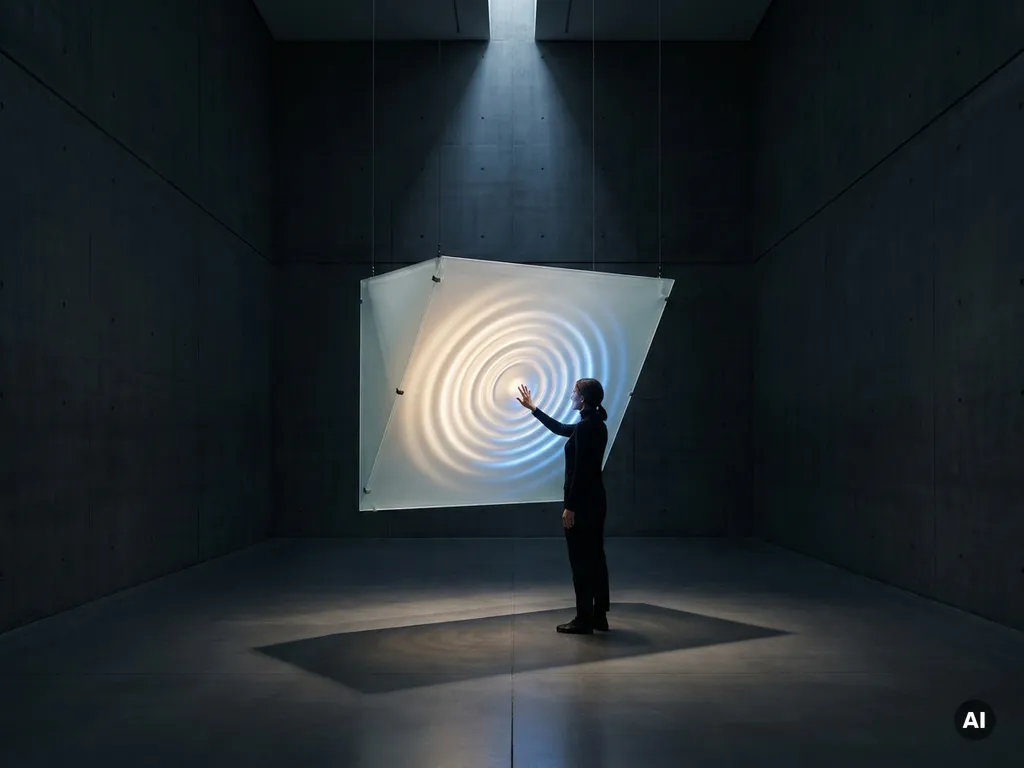
Yes, installation art can absolutely be interactive. Many contemporary installations are specifically designed to respond to, involve, or be shaped by the people who experience them, moving well beyond passive viewing into active participation. Interactivity is not a modern addition to installation art; it has been central to the medium since its earliest forms. The questions below unpack what that interactivity looks like, how it works, and why it matters for artists, institutions, and audiences alike.
What makes an art installation interactive?
An art installation becomes interactive when it responds to, involves, or is shaped by the presence and actions of its audience. Rather than presenting a fixed object to be observed from a distance, an interactive installation changes state, produces output, or evolves based on what visitors do, say, touch, or even feel. The work is, in a meaningful sense, incomplete without the audience.
Interactivity in installation art exists on a spectrum. At one end, a work might simply invite physical movement through a space, where the act of walking changes what you see or hear. At the other end, a fully responsive installation uses sensors, cameras, or biometric data to detect individual visitors and generate a unique experience for each one. Between these poles lie countless approaches: touch-sensitive surfaces, sound-reactive environments, installations that evolve over days as visitors leave marks or contributions, and participatory works where the audience collectively builds the piece.
The defining quality is agency. In an interactive installation, the visitor is not a spectator but a co-author. Their choices, movements, and presence carry consequence within the work. This shift from observation to participation is what separates interactive installation art from traditional static or even kinetic sculpture.
What are the most common types of interactive installation art?
The most common types of interactive installation art include sensor-responsive environments, participatory physical installations, digital and projection-based works, sound installations, and networked or data-driven pieces. Each type engages audiences through a different mechanism, but all share the principle that visitor involvement is essential to the work’s meaning or function.
- Sensor-responsive installations use motion detectors, cameras, or touch sensors to detect visitor presence and trigger visual, sonic, or physical changes in real time.
- Participatory physical installations invite visitors to physically alter the work, adding elements, rearranging components, or leaving traces that accumulate over the exhibition’s run.
- Projection-based and digital installations use screens, projection mapping, or augmented reality to layer digital content onto physical space, often responding to movement or input.
- Sound installations generate or modify audio based on visitor location, voice, or movement, turning the room into an instrument the audience plays.
- Networked and data-driven installations pull from live data streams, social media, or visitor-submitted content, meaning the work is always in flux and never the same twice.
These categories frequently overlap. A projection installation might also be sound-reactive and sensor-driven simultaneously, creating layered interactivity where multiple inputs shape the experience at once.
How does technology enable interactivity in art installations?
Technology enables interactivity in art installations by creating feedback loops between the work and its audience. Sensors detect input, processing systems interpret that input, and output devices, screens, speakers, motors, scent diffusers, lighting rigs, respond in real time. The sophistication of this loop determines how nuanced and responsive the interactive experience feels.
Input technologies
Input is how the installation perceives its audience. Common input technologies include infrared motion sensors, depth cameras, microphones, RFID chips embedded in wristbands or cards, touch screens, pressure-sensitive floors, and increasingly, computer vision systems that can identify body position, facial expression, or even emotional state. The richer the input data, the more precisely the installation can tailor its response.
Output and environment technologies
Output technologies translate that data into sensory experience. Projection mapping wraps digital imagery across irregular physical surfaces. Spatial audio systems place sound with pinpoint precision in three-dimensional space. Haptic devices deliver touch feedback. Scent diffusion systems release controlled aromas in response to triggers. LED and laser systems transform lighting into a responsive, painterly medium. Together, these tools allow artists and studios to design experiences that engage all the senses, not just sight and hearing.
The connective tissue between input and output is software: real-time rendering engines, custom code, and increasingly, machine learning models that allow the installation to adapt not just to individual actions but to patterns of behavior across an entire audience over time.
What’s the difference between immersive and interactive installation art?
Immersive installation art surrounds the visitor with an environment designed to produce total sensory absorption, while interactive installation art specifically requires visitor input to function or evolve. Immersion is about the depth of the experience; interactivity is about the audience’s role within it. The two qualities frequently coexist, but they are not the same thing.
A large-scale projection room that envelops visitors in moving imagery and spatial sound is immersive: it wraps around you and displaces the outside world. But if the imagery plays on a fixed loop regardless of who is in the room, it is not truly interactive. Conversely, a modest interactive installation might invite visitors to press buttons that change a small display, highly interactive, but not particularly immersive in scale or sensory scope.
The most compelling contemporary work tends to combine both qualities: environments that are spatially and sensorially enveloping, and that also respond to the specific people inside them. This combination, immersive art installations that are also genuinely participatory, represents the leading edge of the field. When immersion and interactivity reinforce each other, visitors do not just feel surrounded by an experience; they feel that the experience knows they are there.
Why do museums and galleries invest in interactive installations?
Museums and galleries invest in interactive installations because they demonstrably deepen visitor engagement, attract broader and younger audiences, and create the kind of memorable, shareable experiences that drive repeat visits and word-of-mouth reach. In an era where cultural institutions compete with an enormous range of leisure options, passive display alone is no longer sufficient to sustain relevance.
Interactive installation art solves several institutional challenges at once. It gives visitors agency over their own experience, which increases the time they spend in a space and the emotional investment they bring to it. It makes complex or abstract subjects, historical events, scientific concepts, social issues, tangible and personally felt rather than intellectually distant. And it generates the kind of organic social sharing that no marketing budget can reliably replicate: people photograph and film their own participation because the experience is visually striking and personally meaningful.
There is also a deeper curatorial motivation. Many institutions recognize that their collections and stories have the power to change how people think and feel, but that traditional display formats limit that potential. Interactive museum exhibits allow curators to build emotional journeys rather than information sequences, guiding visitors toward genuine understanding rather than surface-level exposure. For institutions working with sensitive histories, social justice themes, or scientific complexity, this distinction is not cosmetic: it is mission-critical.
How do artists and studios create interactive installation experiences?
Artists and studios create interactive installation experiences through a collaborative, iterative process that moves from conceptual intent through technical design, prototyping, and finally fabrication and installation. The process is fundamentally interdisciplinary, drawing on expertise in fine art, interaction design, software engineering, spatial design, and often sound, scent, and materials science.
The process typically begins with a core question: what should the visitor feel, understand, or do differently as a result of this experience? That question drives every subsequent decision. The interaction model, how the work detects and responds to its audience, is designed to serve the emotional and conceptual intent, not the other way around. Technology is chosen because it enables the right kind of experience, not because it is the most impressive available.
Prototyping is central to the process. Because interactive installations involve complex feedback loops between human behavior and technical systems, assumptions about how people will respond are almost always wrong in interesting ways. Early-stage testing with real visitors reveals how people naturally approach and engage with a work, and those insights reshape the design before fabrication locks anything in place.
Studios that work in this space, including us at Rooftop Immersive, operate across the full pipeline: concept development, spatial design, custom software, hardware integration, content production, and on-site installation. Working under one roof matters because the creative and technical decisions are deeply interdependent. A change in the interaction model affects the spatial design; a change in the projection technology affects the sound design. Fragmented production processes produce fragmented experiences.
What role does AI play in interactive installation art?
AI plays an increasingly central role in interactive installation art by enabling experiences that adapt in real time to individual visitors rather than following fixed scripts. Where earlier interactive installations responded to simple inputs with predetermined outputs, AI-powered installations can interpret complex behavior, recognize patterns, generate unique content, and sustain dynamic, evolving interactions that feel genuinely responsive rather than mechanical.
The most significant application is personalization at scale. An AI system can analyze how a visitor moves through a space, which elements they linger over, how they respond to different stimuli, and use that data to adjust the experience in real time, changing the narrative, the pacing, the visual content, or the language of the work to match the individual in front of it. This is particularly powerful in educational and cultural contexts, where visitors arrive with vastly different levels of prior knowledge and different learning styles.
AI also enables conversational interactivity through AI avatars and natural language interfaces. A visitor can ask questions of a virtual character, receive contextually appropriate answers, and engage in a dialogue that feels genuinely responsive. This transforms the installation from a display into a participant, one that can guide, challenge, or collaborate with the human visitor in ways that static or pre-scripted works cannot.
Generative AI adds another dimension: installations that create visual, sonic, or textual content in response to visitor input, producing outputs that have never existed before and will never exist again in exactly the same form. This makes each visit genuinely unique and gives visitors a sense that their presence has left a real mark on the work.
Interactive installation art is a rapidly evolving field, and the distance between what is technically possible and what is creatively realized continues to shrink. Whether you are a museum building a new permanent gallery, a brand seeking an experience that outlasts a campaign, or an educational institution trying to make complex ideas land with lasting impact, the right immersive partner can help you find the form that serves your story. We would love to explore what that could look like for you: feel free to contact us to start the conversation.
Gerelateerde artikelen
- Can you give me some examples of immersive virtual reality?
- What is a full dome planetarium?
- What are the statistics on the popularity of immersive experiences?
- What is the 20 20 20 rule for VR?
- What are the benefits of immersive experiences?
- What are 360-degree experiences?
- What are dome installations?
- How long does AR content production take?
- How do you create educational immersive content?