
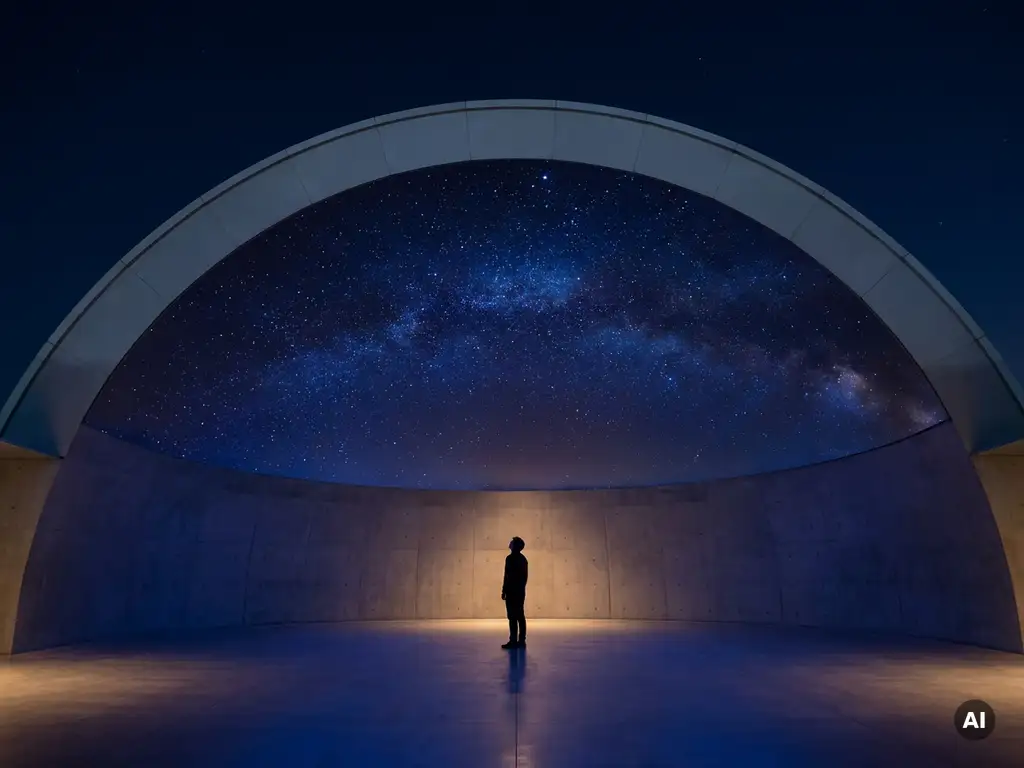
A full-dome planetarium is an immersive projection environment in which imagery is displayed across the entire curved interior surface of a hemispherical dome, surrounding the audience with a seamless 360-degree visual field. Unlike a flat or conventional screen, the dome wraps the image completely overhead and to the sides, creating a powerful sense of presence and spatial depth. The sections below unpack how these systems work, what they can show, and where they are being used today.
How does a full-dome planetarium actually work?
A full-dome planetarium works by projecting pre-rendered or real-time digital content onto the concave inner surface of a hemispherical dome using one or more high-powered digital projectors, often arranged in a fisheye or tiled configuration. The imagery is warped and blended before projection so that it appears geometrically correct to viewers seated beneath the dome. The result is a continuous, edge-to-edge visual environment with no visible seams or borders.
At the heart of the system is a projection engine, typically a single fisheye projector for smaller domes or a multi-projector array for larger installations. Each projector covers a segment of the dome surface, and specialized software handles edge blending so the overlapping areas merge invisibly. The content itself is rendered in a dome master format, which is a circular frame that maps precisely to the dome geometry when projected.
Audio is an equally important component. Full-dome systems pair their visuals with multichannel surround sound, often delivered through speakers embedded around the perimeter or overhead. This combination of enveloping visuals and spatial audio is what gives the dome planetarium its distinctive sense of total immersion: the viewer is not watching a scene but inhabiting it.
What is full-dome content and what formats does it use?
Full-dome content is video, animation, or real-time rendered imagery specifically produced for display on a hemispherical dome surface. It is formatted as a circular fisheye frame, commonly referred to as a dome master, that maps to the dome geometry during projection. Standard resolutions range from 2K to 8K, and content is typically delivered as image sequences or high-bitrate video files.
The most widely used format is the dome master: a single circular image or video frame that represents the full 180-degree field of view as seen from the center of the dome. When projected through a fisheye lens, this circular frame expands to fill the entire dome surface correctly. Content producers work in this format from the start, designing compositions that account for the curved viewing environment rather than adapting flat footage after the fact.
Real-time rendering is a growing alternative to pre-rendered video. Platforms such as Unreal Engine and Unity can generate dome-formatted imagery on the fly, which makes it possible to create interactive experiences where the visuals respond to user input, live data, or performer cues. This opens up possibilities well beyond the traditional pre-recorded show, including live visualization of scientific data, interactive storytelling, and fully personalized educational journeys.
What’s the difference between a full-dome planetarium and a traditional planetarium?
The key difference is the projection technology and the range of content it can display. A traditional planetarium uses an optical-mechanical star projector, a device with thousands of precisely drilled apertures that cast accurate star positions onto the dome. A full-dome planetarium replaces or supplements this with digital projectors capable of showing any content: animations, video, real-time data, or interactive experiences, not just star fields.
Traditional optical planetariums excel at astronomical accuracy. The star projector recreates the night sky with remarkable fidelity, and for pure stargazing education, this remains a powerful tool. However, it is limited to what the mechanical device can physically produce. The dome itself is passive: it only ever shows what the projector is designed to display.
A full-dome digital system transforms the same physical space into a flexible canvas. The same dome that shows a tour of the solar system in the morning can display a documentary about ocean ecosystems in the afternoon, host a live music visualization in the evening, or run an interactive training simulation for a corporate client the following day. Many modern planetariums operate hybrid systems, retaining an optical star projector while adding a full-dome digital layer for expanded programming.
What kinds of experiences can a full-dome planetarium show?
A full-dome planetarium can show virtually any visual experience that benefits from 360-degree immersion, from astronomical simulations and nature documentaries to brand activations, art installations, educational programs, and live performances. The dome format is content-agnostic: if it can be rendered or filmed in a dome master format, it can be projected onto the dome.
In science and education contexts, the most common content includes tours of the solar system, deep-space exploration, earth science visualizations, and biology or anatomy simulations. The immersive scale of the dome makes abstract concepts tangible: a student does not just see a diagram of a cell; they appear to float inside one.
Beyond science, full-dome environments are used for storytelling experiences that place audiences inside a narrative, meditation and wellness journeys, immersive art exhibitions, and live events where performers interact with the projected environment in real time. We design immersive dome experiences that span all of these categories, treating the dome as a spatial storytelling medium rather than simply a screening venue. The creative possibilities expand further when real-time rendering and interactive elements are introduced, allowing audiences to influence what they see and hear.
How big does a dome need to be for a full-dome planetarium?
Full-dome planetariums operate across a wide range of sizes, from portable inflatable domes as small as 3 to 5 meters in diameter, suitable for classroom or event use, up to permanent fixed installations exceeding 30 meters in diameter. The minimum practical size for a seated audience experience is generally around 5 to 6 meters, which comfortably accommodates a small group.
Dome diameter directly influences the sense of immersion. Smaller domes create an intimate, close-surrounding experience, while larger domes produce a more expansive sense of open space, particularly effective for astronomical content where the goal is to evoke the feeling of being under an open sky. Seating capacity scales with diameter: a 10-meter dome might seat 30 to 50 people, while a 20-meter dome can accommodate several hundred.
Tilt angle is another important variable. Some domes are built with a tilted horizon line, angling the dome slightly toward the audience so that more of the projected surface falls within the natural forward field of view. This design is common in modern planetariums and improves viewing comfort significantly compared to a fully vertical dome where audiences must lean back to see the zenith. Portable inflatable domes, by contrast, are typically fully hemispherical and used in a reclined or floor-seated configuration.
Where are full-dome planetariums used outside of science museums?
Full-dome planetariums are used in a broad range of settings beyond science museums, including schools and universities, corporate event venues, music festivals, art exhibitions, religious institutions, theme parks, military and aviation training facilities, and temporary event installations. The technology has moved well outside its astronomical origins and is now recognized as a versatile immersive medium.
Education and institutional settings
Schools and universities install dome systems as flexible teaching environments. A dome can simulate historical environments for humanities students, visualize molecular structures for science classes, or host language immersion programs. Organizations such as UNICEF and other NGOs have used dome installations to create empathy-driven experiences around humanitarian themes, placing audiences inside the realities of communities they would otherwise never encounter.
Brand, event, and entertainment contexts
In the commercial world, brands use full-dome environments for product launches, experiential marketing activations, and trade show installations where the goal is to create a memorable, shareable moment. Music artists and festivals incorporate dome projection into live performances, synchronizing visuals with audio in real time. Temporary inflatable dome installations appear at outdoor festivals, corporate retreats, and public spaces, making the technology accessible without the need for a permanent structure. The immersive experiences we create for these contexts are designed to leave a lasting impression precisely because they engage the audience spatially rather than through a conventional screen.
How much does a full-dome planetarium system cost?
The cost of a full-dome planetarium system varies considerably depending on several interconnected factors, and no single price point applies across all installations. Understanding what drives the investment helps decision-makers plan realistically and prioritize the elements that matter most for their specific use case.
Factors that influence system cost
Dome size is the most significant cost driver. Larger domes require more projection hardware, more structural engineering, and more complex installation work. A portable inflatable dome for occasional use sits at a very different investment level than a permanent fixed installation designed for daily public programming.
Projection technology is the second major variable. Entry-level single-projector fisheye systems are considerably more affordable than multi-projector tiled arrays, which require precise alignment hardware, blending software, and ongoing calibration. Resolution requirements also matter: a 4K system costs more than a 2K system, and an 8K installation designed for a large professional planetarium represents a substantial step up again.
Content and integration costs
The system hardware is only part of the picture. Custom content production, whether pre-rendered animations, real-time interactive programs, or hybrid experiences, adds significantly to the total investment. Audio system complexity, seating design, control room infrastructure, and any interactive elements such as motion platforms or sensory components all contribute to the overall budget.
Ongoing costs include content licensing for off-the-shelf programming, technical maintenance, and staff training. For organizations considering a permanent installation, it is worth evaluating the total cost of ownership over several years rather than focusing solely on the initial build cost. If you are exploring what a full-dome system could look like for your venue or project, contact us to discuss the scope and find the configuration that fits your goals and resources.
Gerelateerde artikelen
- What are the 5 dimensions of experiential marketing?
- How does virtual reality impact society?
- What are the types of learning experiences?
- What is immersive and interactive media?
- How to create an immersive room?
- How do you optimize spatial design for different audiences?
- How do you create compelling interactive narratives?
- What is experiential marketing?
- What software is used for VR content production?