
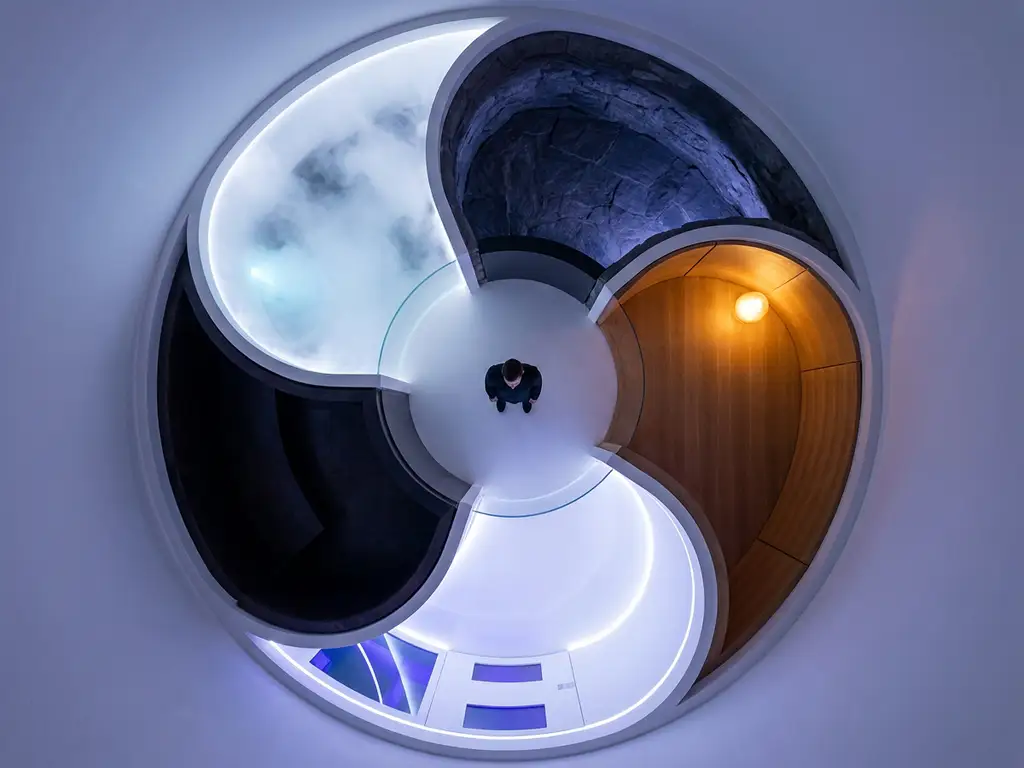
Learning experiences fall into several broad categories: passive, active, experiential, and immersive. Passive learning delivers information through lectures or reading. Active learning involves discussion and problem-solving. Experiential learning puts people inside real or simulated situations. Immersive learning goes furthest by engaging multiple senses simultaneously, creating the conditions for deeper understanding and lasting memory.
The most effective type depends on what you are trying to teach, who your audience is, and how complex or emotionally demanding the subject matter is. The sections below answer the most important questions about how different learning experiences work, what distinguishes them, and how to choose the right approach.
How do different learning experiences actually work in practice?
Different learning experiences work by activating different cognitive and sensory pathways. Passive formats such as lectures deliver information to the brain through a single channel. Active formats like workshops require the learner to process and apply that information. Experiential and immersive formats go further by placing the learner inside a situation, which activates emotional memory, spatial reasoning, and decision-making simultaneously.
In practice, the distinction matters because memory formation is tied to emotional engagement. When a learner simply receives information, retention drops sharply within days. When a learner makes a decision, feels a consequence, or navigates a physical or virtual space, the experience is encoded more deeply. This is not a theoretical claim; it reflects how the brain consolidates memory during emotionally significant events.
Consider the difference between reading about a humanitarian crisis and standing inside a reconstructed environment where the sounds, scale, and visual details surround you. The second experience does not just inform; it creates a felt sense of reality that reading alone cannot replicate. That felt sense is what drives behavior change, empathy, and long-term recall.
What is the difference between experiential and traditional learning?
Traditional learning is primarily transmissive: an expert delivers content and the learner receives it. Experiential learning is participatory: the learner engages with a situation, makes choices, observes outcomes, and reflects on what happened. The core difference is agency. In traditional formats, the learner is a recipient. In experiential formats, the learner is an actor.
This distinction has significant implications for outcomes. Traditional learning works well for foundational knowledge transfer: facts, definitions, procedures that need to be memorized accurately. It is efficient and scalable. However, it struggles with complex topics that require judgment, empathy, or the ability to apply knowledge under pressure.
Experiential learning addresses these gaps by creating conditions where learners must engage rather than observe. A medical student reading about a difficult diagnosis learns differently from one who must diagnose a simulated patient in real time. A corporate team reading about inclusion learns differently from one that navigates a VR scenario designed to surface unconscious bias. The experience creates a reference point that abstract content cannot.
What are the main types of immersive learning experiences?
The main types of immersive learning experiences are virtual reality (VR), augmented reality (AR), mixed reality (MR), interactive installations, and multisensory environments. Each type creates immersion differently and suits different learning contexts, audiences, and logistical requirements.
Virtual Reality (VR) Learning
VR places the learner inside a fully digital environment using a headset. The physical world disappears and the virtual world takes over completely. This is powerful for scenarios that are impossible, dangerous, or impractical to recreate in real life: surgical procedures, emergency response, historical events, or situations requiring perspective-taking across cultural or social divides. VR can be passive (cinematic, 360-degree storytelling) or fully interactive, where the learner makes decisions that shape the experience.
Augmented Reality (AR) Learning
AR overlays digital content onto the real world through a smartphone, tablet, or headset. Unlike VR, the learner remains physically present in their environment while interacting with additional layers of information or storytelling. AR works exceptionally well in museums, classrooms, and field-based learning where the physical context matters. It can animate static exhibits, guide learners through complex processes, or transform a printed page into an interactive experience.
Mixed Reality and Interactive Installations
Mixed reality blends physical and digital elements in real time, allowing virtual objects to interact with the real world. Interactive installations take a different approach, creating purpose-built physical environments: domes, rooms, or multi-screen spaces, where immersion comes from the scale and design of the space itself rather than a headset. Both formats support group learning and are particularly effective for public education, exhibitions, and large-scale awareness campaigns.
How does sensory engagement affect learning outcomes?
Sensory engagement strengthens learning outcomes because the brain encodes memories more durably when multiple senses are activated at once. When sight, sound, touch, smell, or spatial awareness are involved together, the experience creates a richer network of associations in memory. This makes recall easier, more accurate, and longer-lasting compared to single-channel learning.
The mechanism behind this is well established in cognitive science. Each sensory input adds a layer of context to a memory. When you later try to retrieve that memory, any one of those sensory cues can serve as a trigger. A learner who experienced a topic through sound, visual environment, physical movement, and perhaps even scent has far more retrieval pathways available than one who encountered it only as text on a screen.
For learning designers, this means that adding sensory dimensions to an experience is not a cosmetic choice; it is a structural one. The smell of a historical environment, the physical scale of an installation, the spatial audio of a VR scenario: each of these elements is doing cognitive work. At Rooftop Immersive, we design with all the senses deliberately, treating each sensory layer as a tool for deepening understanding rather than simply enhancing atmosphere.
What types of learning experiences work best for complex or sensitive topics?
Complex or sensitive topics are best served by immersive, perspective-driven experiences that create emotional proximity without overwhelming the learner. Topics such as mental health, social inequality, climate impact, or historical trauma require more than information delivery: they require a shift in perspective. Immersive formats that place learners inside a lived experience are particularly effective because they bypass intellectual resistance and engage empathy directly.
Traditional formats often struggle here. A presentation about poverty can be dismissed or held at arm’s length. An immersive environment that recreates the sensory reality of displacement: the noise, the confinement, the absence of privacy, is much harder to intellectualize away. The emotional engagement is not manipulative; it is the point. Understanding a complex topic often requires feeling its weight, not just knowing its facts.
For sensitive topics, the design of the experience matters as much as the content. Learners need agency: the ability to pause, reflect, or step back. They need narrative framing that provides context without oversimplifying. And they need a structured debrief or reflection moment after the experience to process what they encountered. The most effective immersive learning experiences for difficult subjects build all of these elements into the design from the start.
How can AI personalize a learning experience?
AI personalizes a learning experience by adapting its content, pace, language, and difficulty in real time based on how the learner is responding. Rather than delivering a fixed sequence to everyone, an AI-driven experience observes behavior: which choices a learner makes, how long they spend on certain elements, where they hesitate, and adjusts accordingly. The result is an experience that feels tailored to the individual even when it is being delivered at scale.
In practice, this can take several forms. An AI avatar might shift its communication style based on the learner’s responses: becoming more explanatory for someone who seems uncertain, or more challenging for someone who is moving quickly. A VR training scenario might introduce more complex variables once a learner has demonstrated competence at a baseline level. A multilingual experience might detect the learner’s preferred language and switch automatically without requiring manual input.
Personalization through AI also extends to accessibility. Learning experiences can adapt to different reading levels, adjust audio descriptions for visually impaired users, or modify the pacing for learners with cognitive differences. This makes immersive learning genuinely inclusive rather than designed for an assumed average user. For organizations working across diverse populations: schools, NGOs, government agencies, this adaptability is not a luxury; it is a prerequisite for impact.
Which type of learning experience is right for your audience?
The right type of learning experience depends on three factors: the complexity of the subject matter, the characteristics of your audience, and the context in which learning will take place. There is no single best format; the most effective choice aligns the learning objective with the format’s strengths and the audience’s needs.
For audiences who are new to a topic or need to build foundational knowledge quickly, structured active learning with some experiential elements works well. For audiences who need to develop judgment, empathy, or the ability to perform under pressure, healthcare workers, educators, crisis communicators, immersive simulation is significantly more effective than any passive format. For audiences who are geographically dispersed or working at different paces, AI-personalized immersive content delivered through AR or interactive platforms offers the best combination of depth and accessibility.
Context matters too. A museum exhibition serving thousands of visitors of different ages requires a different approach from a corporate training program for fifty senior managers. A school curriculum designed for repeated use over an academic year has different requirements from a one-time awareness campaign at a public event. The format should serve the context, not the other way around.
The most important question to ask is not “which technology should we use?” but “what do we want our audience to understand, feel, or be able to do differently after this experience?” Starting from that outcome makes the format choice far clearer. If you are working through that question for your own project and want to explore what is possible, we welcome you to contact us and start the conversation.
Gerelateerde artikelen
- What are the 5 dimensions of experiential marketing?
- Can immersive experiences reduce anxiety?
- What are the psychological effects of immersion?
- How to create an immersive event?
- What is the difference between interactive and immersive theatre?
- How do immersive experiences improve experiential marketing?
- How do 360-degree experiences work in marketing?
- How does interactive storytelling engage audiences?
- What software is used for VR content production?