
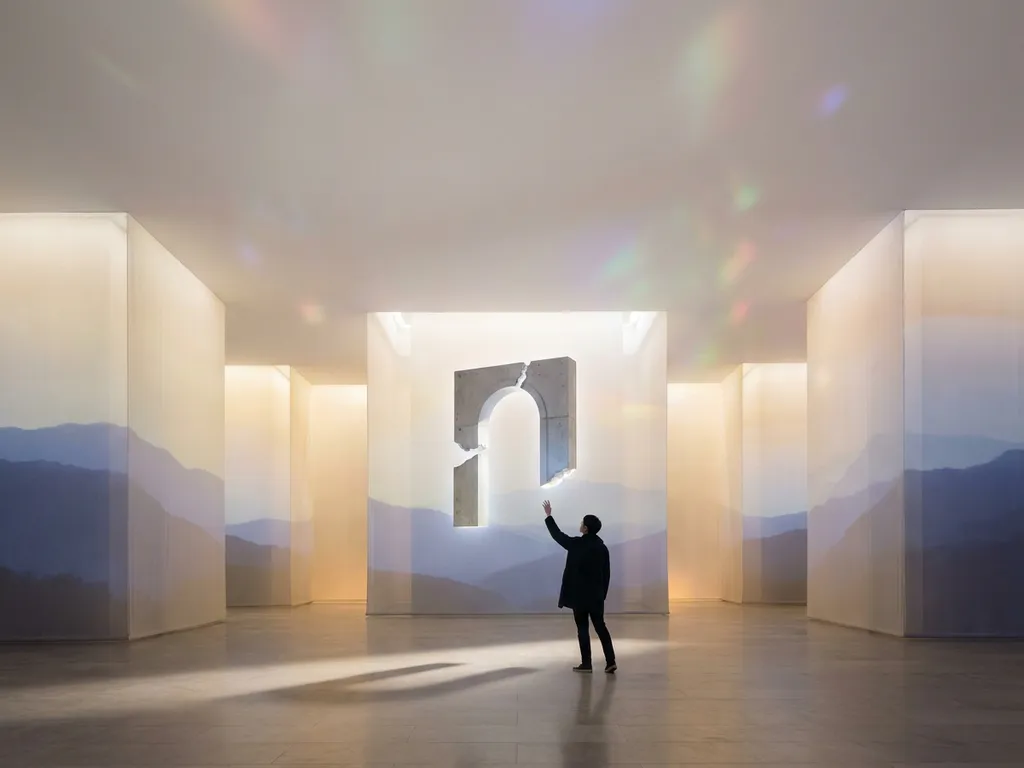
Immersive learning is an educational approach that places learners inside the experience rather than in front of it. Instead of reading about a concept or watching a video, participants engage with realistic, interactive environments, physical, digital, or blended, that activate multiple senses and demand active participation. It works because the brain encodes experience differently than information, forming stronger, more durable memories when the body and emotions are involved.
Immersive learning applies across every sector where knowledge transfer matters: education, corporate training, healthcare, cultural institutions, and social impact campaigns. The underlying principle is universal: people learn more deeply when they are fully present, emotionally engaged, and given agency within the learning environment.
The questions below unpack how immersive learning works, what powers it, who uses it, and how you measure whether it actually delivers.
How does immersive learning differ from traditional education?
Traditional education positions the learner as a receiver, someone who absorbs information delivered by a teacher, textbook, or screen. Immersive learning repositions the learner as a participant who navigates situations, makes decisions, and experiences consequences. The fundamental difference is agency: immersive learning creates conditions where the learner does rather than watches.
In a conventional classroom, knowledge flows in one direction. A student learns about a historical event by reading about it. In an immersive environment, that same student might step inside a reconstructed moment in time, encounter the perspectives of people who lived it, and make choices that shape the outcome. The content is identical; the depth of encoding is not.
This distinction matters because of how memory works. Information delivered passively tends to fade quickly, a phenomenon educators have long observed. When learning is tied to sensory experience, spatial context, and emotional engagement, retention improves significantly. The learner does not just know the fact; they have a memory of experiencing it.
Traditional education also tends toward uniformity: the same lesson, delivered the same way, to every student simultaneously. Immersive learning environments can adapt. AI-driven systems adjust the pace, language, difficulty, and narrative path based on how each individual is responding. That personalisation is not a luxury: it is often the difference between a lesson that lands and one that is forgotten by the following week.
What technologies power immersive learning experiences?
Immersive learning experiences are powered by a combination of spatial computing, real-time 3D rendering, extended reality (XR) technologies, and increasingly, artificial intelligence. The specific technology stack depends on the learning objective, the audience, and whether the experience is location-based or portable.
Extended Reality: VR, AR, and Mixed Reality
Virtual reality (VR) places learners inside a fully digital environment using a headset. They are visually and aurally separated from the physical world and placed inside a simulated one, a surgical theatre, a historical city, an industrial facility, or a social scenario. Interactive VR goes further, allowing learners to manipulate objects, make decisions, and navigate branching storylines.
Augmented reality (AR) overlays digital content onto the physical world, typically through a smartphone or headset. In an educational context, AR can make a printed diagram come alive, bring a museum exhibit to life with additional narrative layers, or place a 3D model of a molecular structure on a student’s desk. Mixed reality (MR), as experienced on hardware like Apple Vision Pro, blends physical and digital elements in real time, allowing virtual objects and real ones to coexist and interact.
AI, Spatial Audio, and Multisensory Design
Artificial intelligence enables immersive learning environments to respond intelligently. AI avatars and non-player characters (NPCs) can hold real-time conversations with learners, answer questions, and adjust their responses based on what the learner says or does. This transforms a linear module into a dynamic dialogue.
Spatial audio, haptic feedback, scent diffusion, and temperature variation extend the experience beyond sight and sound. These multisensory layers are not decorative: they are functional. When a learner can feel the weight of a decision through physical sensation, or smell the environment they are navigating, the brain processes the experience as real. That is the mechanism behind why immersive learning works at a neurological level.
What are the proven benefits of immersive learning?
The proven benefits of immersive learning include significantly improved knowledge retention, stronger emotional engagement, faster skill acquisition, and greater learner motivation. These benefits emerge because immersive environments activate more of the brain simultaneously than passive learning methods, creating richer and more durable memory traces.
Retention is the most consistently reported benefit. When learners engage with content through experience rather than instruction, they form episodic memories, memories tied to place, action, and emotion, which are far more resistant to forgetting than declarative facts. This is why someone who has practised a procedure in a VR simulation can recall and execute it more accurately than someone who read the same procedure in a manual.
Emotional engagement is equally significant. Immersive experiences generate genuine emotional responses: empathy, curiosity, urgency, even discomfort. These emotional states are not incidental: they are the mechanism through which complex or sensitive subjects become truly understood rather than merely acknowledged. An NGO communicating the reality of a humanitarian crisis through an immersive experience creates a fundamentally different level of comprehension than a statistics-heavy presentation.
For learners who have historically struggled in traditional educational settings, whether due to learning differences, language barriers, or low motivation, immersive environments offer a different entry point. The experience itself carries meaning before any explanation is given. That accessibility is one of immersive learning’s most underappreciated advantages.
Who uses immersive learning and in which sectors?
Immersive learning is used across education, healthcare, corporate training, defence, cultural institutions, and social impact organisations. Any sector where knowledge transfer, behaviour change, or empathy development is critical has found practical application for immersive learning methodologies.
In education, schools and universities use VR and AR to teach subjects that are difficult to convey through text alone, human anatomy, historical events, scientific phenomena, social dynamics. Institutions such as universities and vocational schools use immersive modules to give students realistic practice environments before entering professional settings.
In corporate training and L&D, organisations use immersive simulations to train employees in high-stakes scenarios: emergency response, leadership under pressure, customer conflict resolution, safety procedures. The advantage is that learners can make mistakes and learn from them without real-world consequences.
In the cultural sector, museums and heritage institutions use immersive technology to deepen visitor engagement, attract younger audiences, and give physical collections additional narrative depth. AR layers, VR portals, and interactive 360-degree installations transform passive viewing into active discovery.
For NGOs and public sector communicators, immersive learning is a tool for behaviour change. When the goal is not just to inform but to shift perspective and motivate action, experiential approaches consistently outperform traditional media. Organisations working on issues from climate change to public health have used immersive experiences to move audiences from awareness to genuine commitment.
How is immersive learning designed and built?
Immersive learning is designed by combining instructional design principles with spatial storytelling, technology architecture, and sensory experience design. The process starts with a learning objective, not a technology choice, and works outward from there to determine which medium, format, and interaction model will best serve that objective.
A well-built immersive learning experience begins with deep collaboration between the client and the creative team. The most effective experiences are not technology demonstrations dressed up as education: they are purpose-built responses to a specific learning challenge. That means understanding the audience, the subject matter, the emotional journey the learner needs to take, and the environment in which the experience will be delivered.
From that foundation, the design process moves through narrative development, environment design, interaction mapping, and technical build. In a VR experience, this might involve scripting branching scenarios, building three-dimensional environments in Unreal Engine or Unity, recording spatial audio, and integrating AI-driven characters. In an AR experience, it might mean designing image-tracking triggers, creating 3D assets, and building an application that works reliably across a range of devices and contexts.
We work through this entire process under one roof, from first concept through to final deployment, which matters because the design decisions made in the early stages have direct consequences for the technical build, and vice versa. Fragmented production processes, where creative and technical teams work separately, tend to produce experiences that are technically functional but experientially flat.
What’s the difference between immersive learning and gamification?
Immersive learning and gamification are related but distinct approaches. Gamification applies game mechanics, points, badges, leaderboards, rewards, to existing content to increase motivation. Immersive learning redesigns the entire learning environment so that the experience itself is the medium of instruction. Gamification changes how content is presented; immersive learning changes where and how learning happens.
A gamified course might award points for completing a quiz or finishing a module. The underlying learning structure remains unchanged, the learner is still reading text or watching video and then answering questions. The game layer adds incentive, but it does not change the fundamental nature of the experience.
An immersive learning experience, by contrast, places the learner inside a situation where the learning emerges from the experience itself. There may be no explicit instruction at all. The learner discovers, decides, and reflects, and the knowledge is formed through that process rather than delivered beforehand and tested afterward.
The two approaches are not mutually exclusive. Many immersive learning environments incorporate game mechanics to add structure, pacing, and motivation. But gamification without immersion is a surface-level intervention, while immersion without gamification can still produce profound learning outcomes. The distinction matters when organisations are deciding where to invest: gamification is a lower-cost enhancement; immersive learning is a deeper redesign with correspondingly deeper impact.
How do you measure the impact of immersive learning?
The impact of immersive learning is measured across four dimensions: knowledge retention, behavioural change, emotional response, and learner engagement. Effective measurement requires defining success criteria before the experience is built, not after, because what you measure shapes how you design.
Knowledge retention is the most straightforward dimension to assess. Pre- and post-experience testing, delayed recall assessments, and performance in subsequent real-world tasks all provide evidence of whether the learning has transferred. Comparing these results to outcomes from conventional training on the same subject reveals the relative effectiveness of the immersive approach.
Behavioural change is the metric that matters most for organisations focused on social impact, safety training, or professional development. Did the learner do something differently after the experience? Did a healthcare trainee perform a procedure more accurately? Did an employee respond more effectively to a difficult customer interaction? These outcomes require longer observation windows but provide the most meaningful evidence of impact.
Emotional response can be measured through self-reporting, physiological data (where appropriate), and qualitative interviews. Understanding how the experience made learners feel, and specifically whether it generated the intended emotional shift, is essential for experiences designed around empathy, perspective-taking, or behaviour change.
Engagement data, captured through interaction analytics within the experience itself, reveals how learners navigated the environment, where they spent time, where they dropped off, and which decision points generated the most engagement. This data is valuable not just for measuring impact but for iterating and improving the experience over time.
If you are exploring how immersive learning could serve your organisation, whether for education, training, public engagement, or cultural storytelling, we would welcome the conversation. Contact us to talk through what a purpose-built immersive experience could look like for your specific challenge.
Gerelateerde artikelen
- How do you design an immersive installation for public spaces?
- What is an immersive museum?
- What are planetarium domes made of?
- What is the difference between brand activation and brand experience?
- What are the positive effects of virtual reality?
- What is the primary goal of experiential marketing?
- What are the types of immersive technology?
- What are the principles of good spatial design?
- What are the technical requirements for immersive installations?