
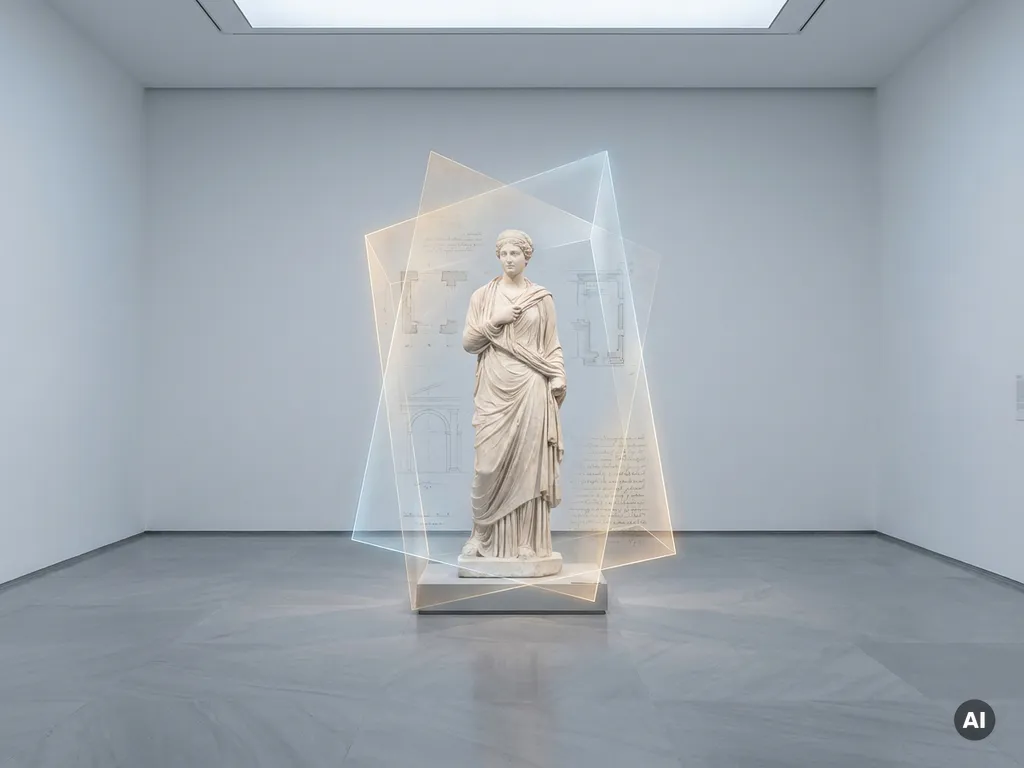
Museums can use augmented reality to layer digital content, animations, audio, 3D objects, historical reconstructions, and interactive narratives, directly onto physical exhibits, artworks, and architectural spaces. Visitors experience this through smartphones, tablets, or AR headsets, transforming static displays into living, responsive environments. The result is a richer, more personal encounter with cultural heritage that deepens understanding without displacing the original artifact.
AR in museums is not a single technology but a spectrum of experiences, from simple image-triggered animations to location-aware outdoor trails and AI-driven interactive characters. What unites them is a shared ambition: to make the invisible visible and the distant feel immediate. The questions below unpack the most important aspects of museum AR, from the types of experiences possible to the strategic choice of whether to build them in-house or with a specialist partner.
What types of AR experiences can museums create for visitors?
Museums can create a wide range of augmented reality experiences, including animated artwork overlays, historical scene reconstructions, interactive 3D object exploration, AR treasure hunts, virtual guides, and portal experiences that transport visitors to other times or places. The right format depends on the collection, the audience, and the story the museum wants to tell.
Some of the most compelling formats include:
- Art Alive overlays – physical artworks or artifacts are scanned by a device, triggering animations, contextual narratives, or alternative historical perspectives layered directly onto the object.
- AR Portals – visitors point a device at a designated wall or floor marker and step through a virtual doorway into a fully rendered historical environment, an archaeological site, or a distant landscape.
- Geospatial AR – content is pinned to precise GPS coordinates, enabling outdoor heritage trails or city-wide discovery routes without any QR codes or physical markers.
- AR Treasure Hunts – gamified discovery experiences that guide visitors through the museum using puzzles, clues, and digital rewards, particularly effective for younger audiences and school groups.
- AR Miniatures – scale models of historical buildings, excavation sites, or urban plans rendered in three dimensions and viewable from any angle through a handheld device.
- AI Avatars and virtual hosts – characters that hold real-time conversations with visitors, answering questions in character as a historical figure or as a knowledgeable guide.
Each format serves a different purpose. Portals and scene reconstructions are powerful for emotional immersion; treasure hunts and gamified trails drive dwell time and return visits; AI avatars personalize the experience at scale. The strongest museum AR programs often combine two or three of these formats across a single exhibition.
How does AR enhance traditional museum storytelling?
Augmented reality enhances museum storytelling by adding sensory and narrative depth to physical objects without removing them from their context. Where a label or audio guide describes, AR shows, reconstructing how a broken sculpture once looked, animating the journey of a historical figure, or revealing the invisible processes behind a scientific specimen.
Traditional museum communication is largely one-directional: the object sits behind glass, the label explains its significance, and the visitor is expected to bridge the imaginative gap. AR closes that gap. A medieval manuscript can unfurl its illuminated pages in three dimensions. A fossil can be animated to show the living creature it once was. A painting can reveal its underdrawing or show how the artist’s palette changed across decades.
Beyond visual enrichment, AR strengthens storytelling through perspective-shifting. Visitors can be placed inside a historical event, invited to see through the eyes of a person from another era, or confronted with the human consequences of abstract historical forces. This is where AR moves from novelty to genuine empathy-building, a quality that aligns closely with what cultural institutions exist to do.
Crucially, well-designed museum AR enhances rather than competes with the original artifact. The physical object remains the anchor; the digital layer is the interpreter. When this balance is maintained, visitors leave with a deeper relationship to the collection, not a memory of a screen.
What AR technology do museums need to get started?
To get started with AR, museums need three core components: a content delivery platform (an app or web-based AR system), compatible visitor devices (smartphones, tablets, or headsets), and the digital assets, 3D models, animations, audio, and narrative content, that populate the experience. The technical threshold is lower than most institutions expect.
The most accessible entry point is smartphone-based AR, which requires no dedicated hardware investment. Visitors use their own devices or museum-provided tablets to access experiences through a dedicated app or, increasingly, a browser-based AR system that requires no download at all. This dramatically reduces friction and broadens reach.
For more immersive installations, museums may consider:
- Shared tablet fleets – curated devices pre-loaded with the museum’s AR application, available for loan at the entrance.
- AR headsets – for guided group experiences or special exhibitions where hands-free interaction adds value.
- Next-generation mixed reality hardware – platforms like Apple Vision Pro enable real-time interaction between virtual content and the physical gallery environment, opening possibilities for future-facing installations.
On the content side, the most significant investment is in high-quality 3D modeling, animation, and narrative design. Photogrammetric scanning can create accurate digital twins of physical objects and spaces, providing the foundation for AR layers that feel genuinely connected to the real thing. Infrastructure requirements, reliable Wi-Fi across gallery spaces, clear wayfinding, and staff training, are equally important and often underestimated in early planning.
How can AR attract younger and more diverse audiences to museums?
AR attracts younger and more diverse audiences by meeting them in familiar interactive territory, the smartphone experience they already use daily, and using it to deliver cultural content in a format that feels participatory rather than passive. Gamification, personalization, and social shareability all play a role in making museums feel relevant to audiences who might otherwise disengage.
For younger visitors, the shift from observation to interaction is transformative. An AR treasure hunt turns a gallery visit into an adventure with agency and reward. An animated historical figure who responds to spoken questions creates a memorable encounter that a static exhibit cannot replicate. These formats also support different learning styles, benefiting visitors who process information better through doing and exploring than through reading.
For diverse audiences, AR offers something equally valuable: the ability to tell multiple stories about the same object. A colonial-era artefact can present the perspective of the colonized community alongside the collector’s narrative. A religious artwork can be contextualized for visitors of different faiths or none. Multilingual AR content removes language barriers without the cost of reprinting every label in a dozen languages.
AR also generates the kind of shareable, visually striking moments that travel through social media, extending the museum’s reach to audiences who discover it through a friend’s post rather than a traditional campaign. This organic visibility is increasingly important for cultural institutions working to grow their relevance beyond their existing visitor base. Our immersive projects demonstrate how this kind of audience expansion works in practice across cultural and educational settings.
What’s the difference between AR and VR for museum exhibitions?
The key difference between AR and VR for museum exhibitions is presence and context. AR adds digital layers to the real physical space the visitor is already standing in, keeping them connected to the actual collection. VR replaces the physical environment entirely, transporting visitors to a fully virtual world. Both have genuine value in museums, but they serve different storytelling purposes.
When AR is the stronger choice
AR works best when the physical object or space is itself the centerpiece of the experience. If a museum wants visitors to engage more deeply with an original painting, a historical building, or an archaeological site, AR enriches that encounter without pulling attention away from the real thing. It is also more accessible, requiring no headset, no dedicated physical space, and no concern about motion discomfort.
When VR is the stronger choice
VR excels when the museum needs to take visitors somewhere they cannot physically go, inside a burning city in 1666, beneath the ocean alongside a marine species, or through the interior of a structure that no longer exists. It creates a level of emotional immersion that AR cannot fully replicate, making it particularly powerful for empathy-driven storytelling around difficult historical events or distant realities.
Many leading cultural institutions now use both in complementary ways: AR throughout the gallery to enrich the physical collection, and a dedicated VR installation for a signature immersive experience that visitors specifically seek out. The choice is not either/or but a question of which tool serves which story best.
How do museums measure the impact of AR experiences?
Museums measure the impact of AR experiences through a combination of behavioral data, visitor feedback, and learning outcomes. The most commonly tracked metrics include session length (how long visitors engage with AR content), completion rates, return visit frequency, and qualitative feedback gathered through surveys or exit interviews. For educational programs, knowledge retention assessments provide a deeper measure of effectiveness.
Digital AR platforms generate data that physical exhibits cannot: every interaction, every point of drop-off, every content element that holds attention longest. This behavioral data allows museums to refine experiences iteratively, removing friction points, extending content that resonates, and tailoring narratives to different visitor segments.
Beyond engagement metrics, museums focused on social impact, awareness campaigns, community outreach, or behavior change around conservation or heritage, look at attitudinal shifts measured before and after the experience. Did visitors leave with a changed perspective? Did they take a specific action? These outcomes align closely with the mission-driven goals that distinguish cultural institutions from commercial entertainment venues.
The most meaningful impact measurement combines quantitative platform data with qualitative human insight. Numbers tell you what visitors did; conversations and surveys tell you why it mattered. Together, they build the evidence base that justifies continued investment in interactive museum exhibits and helps institutions make the case to funders and boards.
Should museums build AR in-house or work with a specialist studio?
Most museums benefit significantly from working with a specialist AR studio, particularly for their first major project. Building AR capability in-house requires sustained investment in technical talent, software licenses, 3D production pipelines, and ongoing platform maintenance, resources that most cultural institutions cannot justify for what may be a single exhibition or seasonal activation. A specialist partner brings all of this immediately, along with experience in what actually works for museum audiences.
That said, the decision is not binary. A useful framework for thinking through it:
- Scale and frequency of use – institutions planning multiple AR experiences per year across a large estate may eventually justify in-house capacity. A museum launching its first AR trail does not.
- Technical complexity – simple image-triggered overlays are within reach of digitally confident in-house teams using off-the-shelf platforms. Custom AI avatars, geospatial AR, or mixed reality installations require specialist expertise.
- Narrative and creative quality – the technical delivery of AR is only half the challenge. Crafting stories that genuinely deepen visitor engagement with a collection requires experience in both cultural storytelling and interactive design.
- Ongoing support and iteration – AR experiences need updating as exhibitions change, devices evolve, and visitor feedback is gathered. A studio partner provides continuity; in-house teams may lack the bandwidth.
The most effective approach for many institutions is a collaborative model: working closely with a specialist studio to co-create the experience, building internal understanding along the way, and retaining the creative and curatorial voice throughout. This is precisely how we work, from first concept through to final delivery, in close partnership with the institutions and teams who know their collections best.
If your institution is exploring how augmented reality could transform visitor engagement, deepen storytelling, or attract new audiences, we would welcome the conversation. Contact us to discuss what an AR experience could look like for your museum or cultural space.
Gerelateerde artikelen
- What equipment is needed for 360 projection mapping?
- Which questions should you ask an immersive agency?
- What are planetarium domes made of?
- What are VR examples?
- What are five applications of virtual reality?
- What are the statistics on the popularity of immersive experiences?
- How do you optimize spatial design for different audiences?
- What is an immersive installation?
- What are the benefits of immersive installations for brands?