
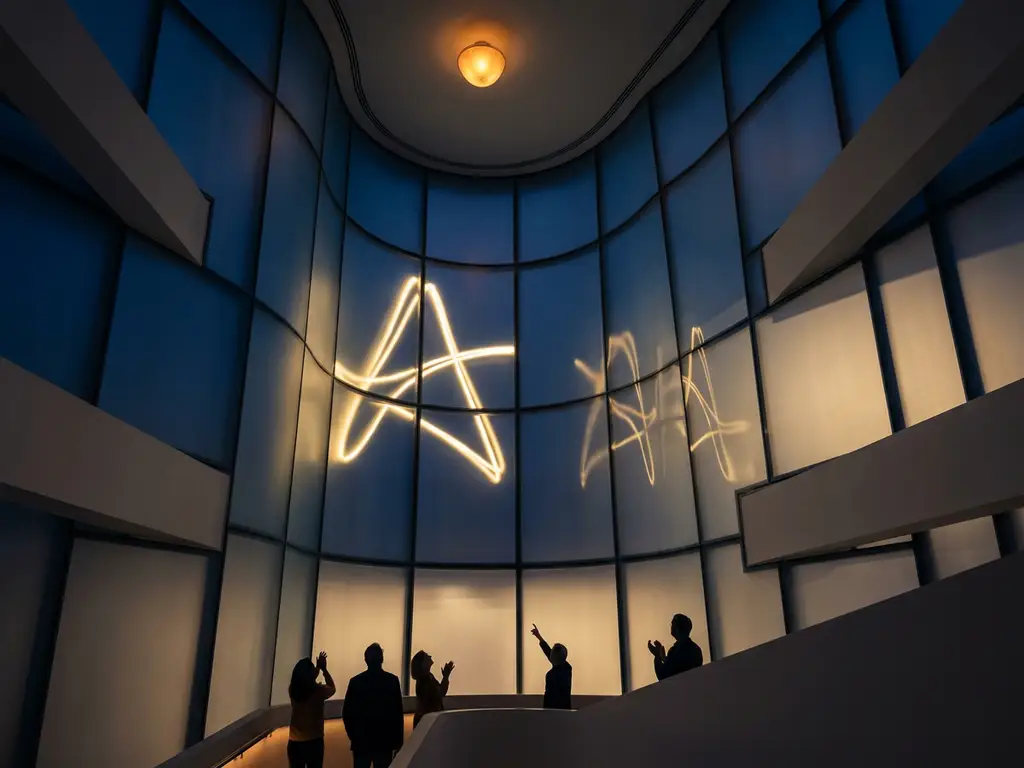
Immersive installations give brands a powerful advantage: they transform passive audiences into active participants, creating multi-sensory experiences that generate far stronger emotional recall than any screen-based campaign. Unlike a banner ad or a social post, a well-designed immersive installation places people physically inside a brand’s story, making the encounter personal, memorable, and shareable. The sections below unpack every key question brands ask before committing to this format.
How do immersive installations differ from traditional brand activations?
Traditional brand activations deliver a message to an audience. Immersive installations place the audience inside the message. Where a pop-up stand, a billboard, or even a branded event relies on passive reception, an immersive installation demands presence, movement, and sensory engagement, turning the visitor from spectator into protagonist. That shift in role is the defining difference.
In practical terms, traditional activations compete for divided attention. People scroll past them, glance at them, or half-listen while doing something else. An immersive installation removes that competition entirely by occupying physical space and engaging multiple senses simultaneously. There is no second screen. There is no background noise to tune out. The visitor is, for that window of time, fully present.
This distinction matters commercially. When a brand experience requires genuine participation, it creates a moment the visitor owns rather than merely observes. That sense of ownership is what drives word-of-mouth, repeat visits, and the kind of emotional association that advertising budgets alone cannot buy.
What measurable impact do immersive installations have on brand recall?
Immersive installations significantly outperform traditional media on brand recall because they engage the brain through multiple sensory channels at once. Research in cognitive science consistently shows that multi-sensory encoding strengthens memory formation. When a person sees, hears, and physically interacts with a brand environment, the experience is encoded more deeply and retrieved more easily than a single-channel message.
The mechanism behind this is well established. The brain’s memory systems respond to novelty, emotion, and physical engagement. An immersive installation triggers all three simultaneously, which is why visitors can describe a brand experience in vivid detail days or weeks after the fact, while struggling to recall a digital ad they saw that same morning.
Beyond anecdotal evidence, brands that invest in immersive formats consistently report stronger post-activation brand lift metrics, higher unaided recall scores, and longer dwell times compared to equivalent traditional activations. Dwell time matters because the longer someone spends genuinely engaged with a brand, the stronger the association formed. Immersive installations are specifically designed to extend that window of engagement.
Which industries benefit most from immersive brand installations?
Virtually every sector that relies on audience engagement can benefit from immersive installations, but the industries that see the most transformative impact are those where emotional connection, complex storytelling, or physical experience are central to the brand promise. Retail, automotive, luxury goods, entertainment, museums, and purpose-driven organizations consistently report the strongest returns.
Retail and consumer brands
Retail brands use immersive installations to turn product launches and flagship stores into destinations. Instead of displaying a product on a shelf, they create an environment that communicates the product’s world, its values, its lifestyle context. This approach is particularly effective for premium and luxury categories where perceived experience is inseparable from perceived value.
Cultural institutions and museums
Museums and cultural venues use immersive technology to bridge the gap between historical artefacts and contemporary audiences. Younger visitors who have grown up with interactive digital environments respond strongly to installations that invite them to explore rather than observe. Immersive layers added to existing collections can dramatically increase dwell time and return visit rates without compromising curatorial integrity.
NGOs and purpose-driven organizations
For organizations working on social impact, immersive installations are uniquely effective at building empathy. Placing a visitor inside a humanitarian crisis, an endangered ecosystem, or a historical injustice creates an emotional response that a two-minute explainer video cannot replicate. That emotional response is what drives donations, advocacy, and lasting behaviour change.
How do immersive installations drive social sharing and earned media?
Immersive installations generate social sharing because they create genuinely extraordinary moments that people want to document and share. The visual spectacle, the novelty of the technology, and the emotional resonance of the experience all combine to produce content that feels worth sharing. When visitors become content creators inside a brand environment, the brand’s reach extends far beyond the physical footprint of the installation.
This dynamic is sometimes called earned media, and it is one of the most commercially valuable outcomes of an immersive activation. Every photograph, video clip, or story posted by a visitor carries an implicit personal endorsement. It is not an advertisement; it is a recommendation. The authenticity of that recommendation makes it more persuasive than paid media at a fraction of the cost per impression.
Effective immersive installations are designed with this in mind. Specific moments, visual compositions, and interactive elements are crafted to be inherently photogenic and shareable. The result is a multiplier effect: the physical installation reaches the people in the room, while the social content it generates reaches their entire network.
What types of immersive technology are used in brand installations?
Brand installations draw on a broad range of immersive technologies, often combined within a single experience to maximise sensory depth and interactivity. The most commonly deployed technologies include augmented reality, virtual reality, mixed reality, large-scale projection, interactive screens, spatial audio, and AI-driven personalisation.
- Augmented Reality (AR): Overlays digital content onto the physical world via smartphone or headset. Used for product visualisation, interactive storytelling, and location-based activations.
- Virtual Reality (VR): Fully immerses the visitor in a digital environment. Ideal for brand narratives that require complete transportation to another world, time period, or perspective.
- Mixed Reality (MR): Blends physical and digital elements in real time, allowing virtual objects to interact with the real environment. Next-generation hardware like Apple Vision Pro is expanding what is possible in this space.
- 360-degree projection domes: Wrap the visitor in panoramic imagery and spatial audio, creating a collective immersive experience for groups of any size.
- 4D sensory environments: Add physical sensations such as scent, temperature, vibration, and haptic feedback to visual and audio content, engaging the full sensory spectrum.
- AI avatars and interactive characters: Real-time conversational AI characters that respond to visitor input, creating personalized brand interactions at scale.
- Anamorphic and holographic displays: Large-format 3D illusions for outdoor and event environments that stop audiences in their tracks.
The technology chosen for any given installation depends on the brand’s objectives, the target audience, the physical space available, and the story being told. The most effective installations do not use technology for its own sake; they select the tools that best serve the narrative and the emotional outcome they are designed to create.
How much does a branded immersive installation typically cost?
The cost of a branded immersive installation varies considerably and is shaped by a combination of creative, technical, and logistical factors rather than a fixed price point. Understanding what drives investment levels helps brands make informed decisions about scope and priorities before entering a production process.
The primary cost drivers include:
- Scale and physical footprint: A single-room experience for fifty visitors per day has very different infrastructure requirements than a touring installation designed for thousands of visitors across multiple venues.
- Technology complexity: A smartphone-based AR activation sits at a different investment level than a fully custom VR environment built in Unreal Engine with real-time AI personalisation.
- Content production depth: The volume and quality of original content, including 3D modelling, volumetric video, spatial audio design, and narrative development, is a significant component of overall investment.
- Duration and deployment: A one-day event activation and a permanent museum installation require fundamentally different approaches to durability, maintenance, and support.
- Degree of interactivity: Passive experiences such as cinematic VR require less ongoing technical infrastructure than fully interactive environments with real-time data processing and AI-driven personalisation.
- Customisation versus modular build: Fully bespoke experiences built from the ground up carry higher investment than experiences built on existing modular frameworks adapted to a brand’s specific requirements.
The most productive starting point is a clear articulation of the experience’s objectives and desired outcomes, which allows a production partner to recommend the appropriate technology mix and scope for the available budget.
When should a brand choose an immersive installation over a digital campaign?
A brand should choose an immersive installation over a digital campaign when the goal is depth of connection rather than breadth of reach. Digital campaigns are highly effective at generating awareness and driving traffic at scale. Immersive installations are the right tool when a brand needs to shift perception, build emotional loyalty, demonstrate a complex product or value proposition, or create a cultural moment that earns media attention.
Specific situations where immersive installations consistently outperform digital campaigns include product launches where the physical experience of the product is central to its appeal, campaigns addressing complex or sensitive topics that require empathy rather than information, brand repositioning moments where a single powerful encounter can reframe audience perception, and events or exhibitions where the brand needs to stand out in a competitive physical environment.
The two approaches are not mutually exclusive. The most effective brand strategies use immersive installations to create the emotional core of a campaign and digital channels to amplify the content those installations generate. The installation produces the story; digital media carries it to a wider audience. Together, they deliver both depth and reach.
If your brand is ready to move beyond passive advertising and create an experience that genuinely resonates, we would welcome the conversation. Contact us to explore what an immersive installation could look like for your next activation.
Gerelateerde artikelen
- How to make museums more interactive?
- How to make an interactive exhibit?
- What are the benefits of multisensory learning?
- What are the 4 types of memory in the brain?
- What are the types of immersive experience?
- What is the difference between interactive and immersive theatre?
- How do you optimize spatial design for different audiences?
- Is 3D modeling a good career choice?
- How do dome installations create immersive experiences?