
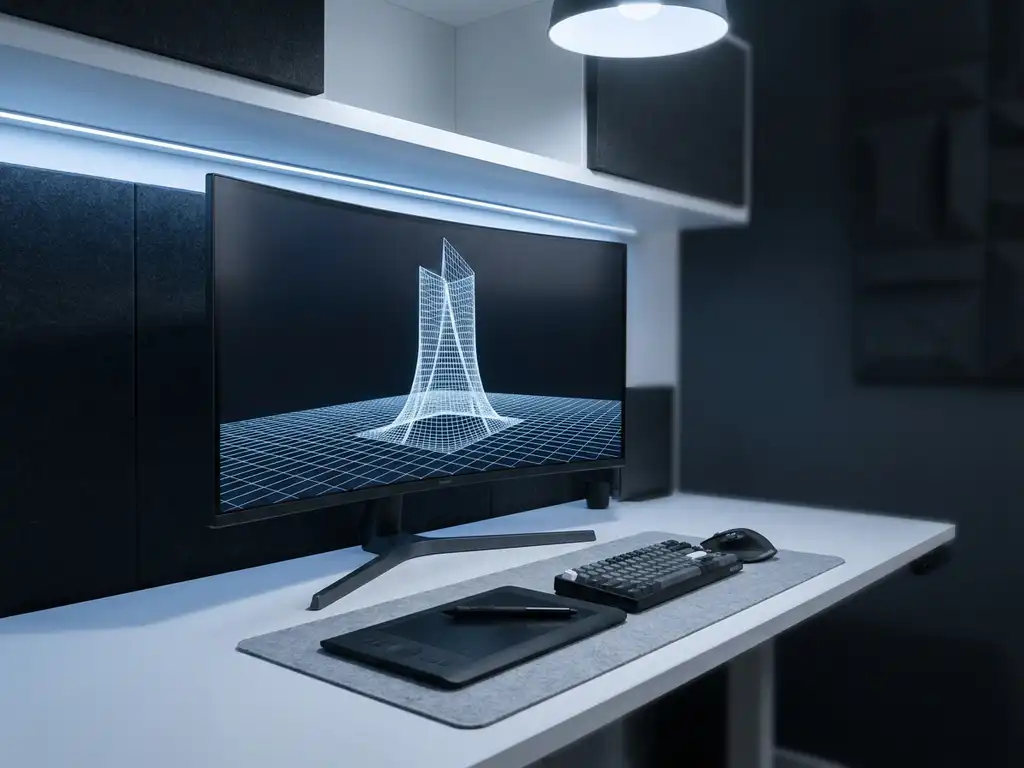
Yes, 3D modeling is a strong career choice in 2026, particularly for those willing to develop a broad, adaptable skill set. Demand spans entertainment, architecture, manufacturing, healthcare, and the rapidly expanding immersive experience sector. The field rewards creative and technical thinkers alike, and the rise of spatial computing, AR, and VR has opened entirely new professional pathways that did not exist a decade ago. The questions below unpack everything from earning potential to the impact of AI on the profession.
What industries actually hire 3D modelers?
3D modelers are hired across a surprisingly wide range of industries. The most consistent demand comes from gaming, film and animation, architecture, product design, manufacturing, healthcare, and the immersive experience sector. Each industry uses 3D modeling differently, which means a modeler who understands multiple application contexts has a significant competitive advantage over someone who specializes narrowly from the start.
In gaming and film, 3D modelers build characters, environments, props, and visual effects assets. These are the roles most people picture when they think about the profession, and they remain among the most competitive. Architecture and real estate firms use 3D modeling to produce photorealistic visualizations, virtual walkthroughs, and digital twins of buildings before construction begins. Product designers and manufacturers rely on precise 3D models for prototyping, engineering review, and virtual assembly.
Healthcare is a growing but often overlooked employer of 3D talent. Medical visualization, surgical simulation, and patient education all draw on high-quality 3D assets. Meanwhile, the immersive experience sector, which includes AR activations, VR training environments, and interactive installations for museums and brands, is one of the fastest-growing areas of demand in 2026. Studios that create immersive experiences need modelers who understand real-time rendering pipelines, spatial constraints, and how digital objects behave inside physical environments.
How much do 3D modelers earn at different career stages?
3D modeler salaries vary considerably depending on career stage, industry, location, and specialization. Entry-level roles typically offer modest but livable wages, mid-level professionals with a strong portfolio command meaningfully higher compensation, and senior specialists or technical directors can earn salaries comparable to other senior creative and technical roles in the technology sector.
At the entry level, a 3D modeler working in a studio environment generally earns enough to build a career foundation, though the range shifts significantly depending on whether the employer is a small independent studio or a large game publisher or film studio. The gap between junior and senior compensation in this field is substantial, which reflects how much specialized knowledge, software fluency, and portfolio quality matter to employers.
Freelance modelers often earn above the standard employed rate once they have established a client base, but income is less predictable. Specialization also drives earnings upward: a generalist modeler earns less than someone who has mastered real-time optimization for VR, photogrammetric scanning, or hyperrealistic character work. Location matters too, with studios in major production hubs in Europe and North America typically offering higher rates than smaller regional markets.
What skills do employers look for in a 3D modeling professional?
Employers look for a combination of technical software proficiency, artistic judgment, and the ability to work within production pipelines. The most in-demand 3D modeling professionals in 2026 are those who can produce clean, optimized geometry, communicate clearly with creative directors, and adapt their workflow to the specific constraints of the platform they are building for, whether that is a game engine, a film render farm, or a real-time AR environment.
Technical and software skills
Proficiency in industry-standard software is non-negotiable. Depending on the target industry, employers expect familiarity with tools like Blender, Maya, 3ds Max, ZBrush, Cinema 4D, or Houdini. For real-time applications, knowledge of Unreal Engine or Unity is increasingly expected alongside modeling skills. Texturing, UV unwrapping, rigging, and understanding of physically based rendering (PBR) workflows are also commonly required. The ability to optimize models for polygon count and performance, particularly for AR and VR applications, is a skill that sets candidates apart.
Soft skills and production awareness
Beyond software, employers consistently value modelers who understand the broader production context. This means reading briefs accurately, meeting deadlines, accepting feedback constructively, and communicating clearly about technical constraints. The ability to collaborate across disciplines, working alongside animators, developers, lighting artists, and creative directors, is essential in studio environments. An understanding of storytelling and spatial design also matters more than many entry-level candidates expect, particularly in immersive and experiential contexts where the model must serve a narrative purpose, not just a technical one.
How long does it take to become job-ready as a 3D modeler?
Most aspiring 3D modelers become job-ready within one to three years of focused, consistent practice. The timeline depends heavily on the depth of prior creative or technical experience, the quality of learning resources used, and how actively the person builds and refines a portfolio. Formal education can accelerate the process but is not a requirement for employment in most sectors.
Many working professionals in the field are self-taught or have completed short courses and boot camps rather than full degrees. What employers evaluate is portfolio quality, not credentials. A strong portfolio demonstrating mastery of topology, texturing, and relevant software will open more doors than a degree without compelling work to show. That said, structured programs at art schools or universities can provide valuable mentorship, peer feedback, and industry connections that accelerate development.
For those targeting specialized areas like real-time environments for VR or photorealistic animation, additional time is needed to develop the specific technical depth those pipelines require. The most pragmatic approach is to pick a target industry early, study the tools and workflows that sector uses, and build portfolio pieces that directly reflect the kind of work that studio or employer would produce.
Is freelancing or full-time employment better for 3D modelers?
Neither path is universally better. Full-time employment offers stability, consistent mentorship, and access to high-end production pipelines, while freelancing offers flexibility, higher potential earnings, and the ability to work across multiple industries. The right choice depends on career stage, risk tolerance, and whether the modeler has already built a strong enough portfolio and network to attract consistent freelance clients.
Early in a career, full-time employment at a studio is generally more beneficial. It provides structured feedback, exposure to professional pipelines, and the kind of collaborative experience that is difficult to replicate working alone. Many experienced freelancers spent their early years in-house for exactly this reason. The studio environment accelerates development in ways that independent work rarely can at the junior level.
Experienced modelers often find freelancing more rewarding once they have the portfolio, client relationships, and discipline to manage their own workflow. The immersive experience and experiential marketing sectors in particular offer strong freelance opportunities, as studios frequently bring in specialist contractors for project-based work. The key risk of freelancing is income variability, which requires financial planning and proactive business development alongside the creative work.
How is AI changing the 3D modeling job market?
AI is reshaping the 3D modeling job market by automating repetitive and lower-complexity tasks while simultaneously raising the baseline quality expected of human modelers. Tools that can generate basic geometry, textures, or environment layouts from text or image prompts are increasingly capable, but they do not replace the judgment, artistic direction, and technical optimization that skilled modelers provide. The net effect is that the profession is evolving rather than disappearing.
AI-assisted tools are already being used in production pipelines to speed up asset generation, retopology, and texture synthesis. This means junior modelers who relied on volume-based work for entry-level roles may face more competition, while those who develop strong art direction skills, technical specialization, and the ability to guide and refine AI-generated assets are finding new value in the market. The modeler who understands how to use AI tools as part of a workflow, rather than viewing them as a threat, is better positioned than one who ignores them.
In the immersive experience sector specifically, AI is enabling new forms of personalization and real-time content adaptation. Studios building interactive environments can now use AI to adjust assets dynamically based on user behavior or context. This creates demand for modelers who understand not just static asset creation but how 3D content behaves within intelligent, responsive systems. The skills that future-proof a 3D modeling career are those that sit at the intersection of craft and systems thinking.
What career paths can a 3D modeler grow into?
A 3D modeler can grow into a wide range of senior and specialized roles, including technical director, art director, VFX supervisor, environment lead, character artist, real-time pipeline specialist, and immersive experience designer. The career path is not linear, and the most successful professionals tend to develop a deep specialization alongside a broad enough understanding of adjacent disciplines to lead teams or projects.
Within studios and production companies, modelers typically progress from junior to mid-level to senior artist, then into lead or supervisory roles. From there, the path can move toward art direction, where the focus shifts from execution to vision and team guidance, or toward technical direction, where the emphasis is on pipeline development, tool creation, and solving complex production challenges.
Outside traditional studios, experienced 3D modelers increasingly move into roles in spatial design, immersive installation, and XR production. These environments reward professionals who can think about 3D assets not just as visual objects but as components of a larger sensory and narrative experience. We work with modelers and creative technologists who bring exactly this kind of thinking to projects, helping brands, educational institutions, and cultural organizations create experiences that go far beyond the screen.
The career ceiling in 3D modeling is genuinely high for those who invest in continuous learning and stay attuned to where the technology is heading. As spatial computing matures and immersive experiences become a standard tool in education, marketing, and culture, the professionals who understand how to build the visual and spatial worlds those experiences require will be among the most sought-after creative technologists in the industry. If you are considering how immersive technology could play a role in your own projects or organization, we welcome you to contact us and explore what is possible together.
Gerelateerde artikelen
- What is digital cultural heritage?
- Can installation art be interactive?
- What is an example of immersive experience?
- What are the benefits of integrating immersive technologies with STEM education?
- How did Gen Z break the marketing funnel?
- How to design an immersive experience?
- Is VR an immersive experience?
- What is an example of an immersive experience?
- What are the principles of good spatial design?