
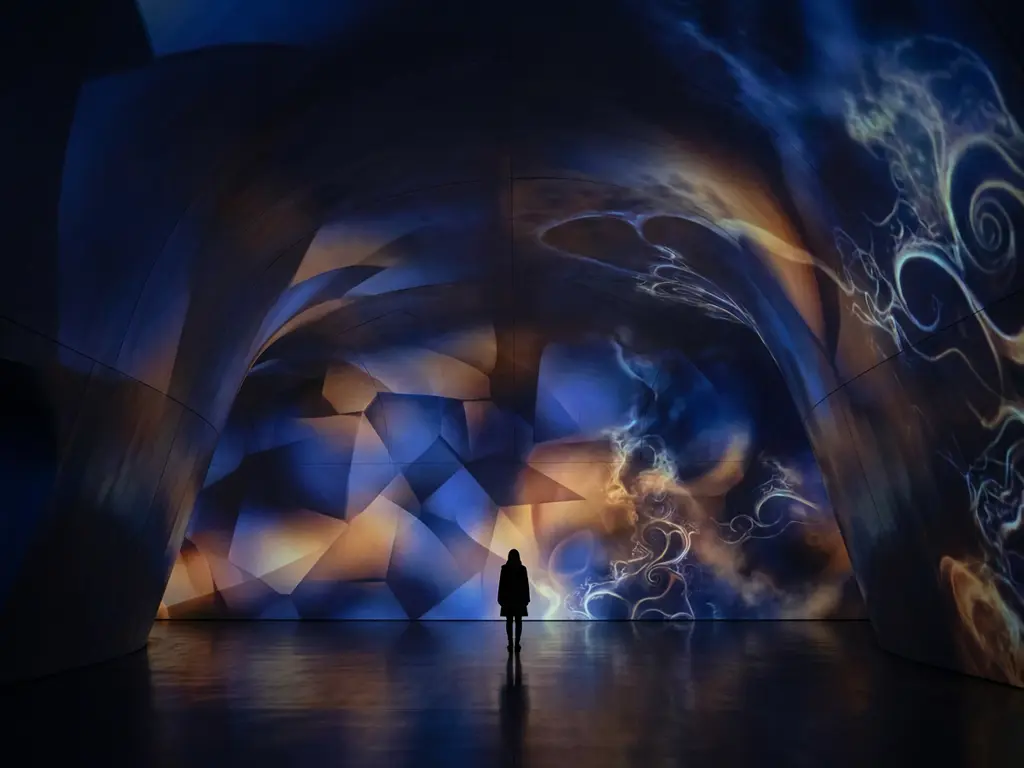
An immersive installation is a purpose-built physical environment that surrounds visitors with sensory stimuli, light, sound, scent, touch, and spatial design, to create the feeling of being fully inside an experience rather than observing it from the outside. Unlike a painting on a wall or a video on a screen, an immersive installation activates the entire space and the visitor’s whole body within it. The questions below unpack exactly how these environments work, who builds them, and why they have become one of the most powerful tools in education, culture, and brand communication.
What makes an installation ‘immersive’?
An installation becomes immersive when it surrounds the visitor on multiple sensory levels simultaneously, removing the psychological distance between observer and experience. The defining quality is envelopment: the visitor is no longer standing in front of content but inside it. This shift from passive viewing to active presence is what separates an immersive installation from a conventional exhibit or display.
Several design principles work together to produce that feeling of total presence. Spatial scale plays a central role: when visuals, sound, or physical elements extend beyond the natural field of view, the brain begins to accept the environment as real. Multisensory layering reinforces this effect: combining projected imagery with spatial audio, temperature shifts, scent, or tactile surfaces engages more of the nervous system and makes the experience far harder to dismiss as artificial.
Interactivity deepens immersion further. When a visitor’s movement, voice, or touch changes what happens in the space, they become an active participant rather than a spectator. This sense of agency is a key driver of emotional engagement and long-term memory formation. Finally, narrative coherence holds everything together: the most technically sophisticated installation will feel hollow without a story or concept that gives the sensory elements meaning. Immersive design is, at its core, environmental storytelling.
What types of immersive installations exist?
Immersive installations span a wide spectrum of formats, from large-scale projection environments to intimate sensory rooms. The type chosen depends on the intended audience, the story being told, the physical space available, and the desired level of interactivity.
Projection-based environments
360-degree projection domes and mapped room installations are among the most visually dramatic formats. These fill every surface, floor, walls, and ceiling, with synchronized imagery, creating the sensation of being transported to another world entirely. They scale well for large audiences and work powerfully in museum halls, event pavilions, and public spaces.
4D and multisensory cinemas
4D cinema formats add physical sensation to audiovisual content: scent diffusers, directional sound, wind, vibration, and temperature changes synchronize with what is happening on screen or around the visitor. The result is a full-body experience that goes far beyond what any screen alone can deliver. We use this format to create the kind of visceral empathy that no documentary or lecture can replicate.
Interactive sensor-driven spaces
These installations respond in real time to visitor behavior. Motion sensors, pressure pads, cameras, and microphones feed data into generative systems that alter visuals, sound, or physical elements based on how people move through the space. Every visit becomes unique, which dramatically increases replayability and word-of-mouth engagement.
AR and mixed reality installations
Augmented reality layers digital content directly onto physical objects or architectural surfaces, visible through smartphones, tablets, or headsets. Mixed reality goes further, allowing virtual and physical elements to interact in real time. These formats are particularly powerful for heritage institutions that want to enrich existing artifacts without physically altering them.
How does an immersive installation actually work?
At a technical level, an immersive installation works by combining hardware systems, projectors, speakers, sensors, computers, and physical set elements, with software that orchestrates all of those components in real time. A central media server or control system acts as the conductor, synchronizing every element so that light, sound, and interaction respond to each other and to visitor behavior as a unified whole.
The production process begins long before any hardware is installed. Concept development defines the story, the emotional arc, and the sensory vocabulary of the experience. 3D spatial design maps how content will wrap around the physical environment, accounting for projection angles, acoustic behavior, and visitor flow. Content production then creates all the visual, audio, and interactive assets that will populate the space.
Technical integration follows: hardware is rigged, calibrated, and tested against the content. This phase often involves edge-blending multiple projectors so their outputs merge seamlessly, tuning speaker arrays for spatial audio accuracy, and programming sensor thresholds so interactive triggers feel intuitive rather than accidental. Final testing with real visitors before opening is essential: human behavior in a space almost always reveals refinements that no amount of technical rehearsal can fully anticipate.
What’s the difference between an immersive installation and a VR experience?
The core difference is physical presence versus personal device. A VR experience places one person inside a digital world through a headset, isolating them from their physical surroundings and from other people. An immersive installation transforms a shared physical space so that groups of people experience it together, without headsets, in a real environment they can walk through, touch, and inhabit collectively.
This distinction has significant practical and emotional consequences. VR delivers an intensely personal and controllable experience: the viewer sees exactly what the creator intends, with no environmental variables. Immersive installations, by contrast, are inherently social. Visitors move through them together, react to each other, and co-create the atmosphere. That shared quality produces a different kind of emotional resonance, one that tends to generate conversation, community, and collective memory.
Neither format is universally superior. VR is often the right choice when deep individual empathy or precise narrative control is the goal, simulating a medical procedure, for instance, or placing a single user inside a refugee’s journey. An immersive installation is often the right choice when the goal is to move large numbers of people through an experience efficiently, to create a social event, or to transform a physical venue into something extraordinary. Many of the most powerful projects combine both: an installation that incorporates VR stations as one of several sensory zones.
Where are immersive installations used?
Immersive installations are used wherever an organization needs to move people emotionally, communicate complex ideas at scale, or create an environment that people choose to enter and remember long after they leave. The format has proven effective across a remarkably wide range of contexts.
- Museums and cultural institutions use them to bring collections to life, attract younger audiences, and create blockbuster temporary exhibitions that drive ticket sales and press coverage.
- Educational institutions and NGOs deploy them to make abstract or difficult subjects, climate change, historical trauma, social inequality, tangible and emotionally accessible in ways that lectures and textbooks cannot match.
- Brands and marketing teams use immersive installations at product launches, trade shows, and flagship retail environments to create experiences people actively seek out and share on social media.
- Public sector and government bodies use them for civic engagement campaigns, public health initiatives, and awareness programs where behavior change is the measurable goal.
- Event and entertainment producers integrate them into festivals, concerts, and live experiences to create signature moments that define an event’s identity.
What unites all of these applications is a shared recognition that passive communication, a poster, a brochure, a website banner, no longer cuts through in an environment saturated with content. Immersive installations demand presence and reward attention.
How long does it take to build an immersive installation?
Building an immersive installation typically takes between three and twelve months from initial brief to opening day, depending on scale, technical complexity, and the amount of original content that needs to be created. A compact, single-room experience with existing content assets can be delivered in a shorter timeframe; a large-scale, custom-built environment with original film, interactive systems, and bespoke hardware requires considerably more time.
The timeline breaks into several distinct phases. Concept and strategy development, defining the story, the sensory approach, and the technical architecture, usually takes four to eight weeks. Content production, which includes filming, animation, 3D modelling, sound design, and software development, is typically the longest phase and runs in parallel with hardware procurement and spatial design. Technical installation and calibration on-site can take anywhere from a few days to several weeks depending on the complexity of the rig. Testing and refinement with real users precede any public opening.
The most common cause of timeline overruns is underestimating the content production phase. Immersive environments consume far more visual and audio content than a conventional screen-based presentation: a 360-degree projection dome, for example, requires imagery that covers every surface simultaneously, which multiplies production effort significantly compared to a flat-screen format.
How do you measure the impact of an immersive installation?
The impact of an immersive installation is measured through a combination of behavioral data, self-reported audience responses, and downstream outcomes that connect the experience to the organization’s broader goals. There is no single universal metric: the right measurement framework depends entirely on what the installation was designed to achieve.
Engagement and behavioral metrics
Time spent inside the installation, visitor flow patterns, interaction rates with specific elements, and return visit rates all provide quantitative evidence of engagement depth. These metrics are captured through sensor data, ticketing systems, and on-site observation. High dwell time and strong interaction rates indicate that the experience is holding attention, a foundational requirement for any deeper impact.
Attitudinal and knowledge outcomes
For educational and awareness-focused installations, pre- and post-experience surveys measure shifts in knowledge, attitude, or stated behavioral intention. This approach is standard practice in museum evaluation and NGO impact reporting. The strength of immersive formats on these measures is well documented in learning science: multisensory experiences that engage emotion alongside cognition produce significantly stronger and more durable memory encoding than passive information delivery.
Social and commercial amplification
For brand and event applications, social media reach, earned media coverage, and direct attribution to commercial outcomes, footfall, sign-ups, sales, provide the metrics that marketing teams need to justify investment. Immersive installations consistently generate organic social sharing because they create genuinely novel visual moments that visitors want to document and distribute.
If you are considering an immersive installation for your institution, campaign, or event and want to understand what is achievable within your context and timeline, we welcome the conversation: contact us to explore what we can build together.
Gerelateerde artikelen
- Does projection mapping require a custom animation?
- What is XR technology?
- What are interactive Experiences?
- Why do people like immersive experiences?
- What are the different types of interactive museums?
- How much does extended reality cost?
- How do I create an immersive experience?
- How to create immersive content?
- What makes a successful branded immersive experience?