
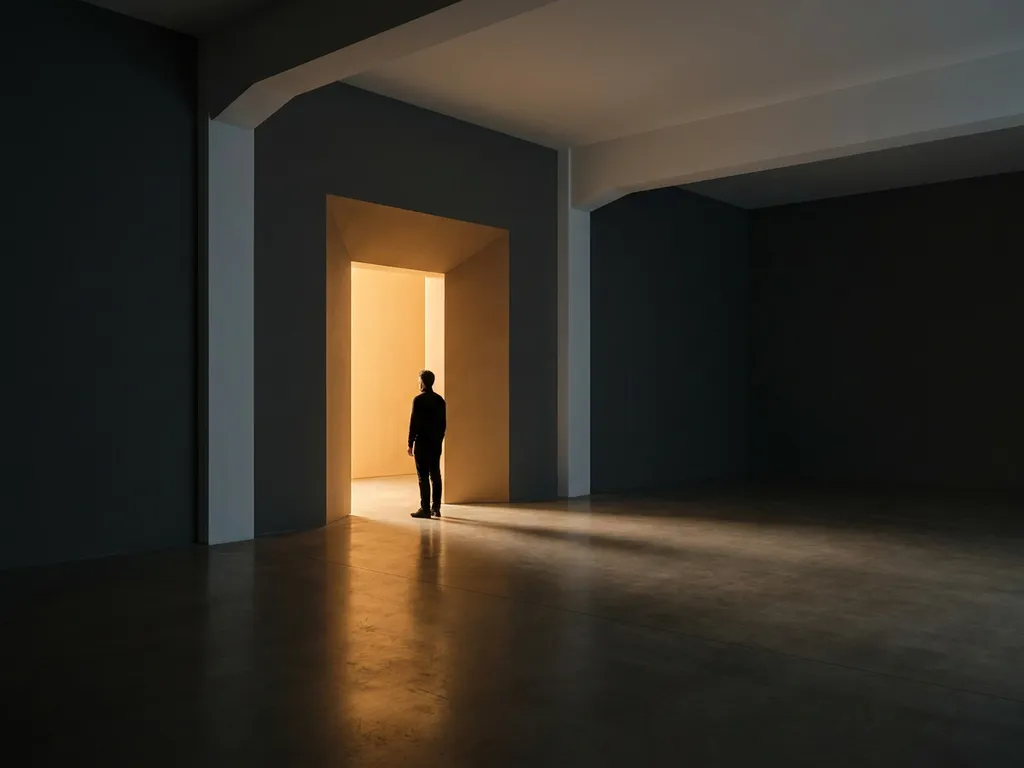
Experimental immersive design is an approach to experience creation that surrounds people completely, physically, sensorially, and emotionally, pulling them out of passive observation and into active participation. Unlike conventional design disciplines that work within a frame (a screen, a page, a stage), experimental immersive design dissolves that frame entirely, making the visitor part of the environment itself. The questions below unpack how it works, what powers it, and when it creates the most meaningful impact.
How is experimental immersive design different from traditional experience design?
Traditional experience design shapes how someone moves through a space or interface, guiding attention and managing flow. Experimental immersive design goes further: it removes the boundary between observer and experience, so the person is no longer watching something happen but is instead inside it. The key distinction is agency and embodiment, immersive design demands physical presence and sensory involvement, not just visual attention.
In traditional design, a visitor reads a museum panel, watches a screen, or follows a guided path. The experience exists at arm’s length. Immersive design collapses that distance. Sound wraps around you. Scent drifts through the air. Light responds to your movement. The environment itself becomes the medium, and your body becomes the interface.
The word “experimental” adds another layer. It signals that the design is not following a proven template but actively testing new combinations of technology, space, and storytelling. Experimental immersive design treats each project as a prototype of what engagement can become, pushing beyond what audiences expect from a cultural, educational, or brand encounter.
This is also where the difference between immersive and interactive becomes important. An interactive experience responds to input, you press a button, something changes. An immersive experience surrounds and involves you regardless of whether you act. The most powerful experimental immersive environments are both: they respond to you while simultaneously enveloping you in a world that feels complete and real.
What are the core elements of an immersive design experience?
The core elements of an immersive design experience are spatial environment, multisensory stimulation, narrative structure, and responsive interactivity. Together, these four components create the conditions for full psychological and physical absorption, the state researchers sometimes call “presence,” where a person genuinely feels they are somewhere other than where their body stands.
Spatial environment
The physical or digital space is not a backdrop, it is the primary material. Immersive designers work with scale, architecture, light, and movement pathways to make the environment feel intentional at every angle. Whether it is a 360-degree dome, a transformed warehouse, or a virtual world rendered in a headset, the space must hold up from every direction because there is no “wrong way” to look.
Multisensory stimulation
Vision and sound are the baseline. Truly immersive experiences layer in tactile feedback, temperature, scent, and spatial audio that shifts as you move. Each additional sense deepens the feeling of being present in the experience. Research in cognitive science consistently shows that memory formation strengthens when multiple sensory channels are engaged simultaneously, which is why multisensory design is not an aesthetic choice but a strategic one.
Narrative structure
Even the most technologically sophisticated environment fails without a story that gives meaning to what people encounter. Narrative structure in immersive design is non-linear, it unfolds differently depending on where a visitor goes and what they choose to engage with. The story must be coherent enough to feel intentional but open enough to feel personal.
Responsive interactivity
When an environment responds to a visitor’s presence, choices, or movement, it signals that they matter to the experience. This responsiveness is what transforms a walk-through into a genuine encounter. It can be as subtle as sound that shifts when you enter a new zone, or as complex as an AI-driven character that holds a real-time conversation with each individual visitor.
What technologies power experimental immersive environments?
Experimental immersive environments are powered by a combination of extended reality technologies (AR, VR, and mixed reality), spatial audio systems, projection mapping, real-time rendering engines, and increasingly, artificial intelligence. No single technology defines an immersive experience, the power comes from how these tools are combined and orchestrated to serve the story and the space.
Extended reality (XR) is the umbrella term for augmented reality (AR), virtual reality (VR), and mixed reality (MR). AR overlays digital content onto the physical world, visible through a smartphone or headset. VR replaces the physical world entirely with a rendered environment. Mixed reality, exemplified by platforms like Apple Vision Pro, blends digital and physical elements in real time so virtual objects appear to exist and interact within the actual room. Spatial computing, the broader category that MR belongs to, is rapidly becoming the defining technology of next-generation immersive design.
360-degree experiences use cameras or rendering engines to capture or create environments that surround the viewer completely. These can be delivered through headsets, dome projections, or even large-format screens arranged to envelop an audience. The result is a visual field with no edges, which is fundamentally different from how humans normally consume media.
Real-time rendering engines like Unreal Engine and Unity allow designers to build environments that respond dynamically, changing lighting, triggering events, or adapting content based on visitor behavior. This is what makes interactive and personalized immersive experiences technically possible at scale.
Artificial intelligence is the newest and most transformative layer. AI enables experiences to adapt in real time to the individual, adjusting language, pacing, difficulty, or narrative path based on how a person engages. AI avatars and non-player characters (NPCs) can hold genuine conversations, answer questions, and guide visitors through complex content in ways that feel personal rather than scripted.
How does immersive design create emotional and behavioral impact?
Immersive design creates emotional and behavioral impact by triggering genuine presence, the psychological state of feeling physically located in an experience rather than observing it from outside. When the brain registers an environment as real, it processes the encounter emotionally rather than intellectually, which is why immersive experiences are remembered far longer and more vividly than information delivered through conventional media.
This connects directly to what cognitive scientists call the forgetting curve, the well-documented pattern by which people lose most passively received information within days. Experiences that engage the body, trigger emotion, and require active participation interrupt this pattern. When learning or messaging is delivered through immersive means, retention improves significantly because the brain encodes the experience as an event rather than a piece of data.
Multisensory environments amplify this effect. When smell, sound, touch, and sight all align to support a single narrative moment, the brain receives consistent signals across multiple channels simultaneously. This convergence creates stronger memory traces and a deeper sense of meaning. It is why a scent can transport you back to a childhood memory more powerfully than a photograph, the sensory channel bypasses analytical processing and goes directly to emotional memory.
For behavioral impact, the mechanism is empathy. Immersive experiences that place a person inside someone else’s perspective, physically inhabiting their environment, hearing their voice, seeing through their eyes, generate genuine empathetic responses that abstract information cannot. This is why organizations working on social awareness, behavior change, or complex ethical issues increasingly turn to immersive design: it does not just inform people, it changes how they feel about what they know.
What industries use experimental immersive design?
Experimental immersive design is used across a wide range of industries, with the strongest adoption in cultural institutions, education, brand marketing, public sector communication, and entertainment. What these sectors share is a need to create genuine engagement with audiences who are increasingly resistant to passive, screen-based content.
- Museums and cultural institutions use immersive design to add digital layers to physical collections, attract younger audiences, and create exhibitions that resonate emotionally rather than just informationally. AR portals, VR art experiences, and interactive 360-degree domes allow heritage organizations to tell richer stories without compromising the integrity of their collections.
- Education and training organizations use VR simulations, AR learning tools, and interactive environments to teach complex or emotionally sensitive subjects in ways that are safe, repeatable, and deeply memorable. Medical training, social awareness programs, and vocational education are particularly strong use cases.
- Brand and marketing teams use immersive activations at product launches, trade shows, and live events to create the kind of memorable encounters that generate organic sharing and lasting brand association. In a saturated media landscape, a physical experience that surprises and moves people is genuinely differentiated.
- NGOs and government bodies use immersive storytelling to communicate complex social issues, build public empathy, and drive behavioral change. When the goal is shifting how people feel about a cause, immersive design is among the most effective tools available.
- Entertainment and media producers use immersive formats to extend intellectual property beyond linear screens, creating participatory worlds that deepen audience connection and open new revenue streams.
How long does it take to design and build an immersive experience?
The time required to design and build an immersive experience typically ranges from six weeks for a focused activation to twelve months or more for a large-scale permanent installation. The timeline depends on the complexity of the environment, the number of technologies involved, the degree of custom content creation required, and how much co-creation happens with the client during the process.
Simpler immersive experiences, such as an AR activation for a product launch or a branded VR film, can move quickly through concept, production, and delivery. These projects benefit from established pipelines and modular components that can be adapted rather than built from scratch. For organizations with tight campaign timelines, this kind of experience can be both impactful and achievable within a standard marketing cycle.
More complex projects, a multi-room immersive installation for a museum, a custom VR training program with AI-driven branching, or a location-based experience designed for thousands of visitors, require longer development cycles. Spatial design, hardware integration, content production, testing, and iteration all take time when the goal is an experience that holds up under real-world conditions and diverse audiences.
The factors that most significantly affect timeline are the level of interactivity required, the number of sensory layers being designed, whether custom hardware needs to be sourced or fabricated, and the complexity of the narrative structure. Working with a studio that handles concept, production, and delivery under one roof, as we do, substantially reduces the coordination overhead that can extend timelines on complex projects.
When should an organization choose immersive design over conventional media?
An organization should choose immersive design over conventional media when the goal is not just to inform but to genuinely change how an audience feels, remembers, or behaves. If the message is complex, emotionally significant, or needs to stand out in a saturated environment, immersive design consistently outperforms passive formats in engagement depth and long-term impact.
Conventional media excels at reach and frequency, broadcasting a message to many people quickly and cost-effectively. But reach without resonance rarely drives the outcomes that matter most: changed attitudes, remembered brands, learned skills, or inspired action. When those outcomes are the measure of success, immersive design is not a premium option but a strategic necessity.
Specific situations where immersive design delivers superior results include:
- Teaching difficult or abstract subjects where learners struggle to connect theory to reality, simulated environments make the abstract tangible.
- Building empathy for unfamiliar perspectives, when an audience needs to genuinely understand an experience they have never lived, immersive design creates that bridge in ways that text and video cannot.
- Creating memorable brand encounters at moments when distinction matters most, such as product launches, flagship events, or competitive trade environments.
- Driving behavioral change on social, health, or environmental issues where awareness alone is insufficient and emotional engagement is required to move people to act.
- Attracting new audiences to cultural or educational institutions that need to remain relevant to younger, more digitally fluent demographics.
The decision ultimately comes down to what success looks like. If the metric is impressions, conventional media may be sufficient. If the metric is impact, real understanding, genuine emotional connection, lasting behavioral change, immersive design is the more powerful investment. If you are ready to explore what an immersive experience could achieve for your organization, we would love to hear from you, contact us to start the conversation.
Gerelateerde artikelen
- What are some ideas for interactive museum exhibits?
- What are the 5 C's of experiential marketing?
- What are the disadvantages of augmented reality?
- What are the types of immersive technology?
- Is VR bad for kids with ADHD?
- How much to build an immersive room?
- What are dome installations?
- What is the ROI of immersive brand activations?
- Are immersive and experiential the same?