
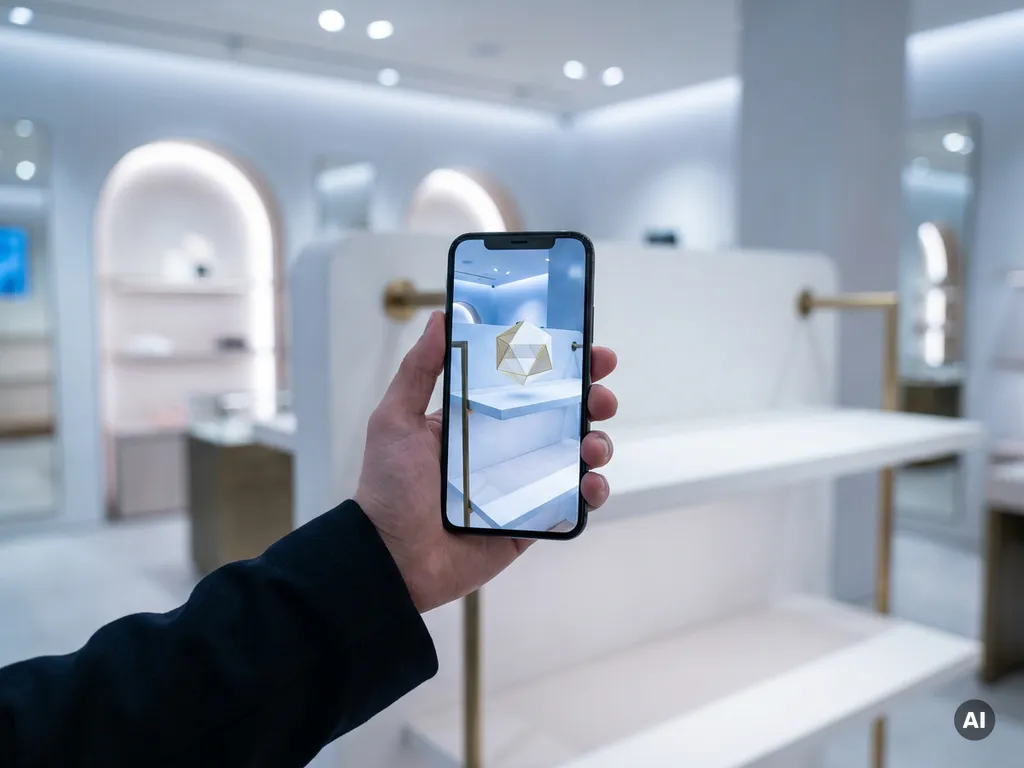
One of the most recognizable examples of augmented reality advertising is a virtual try-on experience – think pointing your smartphone at your face to see how a pair of sunglasses looks before buying, or holding your phone over a living room floor to visualize a sofa in your actual space. These AR ads blend digital content with the real world in real time, turning passive viewers into active participants.
What makes these examples so powerful is that they do not just show a product – they let people experience it. Brands across beauty, fashion, automotive, retail, and food have all used AR advertising to create moments that feel personal, memorable, and genuinely useful. The sections below unpack how this technology works, what formats it takes, and how to decide whether it is the right move for your next campaign.
What types of brands use augmented reality advertising?
Augmented reality advertising is used by brands across virtually every consumer-facing industry, from global beauty giants and automotive manufacturers to NGOs and cultural institutions. The common thread is a desire to move beyond passive media and create a direct, sensory connection with an audience. AR advertising examples span product launches, social campaigns, retail activations, and public awareness initiatives.
In the beauty and personal care space, brands use AR to let customers virtually try on lipstick shades, eyeshadow palettes, or skincare products through their phone camera. Fashion labels apply the same logic to shoes, clothing, and accessories. Automotive brands like Porsche have used AR to let prospective buyers configure and explore vehicles in three dimensions before ever visiting a showroom.
Retailers use AR to bring product catalogs to life, allowing customers to place furniture, appliances, or décor into their homes through their screens. Food and beverage companies activate AR on packaging, turning a label into an animated story or a game. Even NGOs and public sector organizations use AR advertising to build empathy around complex social issues – placing audiences inside a refugee camp, for example, or visualizing the scale of ocean plastic pollution.
The unifying factor across all of these is intent: these brands want engagement that goes deeper than a scroll or a click. AR advertising delivers that by making the audience part of the experience.
How does augmented reality advertising actually work?
Augmented reality advertising works by overlaying digital content – 3D objects, animations, filters, or information – onto a live view of the real world, typically through a smartphone camera, a social media platform’s native AR tool, or a dedicated app. The technology uses the device’s camera, sensors, and software to detect surfaces, faces, or spatial markers and anchor virtual elements to them in real time.
At a technical level, most AR advertising relies on one of three tracking methods. Marker-based AR triggers digital content when the camera recognizes a specific image, logo, or QR code – a poster that comes to life when scanned is a classic example. Markerless AR uses the device’s sensors and spatial mapping to place objects anywhere in the environment without a fixed trigger point. Face tracking AR, widely used in social media filters, maps digital elements directly onto a user’s face in real time.
Social platforms have made AR advertising significantly more accessible by building these tools into their native environments. A brand can deploy an AR filter on Instagram or Snapchat without requiring users to download anything. For more sophisticated activations – spatial AR on a city street, volumetric product visualizations, or location-based AR tied to GPS coordinates – dedicated development is required, and the experience can be far richer and more immersive as a result.
What are the most common formats of AR advertising?
The most common formats of AR advertising are social media filters, virtual try-ons, AR-activated print or packaging, interactive product visualizations, and location-based AR activations. Each format serves a different campaign goal, from broad brand awareness to conversion-focused product discovery.
- Social media AR filters: Branded lenses or effects on Instagram, Snapchat, or TikTok that users apply to their own camera. These are highly shareable and generate organic reach when users post their own content using the filter.
- Virtual try-on experiences: AR tools that let customers see how a product looks on them or in their space before purchasing. Common in beauty, eyewear, fashion, and home furnishings.
- AR-activated packaging and print: Physical materials – product labels, event posters, magazine ads – that trigger animated or interactive content when scanned with a smartphone. This format bridges the physical and digital without requiring a dedicated app.
- 3D product visualization: Interactive AR models that let users place and explore a product in their real environment. Particularly effective for high-consideration purchases like furniture, vehicles, or electronics.
- Location-based and geospatial AR: Digital content anchored to specific real-world coordinates, experienced outdoors without QR codes. Ideal for city activations, outdoor campaigns, tourism, and experiential marketing at scale.
- AR portals and immersive environments: Virtual doorways that transport users into a completely different world or setting when they point their camera at a trigger point. Used by museums, NGOs, and brands seeking deep narrative immersion.
We design and build across all of these formats, tailoring the approach to what the campaign actually needs rather than defaulting to the most common option. You can explore some of our past AR projects to see how different formats serve different goals.
What’s the difference between AR advertising and traditional digital advertising?
The fundamental difference between AR advertising and traditional digital advertising is participation. Traditional digital ads – banners, pre-roll videos, sponsored posts – are consumed passively. Augmented reality ads require the audience to actively engage: to point their camera, move their body, interact with an object, or make a choice. That shift from passive viewing to active participation changes the entire dynamic of the brand relationship.
Traditional digital advertising operates within a screen. It competes for attention in an environment already saturated with content, and it delivers a message that the audience can scroll past in a fraction of a second. AR advertising, by contrast, invades the real world in the most literal sense – it places brand content inside the spaces where people actually live, shop, and move.
There are also meaningful differences in measurable outcomes. Traditional digital advertising is typically measured by impressions, clicks, and conversion rates. AR advertising generates additional data points: time spent in the experience, interactions triggered, objects placed, filters shared, and return visits. This richer behavioral data reflects a deeper level of engagement that standard metrics cannot capture.
Finally, AR advertising has a social amplification quality that traditional formats rarely achieve organically. When someone uses a branded AR filter and shares it, they become a voluntary advocate. When someone places a virtual sofa in their living room and sends the screenshot to a partner, the brand travels with that conversation. This kind of earned distribution is structurally impossible with a banner ad.
Why do AR ads generate higher engagement than standard campaigns?
AR ads generate higher engagement than standard campaigns because they create a sense of personal relevance and agency that passive formats cannot replicate. When a person interacts with AR content, they are not watching a brand’s message – they are inside it. That psychological shift from observer to participant dramatically increases attention, time spent, and emotional investment.
Several reinforcing factors drive this effect. First, AR experiences are inherently novel. Even as the technology becomes more widespread, a well-executed AR activation still produces a moment of genuine surprise – the kind that prompts people to show others and share online. That novelty response is a powerful driver of both memory formation and social sharing.
Second, AR advertising is deeply personal. A virtual try-on shows the product on your face. A product visualization shows the object in your room. This personalization makes the experience feel relevant in a way that a generic video or image ad simply cannot. The brand is no longer speaking at an audience – it is responding to each individual’s real environment.
Third, the interactivity of AR creates what behavioral researchers describe as an endowment effect: when people virtually handle or place an object, they begin to feel a sense of ownership over it, which increases purchase intent. This is not a theoretical benefit – it is a practical outcome that brands in retail, automotive, and home furnishings have observed repeatedly in their AR campaigns.
Finally, AR ads are often opt-in. A user who chooses to open an AR experience is already more engaged than someone who is served an interruptive ad. That self-selection means the audience arriving at an AR activation is predisposed to engage, which compounds the format’s natural advantages.
How much does an AR advertising campaign cost to produce?
The cost of producing an AR advertising campaign varies significantly depending on a range of factors, and there is no single price point that applies across the board. Understanding what drives cost is more useful than any headline figure, because it allows brands to make informed decisions about where to invest and what level of complexity their goals actually require.
The primary cost drivers in AR advertising production include:
- Complexity of the AR experience: A simple social media filter with basic image tracking requires far less development time than a fully interactive 3D product visualization or a geospatial AR activation tied to real-world coordinates.
- 3D asset creation: Producing high-quality, photorealistic 3D models of products, environments, or characters is one of the most resource-intensive parts of any AR project. The more detailed and accurate the assets need to be, the higher the production investment.
- Platform and distribution: Building for a social platform’s native AR tool is generally more cost-efficient than developing a standalone app or a location-based experience that requires custom infrastructure.
- Interactivity and personalization: Experiences that respond dynamically to user input, adapt to different environments, or incorporate AI-driven personalization require more sophisticated development than linear or triggered content.
- Scale and deployment: A campaign running across multiple markets, languages, or physical locations introduces localization, testing, and logistics costs that a single-market activation does not.
- Integration with existing systems: When AR experiences need to connect with e-commerce platforms, CRM systems, or live event infrastructure, that integration adds both technical complexity and cost.
The most productive starting point is always a clear brief: what outcome does the campaign need to achieve, who is the audience, and what does success look like? From there, it becomes possible to design an AR experience that is appropriately scoped – ambitious enough to deliver genuine impact, realistic enough to be executed well within the available resources.
When should a brand choose AR over other experiential formats?
A brand should choose AR advertising when the goal is to create a personal, interactive connection between the audience and a product, idea, or story – particularly when scale, shareability, or real-world context are important. AR is the right format when the experience needs to travel with the audience rather than requiring them to travel to a fixed location.
AR is especially well-suited to campaigns where the product or concept benefits from being seen in context. If a customer needs to visualize how something fits into their life – literally or figuratively – AR makes that possible in a way no other medium can. It is also the format of choice when organic social sharing is a strategic goal, since AR filters and activations are among the most naturally shareable content formats available.
Other experiential formats may be more appropriate in specific circumstances. A fully immersive VR experience is better suited to deep narrative journeys or empathy-building scenarios where complete environmental control matters more than accessibility or scale. A physical installation or 4D cinema creates a collective, embodied experience that AR on a personal device cannot replicate. Live events with interactive screens or mixed reality elements serve audiences who are physically gathered in one place.
The clearest signal that AR is the right choice is when a brand needs to reach a large, distributed audience with an experience that feels personal and participatory – without requiring them to be in a specific place at a specific time. That combination of scale, personalization, and accessibility is where augmented reality advertising genuinely has no equal.
If you are exploring whether AR advertising is the right fit for your next campaign or brand activation, we would be glad to think through it with you. Contact us to start a conversation about what an immersive AR experience could look like for your brand.
Gerelateerde artikelen
- How do interactive museums engage visitors?
- What does XR stand for?
- How does AR work in retail?
- Why is experiential marketing key to winning over Gen Z?
- How does virtual reality impact society?
- What are the benefits of taking a virtual field trip in immersive virtual reality?
- Which is an example of immersive experience technology?
- What is an example of an immersive experience?
- What technology is used in immersive installations?