
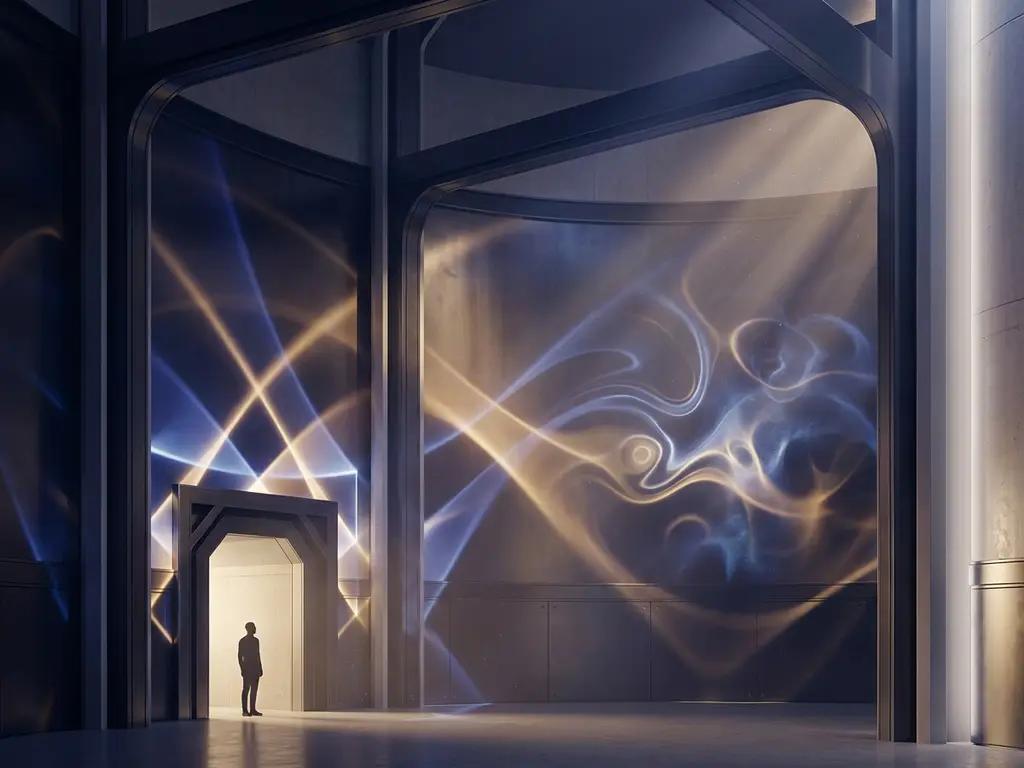
You step out of a bright museum hallway into a quiet, darkened room, and the first thing you notice isn’t what you see. The air feels cooler. It carries the sharp, unmistakable scent of damp forest soil after a summer rain. Ahead, an ancient oak tree stretches from the floor up into the dark ceiling. It looks completely still until you take a step closer. The ground answers your weight. A delicate network of golden roots lights up under your feet, pulsing outward across the floor toward the strangers standing on the other side of the room. As your path connects with theirs, the wooden timbre of string instruments chatters into an irregular orchestral chord, and the canopy above you bursts into movement—leaves rustling three meters behind your shoulder as a flock of birds takes flight across the walls.
Nobody in the room looks at their phone. A child beside you crouches down to press both palms against the floor, watching the roots gather around their fingers, while you stand caught between quiet awe and a single question: So how does this actually work?
An immersive installation works by turning an entire physical space into a responsive environment that listens to the people inside it. Unlike a traditional screen or display that plays a fixed recording to a passive crowd, an installation operates on a continuous, split-second loop of cause and effect: it senses where visitors move and what they touch, calculates how the story should react in real time, and coordinates light, spatial sound, physical texture, and scent. The sections below pull back the curtain on the invisible architecture behind these worlds, how they engage all five senses, and what it takes to build one from the ground up.
What technologies power an immersive installation?
If an immersive installation does its job properly, the visitor never thinks about technology once. Behind the scenes, however, that effortless magic is powered by a tightly synchronized stack of sensors, a visual canvas, spatial audio arrays, and emitters that stimulate other senses like smell dispensers —all governed by a central show-control brain.
To see how these layers actually talk to one another, pull back the curtain on the oak tree room from a moment ago:
Input – Sensors & Motion Tracking
How did the ground know where you stepped, or that the child crouched down to touch the floor? Overhead LiDAR scanners, infrared depth cameras, or pressure-sensitive floorboards map the physical room in three dimensions. Instead of recording video, they track silhouettes, footsteps, and hand coordinates in the dark—sending your exact position into the system in milliseconds.
Processing – Real-Time Engines & Show Control
A standard video file cannot adapt according to your actions. That is why interactive installations run on real-time game engines like Unity or Unreal Engine paired with central show-control architecture. The moment the sensors detect your path meeting another visitor’s, the engine calculates the collision live—generating the golden roots beneath your shoes, triggering the flock of birds, firing the hidden scent diffuser, and locking every light, speaker, or synchronized VR headset (as in our Education of the Future experience) to the exact same heartbeat.
Visual Output – Projection Mapping, LED & XR
To make those roots stretch seamlessly across the floor and up into the canopy, calibrated projection mapping wraps imagery across walls, floors, and irregular architectural surfaces, blending multiple projector beams until the hard edges of the room vanish—much like our traveling SDG Interactive 360 Dome or the multi-canvas choreography of Symphony of Screens. And when a concept calls for a personal screen on top of the physical room, Augmented Reality tablets, Mixed Reality glasses, or synchronized Virtual Reality headsets extend the installation through a lens, as we built for XR Theatremuseum and “Planet Soil”.
Other Output – Spatial Audio, Sensory Emitters
Why did the leaves rustle three meters behind your shoulder while the wooden strings chattered from the trunk, and why did the air smell like rain? This is where the room moves beyond the eyes to touch the rest of the human nervous system. Spatial audio arrays treat every rustle, bird wing, and cello note as a three-dimensional object that moves around the room based on where you stand. Working in lockstep with the sound, physical emitters—scent dispensers like the ones we used in the Unicef 4D Theatre releasing damp forest soil, silent directional fans dropping the air temperature,— convince your body that the digital world is physically real.
At Rooftop Immersive, we design, compose, and code each of these layers under one roof—ensuring the technology serves the story rather than competing with it.
How does an immersive installation engage all the senses?
Having the hardware to trigger scent, wind, and spatial sound is only half the battle. Fire every sensory emitter at full volume at the exact same time, and you create chaos. Engaging the senses is knowing which sense to lead with, how to bypass the analytical mind, and how to time their arrival so the room feels alive.
Human sight is our most analytical, guarded sense. Multisensory storytelling succeeds by completely bypassing visual skepticism.
Bypassing the Eye via Ancient Pathways
While visual processing requires conscious, energy-heavy analysis in the cerebral cortex, our older sensory pathways—olfaction, thermal perception, hearing—wire straight into the amygdala and hippocampus. A heavy low growl in the dark bypasses any analysis in the brain, it makes your body scream RUN at you in hormones. The scent of damp forest soil brings back instant nostalgia. When the air and the smell validate a space a half-second before the visual canvas appears, your nervous system accepts the environment as truth before your eyes even have a chance to look for seams.
Directing the Gaze Without Instructions
In a 360-degree space, a director cannot force a visitor’s head into a single frame. Instead, spatial audio and musical tension become the invisible camera crew. A sudden silence, followed by the dry snap of a branch or a low brass swell three meters to the left, pulls twenty heads around in unison without a single glowing arrow or written prompt.
Sensory Counterpoint & Restraint
Just like an orchestral score needs silence to make a crescendo hit harder, multisensory design relies on contrast. If a narrative holds the air completely still while tension builds on screen, a single sudden gust of warm wind and the faint trace of woodsmoke at the climax hits the skin like a physical shockwave. The impact isn’t loud; it is surgical.
This is why we score all the senses together from the earliest script treatments rather than bolting effects onto a finished video. When light, harmony, air, and touch arrive on the exact same narrative beat, the boundary between watching a story and living inside it disappears completely.
What’s the difference between an immersive installation and a regular exhibition?
The difference comes down to where the boundary lies. A regular exhibition puts the story inside a frame and asks the visitor to stand outside it; an immersive installation erases the frame and puts the visitor inside the story. In an immersive installation, the environment surrounds and responds to the visitor, making them part of the experience rather than a spectator of it.
From Reading to Witnessing
Instead of reading statistics about corporate ESG impact on a wall panel, executives in our Sustainability VR Experience and SDG Interactive 360 Dome stand inside the living ecosystem as it shifts around them.
Instead of looking at flat archival photos of a 1920s theater exhibition, visitors in the XR Theatremuseum walk directly through the reconstructed rooms at full human scale.
A traditional display looks the exact same whether the room is empty or packed. An immersive installation wakes up when you walk in—shifting its soundscape, opening new narrative branches, and reacting to the choices the crowd makes together.
How does interactivity work inside an immersive space?
Interactivity is a closed-loop conversation that happens in less than a tenth of a second: Human Action -> Sensor Detection -> Real-Time Engine -> Environmental Response. When that loop is fast enough and intuitive enough, the interface vanishes completely.
Inside a responsive space, we build interactivity across four escalating layers of depth:
Crowd Flow
The room knows you are there before you touch a thing. Overhead depth sensors and LiDAR map footsteps across the floor. Step into a quiet zone, and an ambient cello line swells to greet you; gather five strangers in the center of a dome, and the floor projection pulls together to unlock a collaborative challenge.
Tactile & Gesture Control
Buttons and mice belong in offices, not immersive worlds. Using computer vision, hand-tracking, or capacitive surfaces, a visitor can brush their hand across a real wooden table to reveal underground life—just as students do in our “Planet Soil” Learning Module—or reach into mid-air during our mixed-reality ESG Experience to rotate a virtual city model with their bare fingers.
Collective Decision-Making
In group spaces like our interactive domes, audiences steer the narrative together. When a moral or strategic dilemma flashes across the 360-degree horizon, visitors vote with their movement or hands, and the real-time engine immediately branches the story to show the consequences of the room’s choice.
Conversational AI Characters
At the cutting edge, pre-scripted dialogue gives way to live AI-driven characters and avatars. A visitor can walk up to a historical figure or virtual guide, ask an unscripted question out loud in their own language, and receive an immediate, in-character response that adapts to their curiosity.
How long does it take to build an immersive installation?
From a blank napkin sketch to opening day typically takes between three and twelve months, depending on physical footprint, hardware complexity, and how much original 3D, film, and audio content needs to be crafted from scratch. A focused AR campaign or pop-up activation can launch in 4 to 12 weeks, while a permanent multi-sensory museum exhibition or custom 4D venue generally spans 3 to 12 months.
To keep complex builds from spiraling, production runs across four tightly interlocked phases:
Discovery, Story & Technical Architecture (Weeks 1–6)
Every failure in immersive production starts with picking the hardware before locking the story. In this first phase, we define the emotional arc, map the visitor flow through the physical venue, and lock the technical blueprint.
Parallel Content & Code Production (Months 2–6+)
Once the blueprint is locked, our creative and technical pipelines run side by side. While directors and 3D artists build the visual worlds or shoot live-action plates, our composers write the spatial score and our developers build the real-time Unity/Unreal logic and sensor triggers.
Studio Prototyping & Stress-Testing (Months 2–6+)
Before a single projector hits the venue, we mock up the interaction loops and synchronize the hardware in the studio—testing how real human beings actually move, where they look first, and how to make the triggers bulletproof.
On-Site Rigging, Calibration & Commissioning (Weeks 1–3 before launch)
On location, projectors are edge-blended to the millimeter, spatial speaker arrays are tuned to the room’s acoustics, sensors are calibrated to the lighting conditions, and local staff are trained to run the show with a single button press.
Working with a studio that keeps narrative direction, real-time code, spatial audio, and hardware integration under one roof eliminates the costly “lost in translation” gaps that happen when you hire four separate vendors.
What spaces are suitable for an immersive installation?
You do not need an empty aircraft hangar. Almost any space can host an immersive installation if you can control three variables: sightlines, ambient light, and acoustics—or if you choose a medium specifically designed to work with the existing room.
Black Boxes, Warehouses & Galleries
High ceilings, uninterrupted walls, and total darkness are the gold standard for projection mapping and multi-sensory builds, allowing complete control over light and sound bleed.
Portable Domes & Pop-Up Structures
When a venue has glass walls, harsh daylight, or historical architecture you aren’t allowed to drill into, you bring your own room. Our traveling SDG Interactive 360 Dome sets up inside existing conference halls or festivals, creating a sealed, acoustically controlled 360-degree theater anywhere.
Public Atriums, Plazas & Streetscapes
Bright, chaotic spaces require formats that cut through daylight. High-brightness architectural displays—like our UvA Lab 42 opening show—or geospatial Augmented Reality campaigns like Just Diggit – Our World and The World of Vortexia turn bustling city streets and corporate lobbies into interactive stages with zero wall construction.
Intimate Rooms, Tents & Classrooms
Some of the deepest immersion happens in tight quarters. From a multi-user VR tent at a summer theater festival to a standard school classroom running “Planet Soil”, designing into the constraints of a small space often makes the encounter feel even more personal.
Who uses immersive installations and for what purpose?
Museums, global brands, educational institutions, NGOs, and live event producers all build immersive installations for different surface goals—but underneath, they are all solving the exact same human problem: how to make people care in a world that has gone numb to flat screens. To make audiences feel something, understand something, or remember something that conventional media cannot achieve alone.
Museums & Cultural Institutions use installations like the XR Theatremuseum to blow the dust off historical archives, pull younger generations away from passive scrolling, and turn a quiet afternoon visit into a visceral first-person memory.
Brands & Experiential Marketers deploy location-based installations like Symphony of Screens and interactive AR campaigns like ‘Skip The Cow’ or ‘Break The Ice’ to trade forgettable ad impressions for five minutes of genuine, shareable wonder.
Schools, Universities & Corporate Leaders use synchronized journeys like Education of the Future and decision-making arenas like the SDG Interactive 360 Dome to turn abstract topics—from soil biology to ESG compliance—into urgent, hands-on simulations.
Whether your canvas is a museum wing, a festival tent, a classroom desk, or a global flagship launch, the secret is never the projector count. It is the story waiting on the other side of the doorway. Ready to turn an empty space into an unforgettable encounter? Explore our projects to see our installations in action, or contact us to talk through your space over a coffee at the Danzigerkade.
Gerelateerde artikelen
- Which questions should you ask an immersive agency?
- What are some examples of projection mapping?
- What are planetarium domes made of?
- What are the benefits of immersive learning?
- How much to build an immersive room?
- Why is my brand campaign not creating buzz?
- What is an immersive installation?
- How do immersive experiences improve experiential marketing?
- What are the principles of good spatial design?