
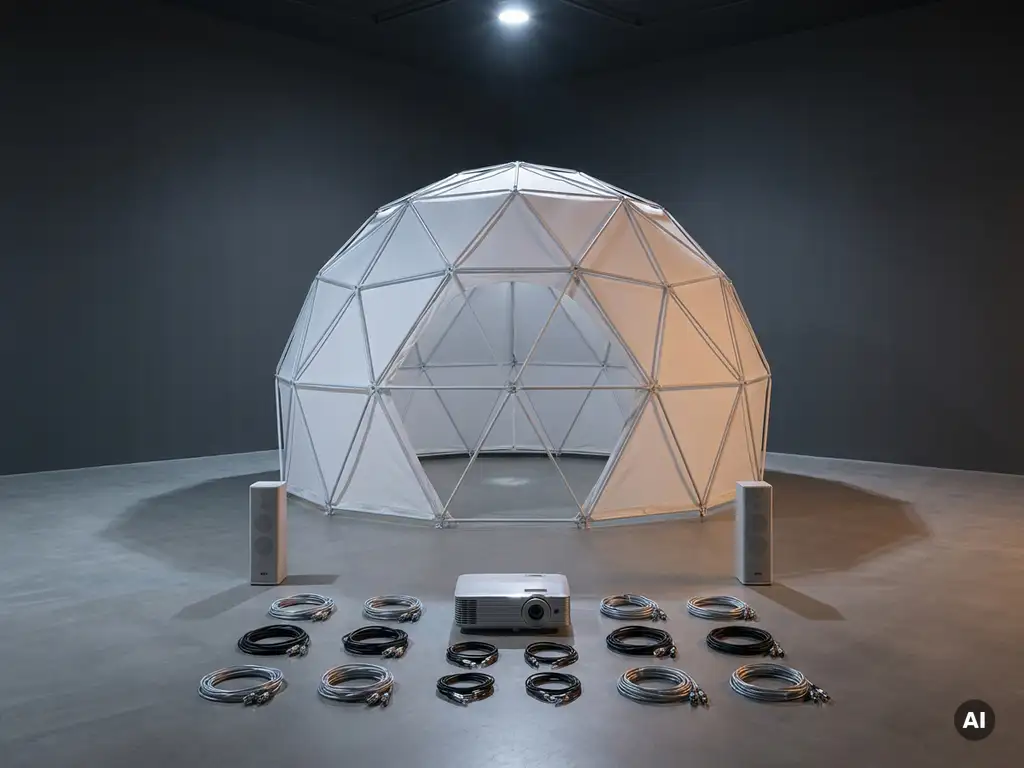
A dome setup typically includes a projection system, a rigid or inflatable dome structure, a spatial audio array, a media server with dome-specific software, and a range of on-site support equipment. The exact configuration depends on whether the experience is passive or interactive, the size of the dome, and the complexity of the content being delivered. The sections below break down each component in detail so you know exactly what to expect from a professional immersive dome installation.
What types of projectors are used in a dome setup?
Dome setups use high-brightness laser projectors, typically arranged in a multi-projector array to cover the full 360-degree interior surface without visible seams. The most common configurations use fisheye or ultra-wide lenses paired with edge-blending software to create a seamless panoramic image. Projector count ranges from a single unit in small portable domes to six or more in large-scale permanent installations.
The choice of projector depends on three key factors: dome diameter, ambient light conditions, and the resolution required by the content. For a dome up to eight metres in diameter, a single high-lumen laser projector with a fisheye lens can deliver a convincing 360-degree projection. Larger domes, particularly those used for events with hundreds of visitors, require multiple projectors positioned around the perimeter or at the dome’s apex, each covering a segment of the interior canvas.
Brightness is measured in lumens, and dome environments demand projectors that can overcome the light loss caused by wide-angle lenses and curved surfaces. Professional dome projection systems typically rely on laser phosphor technology rather than traditional lamp-based units because laser projectors offer longer operational life, consistent colour accuracy, and lower maintenance requirements during multi-day installations. Resolution is matched to the content format, with 4K-per-projector setups becoming increasingly standard for high-detail visual experiences.
What does the dome structure itself consist of?
A dome structure consists of either an inflatable shell supported by continuous air pressure or a rigid geodesic framework covered with a projection-grade fabric or hard-panel surface. Inflatable domes are the most common choice for temporary and touring installations because they can be packed into flight cases and erected by a small crew. Rigid geodesic domes offer greater structural stability and are preferred for permanent or semi-permanent venues.
The interior surface of the dome is the projection screen, so material quality is critical. Projection fabric must be white or near-white, acoustically transparent to allow speakers to be placed behind it, and coated to minimise hot-spotting where the projector beam is strongest. Inflatable domes achieve this with a double-skin construction: an outer weatherproof layer and an inner projection surface separated by an air gap that provides insulation and shape.
Entry and exit points are integrated into the structure as airlock tunnels in inflatable models, preventing pressure loss when visitors move in and out. Geodesic frames use panel-based construction, with each triangular section bolted or clipped together to form the hemisphere. Both structure types are available in diameters ranging from five metres for intimate experiences to twenty-five metres or more for large public events.
What audio equipment is included in a dome installation?
A dome installation includes a spatial audio system, typically built around a surround or object-based audio format such as Dolby Atmos or ambisonics. Speakers are distributed around the dome’s circumference and above the audience to create a fully enveloping soundscape that matches the visual field. A central subwoofer or bass array handles low-frequency content, adding physical presence to the audio experience.
The number of speakers scales with dome diameter and audience size. Smaller domes may use six to eight satellite speakers plus a subwoofer, while large-format installations can incorporate sixteen or more channels. Where the projection fabric is acoustically transparent, speakers are mounted behind the screen surface so that sound appears to emanate from the image itself, reinforcing the sense of immersion.
Audio processing is handled by a dedicated digital signal processor (DSP) that decodes the spatial audio format and routes signals to each speaker with precise timing and level control. This prevents phase cancellation and ensures that sound localisation remains accurate regardless of where a visitor stands within the dome. For outdoor or semi-outdoor installations, weatherproof speaker enclosures and sealed amplifier racks are used to protect equipment from humidity and temperature variations.
What media servers and software power a dome experience?
Dome experiences are powered by professional media servers running dome-specific playback and warping software. Common platforms include Disguise, Ventuz, Resolume, and DomeProjection software, all of which handle the geometric correction needed to map flat or equirectangular content onto a curved surface without distortion. The media server renders content in real time or plays back pre-rendered files, outputting individual video signals to each projector in the array.
Geometric warping and edge blending are the two core software functions that make seamless 360-degree projection possible. Warping corrects the distortion introduced by projecting onto a curved surface, while edge blending softens the overlap zones between adjacent projectors so that no hard lines are visible in the final image. These calibrations are performed during installation using test patterns and camera-based alignment tools.
For interactive dome experiences, the media server integrates with input devices such as motion sensors, touch interfaces, or game controllers, and the software responds to those inputs in real time. This requires a more powerful server configuration with lower-latency rendering pipelines. Content is typically authored in Unreal Engine or Unity and then output through a real-time bridge to the dome projection system, allowing dynamic, responsive visuals rather than pre-rendered loops.
How does the setup differ for interactive versus passive dome experiences?
Passive dome experiences use pre-rendered video content played back on a loop or triggered by a show controller, requiring only a media server, projectors, and an audio system. Interactive dome setups add input hardware, real-time rendering engines, and network infrastructure to allow the experience to respond to visitor actions. This distinction significantly affects both the equipment list and the complexity of installation.
Passive dome setup
In a passive configuration, content is delivered as a pre-rendered video file in an equirectangular or fulldome format. The media server plays this file back with frame-accurate synchronisation across all projectors. Show control systems such as Medialon or Alcorn McBride can automate scheduling, transitions, and lighting cues, making passive domes well suited to museum installations, planetariums, and branded environments where consistent, repeatable delivery is the priority.
Interactive dome setup
Interactive installations require real-time rendering, which demands significantly more GPU processing power. Input devices such as depth cameras, pressure-sensitive floors, handheld controllers, or touch panels are connected to the media server and feed data into the rendering engine. Network switches and low-latency cabling infrastructure become essential components because any delay between a visitor’s action and the visual response breaks the sense of presence. Our immersive project work demonstrates how interactive dome experiences can be designed to respond to individual visitors in real time, creating genuinely personalised moments within a shared physical space.
What environmental and support equipment is needed on-site?
On-site support equipment for a dome installation includes power distribution units, climate control systems, cable management infrastructure, and safety barriers or crowd control elements. Domes generate significant heat from projectors and amplifiers, so active ventilation or air conditioning is essential for both equipment protection and visitor comfort during extended operating hours.
Power requirements vary with dome size and equipment load, but professional installations typically draw between fifteen and sixty kilowatts. A dedicated power distribution unit with circuit breakers and surge protection isolates the dome’s electrical supply from the venue’s general circuits, reducing the risk of interference or tripped breakers during operation. For outdoor events, a generator with automatic transfer switching provides a reliable independent power source.
Cable management is a safety and operational concern. Signal cables running from the media server to projectors and speakers must be routed to avoid trip hazards and protected from foot traffic. Conduit, cable ramps, and overhead rigging points are standard tools for achieving a clean, safe installation. Crowd barriers or floor markings define the visitor area and protect equipment from accidental contact.
How long does it take to set up and dismantle a dome installation?
Setup time for a dome installation ranges from four hours for a small inflatable dome with a single projector to three or more days for a large geodesic dome with a full multi-projector array, spatial audio system, and interactive components. Dismantling typically takes sixty to seventy percent of the build time. The primary variables are dome size, crew size, and the complexity of the technical calibration required.
Inflatable domes are the fastest to erect structurally, often reaching full inflation within thirty to sixty minutes. The majority of setup time is spent on projector alignment, geometric warping calibration, edge blending, and audio tuning. These calibration steps cannot be rushed without compromising the quality of the final experience, so scheduling adequate technical time is essential when planning an event.
Geodesic dome frames require panel-by-panel assembly, which adds structural build time but results in a more stable platform for long-running installations. For multi-week exhibitions or permanent setups, the additional build time is offset by reduced maintenance and greater resilience to environmental conditions. Experienced installation crews working with well-documented technical riders can significantly reduce both build and strike times by preparing equipment off-site before arrival.
If you are planning an immersive dome experience and want to understand exactly what equipment, crew, and timeline your project requires, we would be glad to walk you through the details. Every installation we design is built around your specific goals, venue, and audience, so feel free to contact us to start the conversation.
Gerelateerde artikelen
- What is digital cultural heritage?
- What are the four types of augmented reality?
- What is an example of augmented reality advertising?
- Does AR VR require coding?
- What is an example of a non immersive virtual reality?
- How to create an immersive exhibition?
- How do immersive installations work?
- What makes an immersive experience?
- What are the principles of good spatial design?