
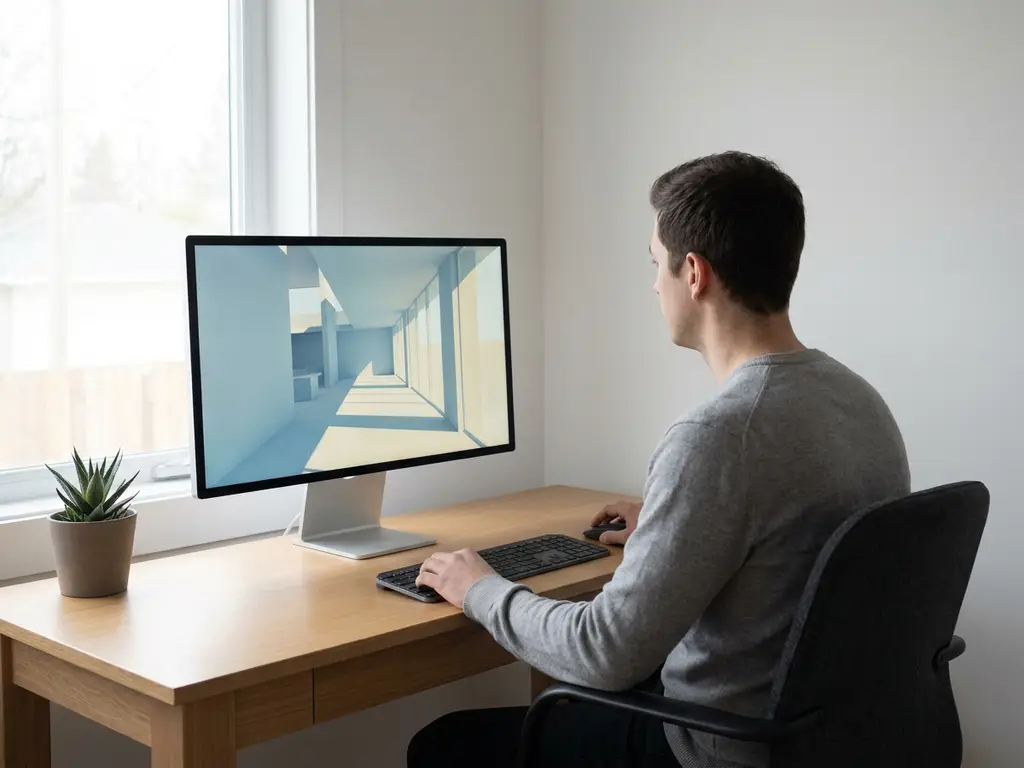
A non-immersive virtual reality experience is one where a user interacts with a computer-generated environment through a standard screen, keyboard, and mouse, without any sense of physical presence inside that environment. The most familiar example is a desktop video game or a 3D architectural walkthrough viewed on a monitor. Unlike fully immersive VR, non-immersive systems keep the user clearly separated from the virtual world, aware of their physical surroundings at all times. Understanding where non-immersive VR sits on the broader spectrum helps clarify when more powerful immersive technologies are worth pursuing.
What are the three levels of virtual reality immersion?
Virtual reality is commonly divided into three levels of immersion: non-immersive, semi-immersive, and fully immersive. Each level describes how completely a user is surrounded by and engaged in a virtual environment, ranging from simple screen-based interaction at one end to full sensory enclosure at the other. The level of immersion directly shapes how present, engaged, and emotionally affected a user feels.
Non-immersive VR
At this level, the virtual world is displayed on a standard monitor or screen. The user controls their viewpoint and interactions using conventional input devices such as a keyboard, mouse, or game controller. There is no head tracking, no spatial audio tied to physical movement, and no sense of being inside the environment. The user remains a spectator rather than a participant.
Semi-immersive VR
Semi-immersive systems expand the visual field significantly, often through large curved screens, projection walls, or multi-monitor setups. Flight simulators and driving simulators used in professional training are classic examples. The user gains a stronger sense of spatial depth and scale, and some head or body tracking may be incorporated, but they are still physically present in the real room and not fully enclosed by the virtual world.
Fully immersive VR
Fully immersive VR uses a head-mounted display, spatial audio, and often haptic or motion-tracking technology to replace the user’s sensory environment almost entirely. The visual field is completely filled by the virtual world, and head movement updates the view in real time, creating a convincing sense of presence. This is the level at which the brain most readily accepts the virtual environment as real, making it the most powerful format for emotional impact, behavior change, and deep learning.
What is an example of non-immersive virtual reality?
The clearest example of non-immersive virtual reality is a desktop video game played on a monitor. The player navigates a fully rendered three-dimensional world using a keyboard and mouse, but they remain seated in front of a screen, fully aware of their physical surroundings. Other common examples include online 3D property tours, browser-based virtual museum walkthroughs, and architectural visualization software used by designers to explore building models on screen.
Google Street View is another widely recognized example. Users can pan and navigate through photorealistic street-level imagery of real-world locations, but they do so by clicking and dragging on a flat screen. The experience is spatial and exploratory, but it offers no sense of physical presence or sensory depth beyond sight.
In professional settings, non-immersive VR appears in computer-aided design tools, medical imaging software that renders organs in 3D, and training simulations run on standard workstations. What all these examples share is that the virtual environment is clearly framed within a screen boundary. The user’s body, senses, and spatial awareness remain anchored in the real world throughout.
How does non-immersive VR differ from semi-immersive and fully immersive VR?
The key difference between non-immersive VR and more advanced levels lies in the degree of sensory enclosure and the sense of presence the technology creates. Non-immersive VR confines the virtual world to a screen and requires deliberate input device interaction. Semi-immersive VR expands the visual field and may add motion tracking, creating stronger spatial awareness. Fully immersive VR replaces the user’s sensory environment almost entirely, generating a genuine feeling of being inside the virtual world.
From a cognitive and emotional standpoint, these differences are significant. Research in human perception consistently shows that the stronger the sense of presence, the more the brain processes an experience as real. This means emotional responses are deeper, memory retention is higher, and behavioral impact is greater in fully immersive environments compared to non-immersive ones.
From a practical standpoint, non-immersive VR requires no specialist hardware beyond a computer. Semi-immersive setups require larger display systems or projection rigs. Fully immersive experiences require head-mounted displays and, in the most sophisticated applications, spatial audio, haptic feedback, scent, and physical set design. The investment in hardware and design complexity scales with the level of immersion, but so does the depth of impact on the audience.
Where is non-immersive virtual reality commonly used?
Non-immersive virtual reality is most commonly used in contexts where accessibility, cost efficiency, and broad reach matter more than emotional depth or presence. It appears across education, architecture, healthcare, gaming, retail, and corporate training, wherever a three-dimensional environment needs to be explored or demonstrated without specialist hardware.
- Education: Interactive 3D models of historical sites, human anatomy, or scientific phenomena delivered through school computers or tablets.
- Architecture and real estate: Digital walkthroughs of buildings and spaces that clients can explore on a standard screen before construction begins.
- Healthcare: 3D medical imaging tools that allow clinicians to examine scans and models on workstation monitors.
- Gaming: Open-world video games that render vast, interactive three-dimensional environments on home screens.
- Corporate training: Scenario-based simulations run on standard computers to teach procedures, compliance, or decision-making skills.
- Tourism and culture: Virtual museum tours and heritage site explorations accessible via web browsers.
In each of these contexts, non-immersive VR delivers genuine value. It democratizes access to three-dimensional content and makes spatial information easier to understand than flat images or text alone. However, the emotional engagement and behavioral impact it generates remain limited compared to what becomes possible when the user is physically surrounded by the experience.
What are the limitations of non-immersive VR compared to full immersion?
The primary limitation of non-immersive VR is its inability to generate a genuine sense of presence. Because the user remains aware of their physical surroundings and interacts through a screen, the brain does not process the virtual environment as real. This fundamentally caps the emotional resonance, memory retention, and behavioral change the experience can produce.
Several specific limitations follow from this core constraint:
- Limited emotional impact: Without presence, users engage intellectually rather than emotionally. They observe the virtual world rather than inhabit it, which reduces empathy, urgency, and personal connection.
- Reduced memory encoding: Multisensory, embodied experiences are encoded far more deeply in long-term memory than screen-based ones. Non-immersive VR misses the spatial, physical, and emotional cues that strengthen retention.
- Weaker behavior change: For applications in education, social awareness, or training where the goal is to change how people think or act, non-immersive formats are considerably less effective than fully immersive alternatives.
- No multisensory engagement: Non-immersive VR is almost entirely visual, with limited audio. It cannot incorporate touch, scent, spatial sound, or physical sensation, all of which significantly deepen the quality of an experience.
- Distraction from the real environment: Because users remain in their physical space, interruptions, ambient noise, and competing visual stimuli constantly compete with the virtual content for attention.
These limitations do not make non-immersive VR without value. For many use cases, it is entirely appropriate. But for organizations seeking genuine transformation in how audiences feel, understand, or behave, these constraints are meaningful and worth addressing with more powerful technology.
When should immersive VR be chosen over non-immersive alternatives?
Fully immersive VR should be chosen when the goal goes beyond information delivery and reaches into emotional transformation, deep learning, or perspective change. If the objective is to make someone truly feel what it is like to stand inside a historical event, experience a social crisis firsthand, or master a complex skill through realistic practice, non-immersive formats will fall short. The stronger the required emotional or behavioral outcome, the stronger the case for full immersion.
Specific situations where fully immersive experiences consistently outperform non-immersive alternatives include:
- Empathy-building campaigns where audiences need to understand experiences radically different from their own, such as humanitarian crises, accessibility challenges, or historical injustices.
- High-stakes professional training where realistic simulation of pressure, consequence, and environment is essential, such as medical procedures, safety protocols, or crisis management.
- Cultural and museum experiences where the goal is to transport visitors into a historical period, an artwork, or a distant location in a way that creates lasting memory.
- Brand activations where the aim is not just awareness but a memorable, shareable emotional encounter that builds genuine loyalty.
- Educational programs addressing complex or abstract subject matter that benefits from embodied, spatial learning rather than passive reading or screen-based interaction.
The decision also involves practical considerations. Fully immersive experiences require more investment in hardware, content production, and physical space design. But the return, measured in engagement depth, retention rates, emotional impact, and audience response, is consistently greater. For organizations in education, culture, social impact, or brand experience that are serious about making something genuinely memorable, the step from non-immersive to fully immersive is rarely a question of whether, but when and how.
We design fully immersive experiences that go far beyond the screen, combining spatial storytelling, multisensory design, and AI-driven personalization to create encounters that people carry with them long after they leave. If you are ready to move beyond non-immersive formats and explore what full immersion can do for your audience, we would love to hear about your vision. Contact us to start the conversation.
Gerelateerde artikelen
- What are some ideas for interactive museum exhibits?
- What is immersive entertainment?
- What are five applications of virtual reality?
- How is augmented reality used in marketing?
- How to attract people in an exhibition?
- What are the 4 types of memory in the brain?
- What are the 5 sensory memories?
- How do I create an immersive experience?
- How to create an immersive experience?