
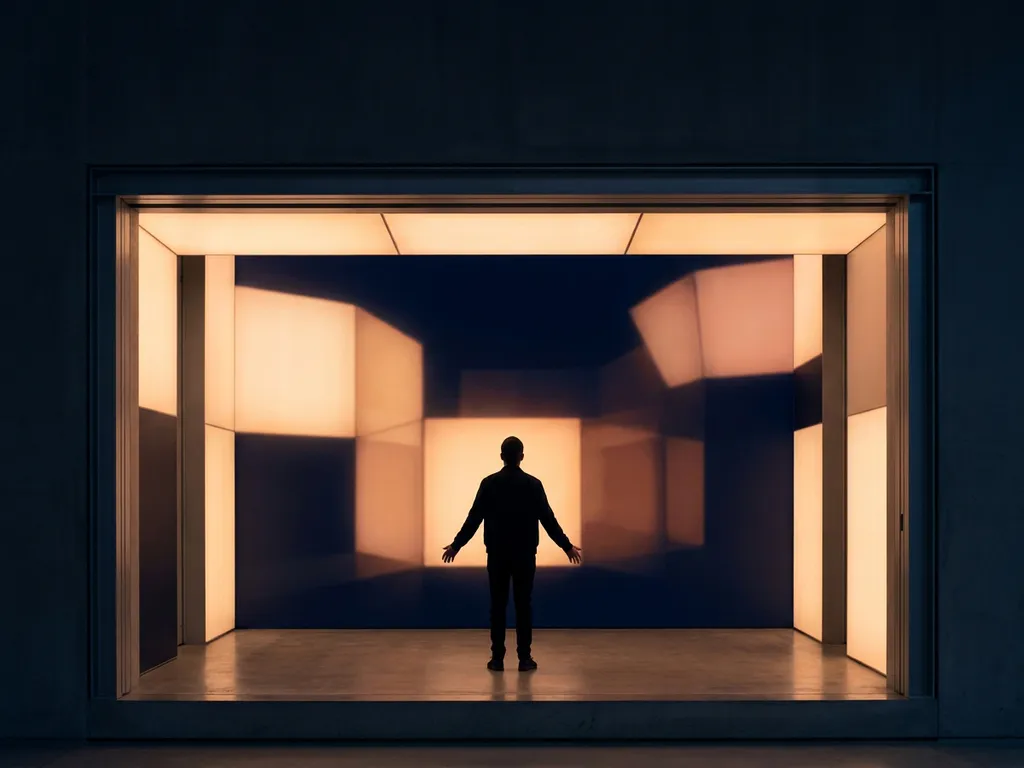
An immersive experience is a designed environment or encounter that surrounds participants completely, engaging multiple senses simultaneously to create a feeling of presence and deep involvement. Unlike passive media, immersive experiences dissolve the boundary between observer and content, drawing people into a world they can explore, interact with, and feel part of. The questions below unpack every dimension of what makes these experiences so powerful and how they are built.
How do immersive experiences differ from traditional media?
Traditional media delivers content to an audience. Immersive experiences place the audience inside the content. Where a film, advertisement, or lecture positions people as passive receivers watching from a distance, an immersive experience removes that distance entirely, making the participant an active presence within the story, space, or message being communicated.
The distinction goes deeper than interactivity alone. A website can be interactive without being immersive. What separates the two is the degree to which the experience commands full attention, activates the body, and creates a genuine sense of being somewhere or someone other than where you physically are. This is sometimes called presence, and it is the defining quality of truly immersive design.
Traditional media competes for attention in an already saturated environment. Immersive experiences, by contrast, create a dedicated perceptual world that pulls participants away from distraction and into focused engagement. That shift in attention quality translates directly into deeper memory formation, stronger emotional response, and more lasting behavioral change, which is precisely why sectors from education to brand marketing are investing in immersive formats at an accelerating pace in 2026.
What are the main types of immersive experiences?
The main types of immersive experiences are Virtual Reality (VR), Augmented Reality (AR), Mixed Reality (MR), and large-scale physical installations such as projection domes and 4D environments. Together, these formats are often grouped under the term Extended Reality (XR), which covers any technology that blends real and virtual worlds along a spectrum.
Virtual Reality (VR)
VR replaces the physical environment entirely with a computer-generated world experienced through a headset. It can be passive, such as a cinematic 360-degree film, or fully interactive, allowing participants to move through and manipulate virtual spaces. VR is particularly effective for training simulations, empathy-building narratives, and location-based experiences where groups share a synchronized journey.
Augmented Reality (AR)
AR layers digital content over the real world, experienced through a smartphone, tablet, or AR glasses. Applications range from product activations and interactive posters to geospatial campaigns that anchor content to specific geographic coordinates without QR codes. AR preserves physical context while adding a digital dimension, making it highly accessible and scalable for public-facing campaigns, museum exhibitions, and educational settings.
Mixed Reality (MR) and Spatial Computing
Mixed Reality goes further than AR by allowing virtual objects to interact with the physical environment in real time. Devices such as the Apple Vision Pro represent the frontier of spatial computing, where the boundary between digital and physical becomes genuinely seamless. MR is increasingly used for next-generation product demonstrations, architectural visualization, and training environments where physical and virtual elements must coexist and respond to each other.
Physical Immersive Installations
Not all immersive experiences are screen-based. Interactive 360-degree projection domes, 4D cinemas with scent, heat, and motion, and multi-sensory walk-through environments create immersion through spatial design rather than wearable technology. These formats are especially powerful for large audiences at festivals, museums, and corporate events.
What senses does an immersive experience engage?
A fully realized immersive experience engages all five senses: sight, sound, touch, smell, and sometimes taste. Most digital experiences focus on vision and hearing, but the most impactful immersive designs deliberately activate additional sensory channels because multisensory stimulation dramatically deepens memory encoding and emotional resonance.
Sound design is often underestimated. Spatial audio, which places sound in three-dimensional space around the participant, is one of the most powerful tools for creating presence. The brain interprets directional sound as a strong signal that something real is happening nearby, heightening alertness and emotional engagement.
Scent and haptic feedback take immersion further still. Research in sensory psychology consistently shows that smell is the sense most directly connected to emotional memory. Introducing a relevant scent, whether the salt air of an ocean environment or the warmth of a forest, can anchor an experience in long-term memory far more effectively than visual content alone. Haptic elements, from vibrating floors to textured surfaces, complete the physical reality of a designed world.
This is why we design with all the senses, not just eyes and ears. The goal is not spectacle but genuine presence, and presence requires the whole body to believe in the environment it has entered.
Where are immersive experiences used in practice?
Immersive experiences are used across education, museums and cultural institutions, brand marketing, NGOs and public sector campaigns, healthcare, corporate training, and live entertainment. Any context where engagement, empathy, or behavior change matters is a context where immersive design delivers measurable value.
In education, immersive learning modules allow students to explore historical events, scientific processes, or social situations from the inside rather than reading about them. The experiential quality of VR and AR learning environments addresses motivation loss and helps learners who struggle with abstract concepts by grounding knowledge in lived experience.
In museums and cultural institutions, immersive technology adds digital layers to physical collections, brings historical figures back to life through volumetric video, and creates walk-through environments that attract younger audiences while deepening engagement for all visitors. The challenge for cultural leaders is integrating technology in a way that enhances rather than competes with the authenticity of their collections, and that balance is central to thoughtful immersive design.
In brand marketing, immersive activations at events, retail spaces, and public locations create the kind of memorable, shareable moments that passive advertising cannot generate. When a brand gives someone an experience rather than a message, the emotional association formed is qualitatively different and significantly more durable.
For NGOs and public sector organizations, immersive storytelling is one of the most effective tools available for communicating complex social issues and inspiring genuine empathy. Placing someone inside the perspective of another person, whether a refugee, a child in a conflict zone, or a future version of their own city, creates understanding that statistics and reports cannot replicate.
How does immersive technology create emotional impact?
Immersive technology creates emotional impact by triggering the same neurological responses as real experiences. When the brain perceives itself to be physically present in an environment, it processes that environment emotionally rather than analytically, producing genuine feelings of fear, wonder, compassion, or excitement rather than intellectual acknowledgment of those states.
This is directly relevant to the well-documented challenge of information retention. People forget the majority of what they read or hear within days, a pattern described by the forgetting curve in cognitive psychology. Experiences, by contrast, are encoded differently. Emotion acts as a memory consolidation signal, and multisensory immersion generates far more emotional activation than screen-based content, which is why people remember what they felt in an immersive environment long after they have forgotten the facts they were told.
Perspective-taking is another powerful mechanism. When someone physically inhabits another viewpoint, even virtually, their capacity for empathy increases in measurable ways. This is the principle behind some of the most impactful immersive campaigns in humanitarian communication, where experiencing a situation firsthand, even in a simulated form, motivates action in ways that images and statistics do not.
The combination of presence, multisensory engagement, and narrative creates a state of flow, total absorption in the experience, that makes immersive formats uniquely effective for any goal that depends on genuine human connection rather than passive information transfer.
What is the role of AI in immersive experiences?
AI in immersive experiences enables personalization, real-time responsiveness, and conversational interaction at a scale that was previously impossible. Rather than delivering the same fixed experience to every participant, AI allows an immersive environment to adapt dynamically to the individual, adjusting language, pacing, content depth, or narrative direction based on who is engaging and how.
One of the most visible applications is AI-powered avatars and non-player characters (NPCs) that hold real-time conversations with participants. These virtual characters can answer questions, respond to emotional cues, and guide learners or visitors through an experience in a way that feels genuinely interactive rather than scripted. For educational applications, this means a learner can ask follow-up questions, explore tangents, and receive feedback tailored to their level of understanding.
AI also plays a role in accessibility and scale. An immersive experience that can automatically switch languages, adjust its complexity for different age groups, or modify its emotional intensity based on user behavior becomes viable for vastly more diverse audiences. This is particularly significant for organizations in education and the public sector, where reaching people across different backgrounds and learning styles is a core requirement.
Looking at the trajectory of immersive design in 2026, AI is not a feature added on top of an experience. It is increasingly the engine that makes truly responsive, personalized immersion possible at scale.
What does it take to create an immersive experience?
Creating an immersive experience requires the convergence of creative direction, spatial design, technology development, narrative craft, and production expertise. It is a multidisciplinary process that begins with a clear understanding of the audience, the intended emotional or behavioral outcome, and the environment in which the experience will be delivered.
The creative and strategic foundation
Before any technology is selected, the core question must be answered: what do you want participants to feel, understand, or do differently after this experience? The most effective immersive projects begin with a strong conceptual brief that defines the emotional journey, the key moments of engagement, and the sensory dimensions that will support the narrative. Technology serves this vision; it does not define it.
Production, technology, and delivery
The production phase involves 3D modeling and environment design, software development for interactive or AI-driven elements, hardware selection and integration, spatial audio design, and physical set or installation work where relevant. The scope of each component depends on the format chosen, the level of interactivity required, the number of simultaneous participants, and the duration and locations of deployment.
In terms of investment, the factors that most significantly influence cost are the complexity of the interactive logic, the quality of visual and audio production, whether custom hardware is required, and the scale of deployment. A single-location AR activation for a product launch sits at a very different level of investment than a multi-site VR education program with AI-personalized content for thousands of learners. Understanding these variables early in the process allows organizations to make informed decisions about where to focus their resources for maximum impact.
Timelines vary accordingly. A focused AR experience can be developed in a matter of weeks. A fully custom interactive VR installation with AI-driven characters and physical set design typically requires several months of collaborative development. Working with a partner who manages the entire process from concept to delivery, under one roof, significantly reduces the coordination complexity that would otherwise add time and risk to production.
If you are exploring what an immersive experience could look like for your organization, whether for education, cultural engagement, or brand activation, we would love to hear about your vision. Contact us to start the conversation.
Gerelateerde artikelen
- What is an example of an immersive experience?
- What makes immersive experiences memorable?
- What is an example of immersive experience?
- What is an example of a brand activation?
- Why is experiential marketing key to winning over Gen Z?
- What are the types of immersive technology?
- What are the 5 sensory memories?
- How do immersive installations work?
- How do 360-degree experiences work in marketing?