
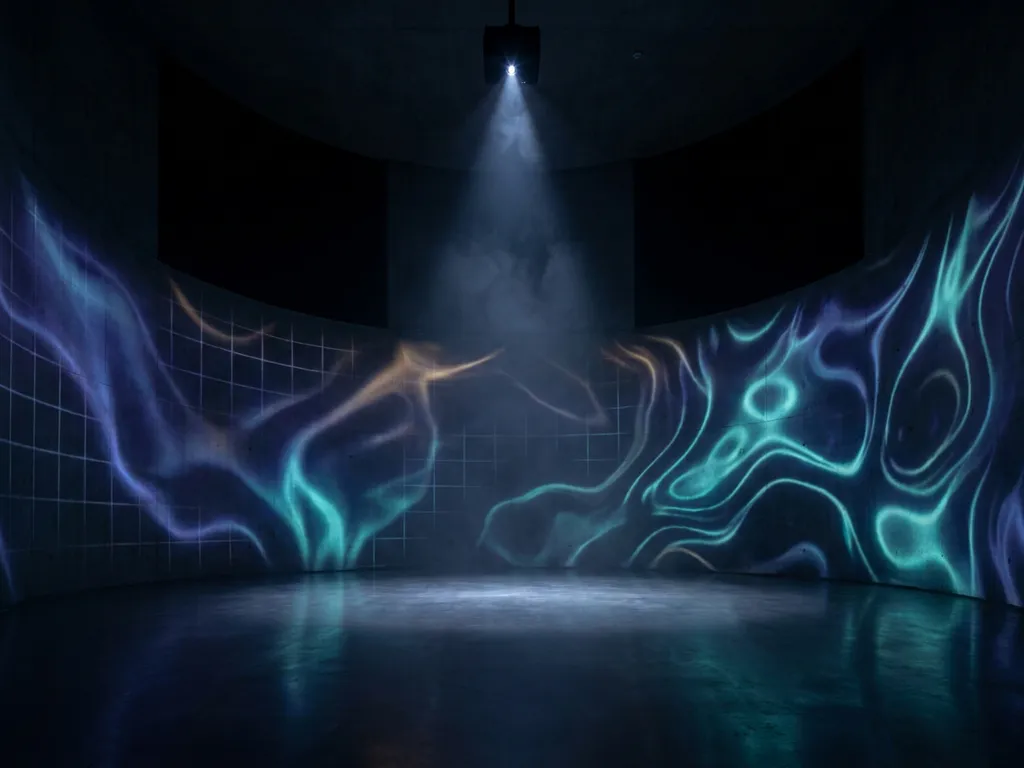
Immersive installations combine projection mapping, spatial audio, motion tracking, extended reality (XR) technologies, AI-driven personalisation, and multisensory physical elements into a single cohesive environment. The specific mix depends on the goals of the experience, the venue, and the audience being served. The sections below break down each technology layer and how they work together to create experiences that genuinely move people.
What types of technology make up an immersive installation?
An immersive installation typically combines five core technology categories: visual projection and display systems, spatial audio, motion and sensing hardware, extended reality (AR, VR, or mixed reality) layers, and physical or sensory elements such as scent, temperature, and haptic feedback. These layers are orchestrated by a central software stack that synchronises every element in real time.
No single technology creates immersion on its own. What makes an installation truly immersive is the seamless integration of multiple sensory inputs that respond to one another and to the people inside the space. A visitor should not be able to point at a single screen and say “that is the experience”: the experience is the entire environment.
Depending on the scale and purpose of the installation, the technology stack can range from a relatively compact setup of a few projectors and speakers to a full architecture of real-time rendering engines, AI personalisation systems, volumetric capture, and custom-built physical interfaces. The ambition of the storytelling drives the complexity of the technology, not the other way around.
How does projection mapping work in immersive spaces?
Projection mapping works by using specialist software to warp and align digital imagery so that it fits precisely onto irregular three-dimensional surfaces, such as curved walls, architectural features, or physical objects. Rather than projecting onto a flat screen, the image becomes the surface itself, turning an entire room or structure into a dynamic visual canvas.
The process starts with a precise 3D scan or model of the physical space. The projection software then calculates how to distort the image so that, when projected, it appears geometrically correct from the intended viewing angle. Multiple projectors are often blended together to cover large surfaces without visible seams.
In immersive installations, projection mapping is particularly powerful because it dissolves the boundary between the physical and the digital. Walls appear to breathe, floors seem to shift, and objects transform before visitors’ eyes without any headset or screen acting as an intermediary. This directness makes it one of the most emotionally immediate technologies in the immersive designer’s toolkit. For large-format venues such as domes or exhibition halls, real-time rendering engines like Unreal Engine allow the projected content to respond dynamically to visitor movement or narrative triggers.
What role does spatial audio play in immersive installations?
Spatial audio places sound in three-dimensional space around the listener, making it appear to come from specific directions, distances, and heights rather than from fixed speaker points. In immersive installations, it is the acoustic equivalent of projection mapping: it wraps the visitor in a soundscape that feels as physically present as the visuals around them.
Technologies such as Dolby Atmos, ambisonics, and object-based audio systems allow sound designers to position individual audio elements anywhere in a three-dimensional field. When a visitor moves through the space, the soundscape shifts accordingly, reinforcing the sense that they are inside a living environment rather than watching one from the outside.
The psychological impact of spatial audio is significant. Research in sensory perception consistently shows that sound is one of the most powerful triggers of emotional memory and spatial awareness. An installation that neglects audio, or treats it as background music rather than a spatial design element, loses a critical layer of immersive depth. In experiences designed for empathy-building or education, spatial audio can place a visitor inside a conversation, a historical moment, or a natural environment in a way that visuals alone cannot replicate.
How is motion tracking and sensing used to create interactivity?
Motion tracking and sensing technologies detect the position, movement, and gestures of visitors and feed that data back into the installation’s systems in real time, triggering responses in the visuals, audio, or physical environment. This transforms a passive viewing experience into an active, participatory one where the visitor becomes part of the work.
The most commonly used sensing technologies in immersive installations include:
- Depth cameras and LiDAR sensors – capture the three-dimensional position of bodies in space without requiring wearable devices
- Infrared tracking systems – track movement across large floor areas with high precision
- Computer vision and AI-powered body tracking – identify gestures, posture, and even facial expressions to trigger nuanced responses
- Pressure-sensitive floors and surfaces – respond to footsteps or touch without any visible technology
- RFID and NFC tokens – allow visitors to carry physical objects that unlock personalised content at different points in the space
The quality of interactivity depends not just on the sensitivity of the sensors but on how thoughtfully the responses are designed. The best interactive installations make visitors feel that the environment is genuinely aware of them: curious, responsive, and alive. That sense of agency is one of the key reasons immersive experiences are remembered long after a visit.
What is the difference between AR, VR, and mixed reality in installations?
Augmented reality (AR) overlays digital content onto the physical world, virtual reality (VR) replaces the physical world entirely with a digital environment, and mixed reality (MR) allows digital and physical elements to coexist and interact with each other in real time. In the context of immersive installations, each technology serves a different relationship between the visitor and the physical space.
Augmented reality in installations
AR is experienced through smartphones, tablets, or AR glasses and adds a digital layer to what the visitor already sees in front of them. In a museum setting, this might mean pointing a device at a painting and watching it animate or reveal hidden layers of context. AR preserves the visitor’s connection to the physical environment while enriching it with digital storytelling, making it particularly effective in heritage and cultural settings where the physical artefact must remain central.
Virtual reality in installations
VR headsets replace the visitor’s visual field entirely, transporting them to a fully rendered digital environment. In location-based installations, groups of visitors can share synchronised VR experiences simultaneously, creating collective journeys that are impossible with traditional media. VR is especially powerful for perspective-shifting experiences, placing someone inside a historical event, a scientific process, or another person’s lived reality in a way that generates genuine empathy.
Mixed reality in installations
MR devices such as the Apple Vision Pro allow digital objects to appear anchored in the real world, responding to physical surfaces and lighting conditions. Unlike AR, MR enables real-time interaction between virtual and physical elements: a digital character can walk around a real table, or a virtual architectural model can sit convincingly on a physical plinth. MR represents the frontier of immersive installation design and is increasingly accessible as next-generation hardware matures.
How does AI personalise immersive experiences for individual visitors?
AI personalises immersive experiences by analysing visitor data, such as language preference, interaction pace, choices made within the experience, or demographic context, and adapting the content, narrative path, or sensory environment in real time to suit the individual. This means two visitors moving through the same installation can have meaningfully different experiences shaped by their own responses.
Personalisation can operate at several levels. At the most accessible level, AI adjusts language, subtitles, or audio descriptions automatically based on detected or selected preferences. At a deeper level, AI-driven narrative systems can branch storylines based on the choices a visitor makes, extending dwell time and increasing emotional investment. In educational installations, AI can modulate the complexity of information presented based on how a visitor is engaging, slowing down for those who need more time, offering deeper layers for those who want them.
AI avatars and non-player characters (NPCs) represent one of the most compelling applications of this technology. These are virtual characters capable of holding real-time, natural-language conversations with visitors, answering questions, guiding journeys, or embodying historical figures. The result is an experience that feels genuinely responsive rather than scripted and that scales without requiring a human guide in every space. This is an area where we invest significant development effort, particularly for educational and public-sector clients who need experiences that serve diverse audiences at scale.
What physical and sensory technologies go beyond screens and sound?
Physical and sensory technologies in immersive installations include scent delivery systems, haptic feedback devices, temperature and airflow control, motion platforms, and tactile surfaces. These elements engage the senses that screens and speakers cannot reach, deepening the sense of presence and making experiences significantly more memorable.
Scent is one of the most underused and most powerful tools in immersive design. The olfactory system has a direct neural connection to the brain’s memory and emotion centres, which means a carefully deployed scent can anchor an experience in long-term memory in a way that visuals rarely achieve alone. In a 4D cinema or themed installation, the smell of pine forest, ocean air, or a specific historical environment can shift a visitor’s physiological state within seconds.
Haptic technology ranges from vibrating floor panels that transmit the rumble of a distant explosion to wearable vests that simulate physical contact or environmental pressure. Motion platforms, seats or floors that tilt, shake, or shift, add a kinetic dimension to visual and audio storytelling. Temperature and airflow systems can make a desert scene feel genuinely warm or a polar environment feel cold. Together, these physical layers transform an installation from something visitors watch into something they inhabit, which is the defining difference between an impressive display and a truly immersive experience.
Which technology stack is best suited for a large-scale immersive installation?
For a large-scale immersive installation, the most effective technology stack combines a real-time rendering engine (typically Unreal Engine or Unity) as the content backbone, a show control system to synchronise all technical elements, high-lumen laser projectors or LED volumes for visuals, a spatial audio processor for three-dimensional sound, and a sensing layer for interactivity. The right combination depends on the venue, audience size, and narrative goals.
The show control layer is often the least visible but most critical component. Software platforms designed for live entertainment and themed environments allow technical directors to trigger, synchronise, and monitor every element, lighting, projection, audio, scent, motion, from a single interface. Without robust show control, even the most sophisticated individual technologies will feel disjointed.
Scalability is a key consideration for large installations. Technologies that work beautifully for fifty visitors may require significant re-engineering for five hundred. This is why the planning phase, defining visitor flow, dwell time, and interaction density before any hardware is specified, is as important as the technology selection itself. The most successful large-scale installations we have designed and delivered are those where the technology choices followed the experience design, rather than the experience being built around available equipment.
For organisations exploring what a large-scale immersive installation could look like for their venue, audience, or campaign, the best starting point is a conversation about goals rather than a hardware specification. If you are ready to explore what is possible, we would love to contact us and start that conversation together.
Gerelateerde artikelen
- What is XR technology?
- What's the difference between immersive and interactive?
- What is an immersive museum?
- What is immersive branding and how does it work?
- How is augmented reality used in marketing?
- Is VR bad for kids with ADHD?
- What is an example of immersive learning experience?
- What are the benefits of immersive experiences?
- What are the ROI benefits of experiential marketing campaigns?