
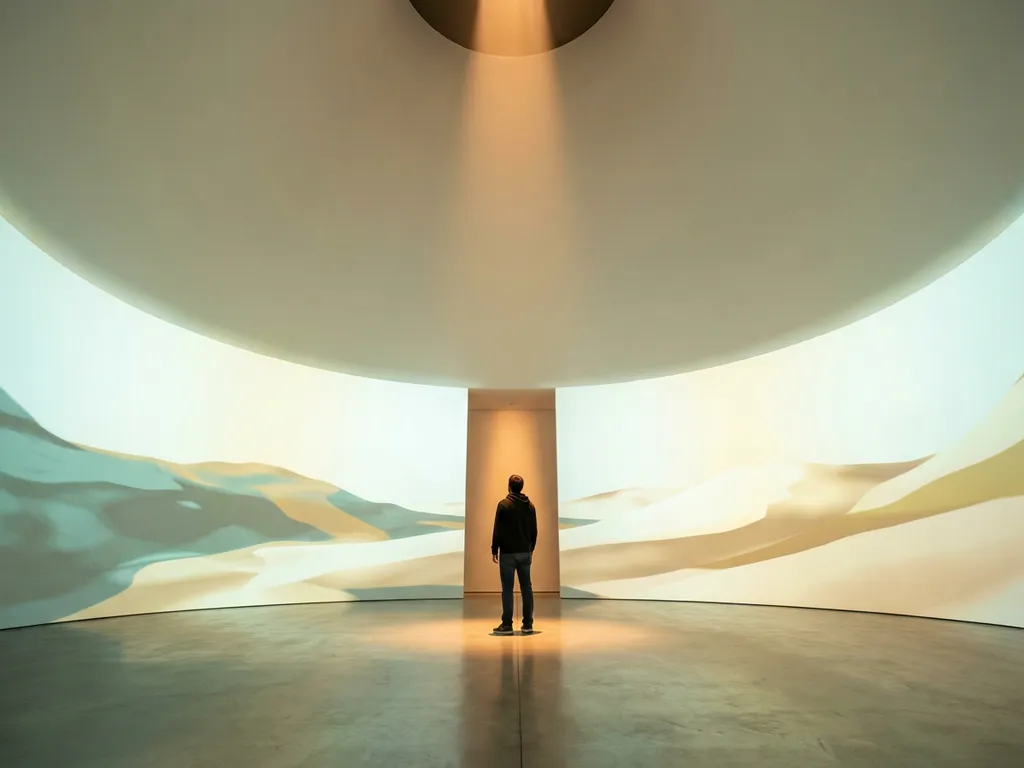
A virtual reality simulation that places medical students inside a human body, a 360-degree dome that transports schoolchildren to the Amazon rainforest, or a VR training module that lets employees practice high-stakes conversations without real-world consequences: these are all examples of immersive learning experiences. What they share is the ability to move learners from passive observation into active participation, using spatial environments, multisensory engagement, and realistic scenarios to make learning stick. The sections below explore the most common formats, real-world applications, and what makes these experiences genuinely effective.
What makes a learning experience truly immersive?
A learning experience becomes truly immersive when it places the learner inside the subject matter rather than in front of it. This means creating an environment where the learner must actively engage, make decisions, and respond to realistic stimuli, not simply watch or listen. The defining quality is presence: the feeling of actually being somewhere or doing something, rather than being told about it.
Several factors work together to produce this effect. Multisensory input is one of the most powerful. When learning engages not just sight and sound but also spatial awareness, touch, or even smell, the brain processes and retains information more deeply. Research in cognitive science consistently shows that multisensory experiences strengthen memory encoding, which is why traditional lecture formats often fall short for complex or emotionally demanding topics.
Interactivity is the second critical ingredient. Passive consumption, watching a video, reading a slide deck, activates only surface-level engagement. When learners must make choices, solve problems, or navigate consequences within an experience, they develop genuine understanding rather than surface familiarity. This is why immersive formats are particularly effective for topics like empathy-building, safety training, or cultural awareness, where emotional engagement and behavioral change are the real goals.
Finally, contextual realism matters. The more closely an immersive environment mirrors the actual conditions in which a skill or understanding will be applied, the more effectively learning transfers to real life. A firefighter who has practiced a virtual evacuation scenario responds differently in an actual emergency than one who has only read the protocol.
What are the most common types of immersive learning experiences?
The most common types of immersive learning experiences include virtual reality simulations, augmented reality overlays, 360-degree video environments, interactive installations, and mixed reality applications. Each type offers a different balance of immersion depth, accessibility, and production complexity, making some formats better suited to certain learning objectives than others.
- Virtual Reality (VR) simulations: Learners wear a headset and enter a fully digital environment where they can interact with objects, characters, and scenarios. Used widely in medical training, safety education, and empathy-building programs.
- Augmented Reality (AR) overlays: Digital content is layered onto the physical world through a smartphone or headset. Effective for contextual learning, such as visualizing how machinery works or bringing historical sites to life.
- 360-degree video: Filmed or rendered environments that surround the viewer in all directions. Lower in interactivity than full VR but highly effective for perspective-taking and documentary-style learning.
- Interactive installations: Physical spaces designed with sensors, projections, and responsive technology that react to the learner’s presence and behavior. Common in museums, science centers, and public education campaigns.
- Mixed Reality (MR): Real-time blending of physical and digital elements, enabling learners to interact with virtual objects in their actual environment. Emerging strongly with spatial computing devices.
The right format depends on the learning objective, the audience, the available infrastructure, and the depth of engagement required. Many of the most effective programs combine more than one format within a single experience.
How does VR create an effective immersive learning experience?
VR creates an effective immersive learning experience by triggering the brain’s sense of presence, the psychological state of feeling physically located within a virtual environment. When presence is achieved, the brain responds to virtual events with real emotional and physiological reactions, which deepens memory encoding and accelerates behavioral learning in ways that screen-based methods cannot replicate.
The mechanism works on several levels. First, VR removes the distractions of the physical world. When a learner puts on a headset, peripheral interruptions disappear and attention narrows to the experience itself. This focused state is cognitively similar to the deep engagement associated with flow, which is one of the most effective conditions for learning.
Second, VR enables safe failure. In a virtual environment, a trainee can make mistakes, misjudge a chemical reaction, misread a patient’s symptoms, or handle a difficult conversation poorly, without real-world consequences. This freedom to fail repeatedly and learn from each attempt accelerates skill development dramatically, particularly in high-stakes professional contexts.
Third, VR enables perspective-taking at a depth that no other medium matches. A learner can inhabit the viewpoint of another person, experience a different time period, or navigate a scenario from an unfamiliar cultural context. This capacity for embodied empathy makes VR particularly powerful for social impact education, diversity and inclusion training, and awareness campaigns around issues like poverty, displacement, or disability.
What is an example of immersive learning in education?
One of the clearest examples of immersive learning in education is a VR field trip that transports students to environments that are physically inaccessible, the surface of Mars, the interior of a cell, or a historical event like the construction of the Berlin Wall. Instead of reading about the topic, students navigate the space, interact with elements, and experience the subject from the inside.
Another compelling example is the use of AR in science education, where students point a tablet at a diagram and watch a 3D model of the human heart animate in real time, allowing them to rotate it, zoom in, and observe how blood flows through each chamber. This kind of spatial, hands-on exploration is far more effective for understanding complex biological systems than static illustrations.
We have developed immersive education programs for institutions including universities and vocational training centers, combining custom VR environments with guided learning frameworks that align with curriculum goals. These programs are designed not just to impress but to produce measurable improvements in comprehension, retention, and learner motivation, particularly for subjects that are abstract, emotionally demanding, or difficult to demonstrate in a traditional classroom.
SDG-focused learning pods are another format gaining traction in 2026. These combine physical installations with VR content to help young learners engage with global challenges like climate change or food security through direct, embodied experience rather than statistics and lectures.
What is an example of immersive learning for corporate training?
A strong example of immersive learning in corporate training is a VR simulation that places employees in realistic, high-pressure scenarios they are likely to face on the job, a difficult client conversation, a workplace safety emergency, or a cross-cultural negotiation. The employee must respond in real time, and the simulation adapts based on their choices, providing immediate feedback and the opportunity to repeat the scenario with different decisions.
This format has proven particularly effective in industries where errors are costly or dangerous, such as healthcare, manufacturing, aviation, and financial services. Rather than sitting through a compliance video and clicking through a quiz, employees experience the consequences of their decisions in a controlled environment, which produces far stronger behavioral change.
Leadership development is another growing application. Organizations use immersive role-play simulations to help managers practice delivering difficult feedback, managing team conflict, or navigating ethical dilemmas. AI-driven characters within these environments can respond dynamically to the learner’s tone, word choice, and decision-making, making each session feel genuinely unpredictable and realistic.
The advantage over traditional e-learning is not just engagement: it is transferability. Skills practiced in a realistic immersive environment carry over to actual workplace behavior more reliably than skills learned through passive instruction.
How do museums use immersive experiences for learning?
Museums use immersive experiences for learning by creating environments where visitors become active participants in the story of a collection, rather than passive observers walking past glass cases. This might take the form of a 360-degree projection dome that places visitors inside an ancient civilization, an AR layer that animates artifacts when viewed through a device, or a VR experience that reconstructs a historical event in full spatial detail.
The motivation behind this shift is both cultural and strategic. Visitor expectations have changed significantly, particularly among younger audiences who have grown up with interactive digital environments. Museums that offer only static displays increasingly struggle to attract and retain these visitors. Immersive technology gives cultural institutions a way to deepen engagement with their collections without compromising the integrity of the artifacts themselves.
AR is especially well-suited to museum contexts because it enhances rather than replaces the physical object. A visitor standing in front of an ancient Egyptian relief can use a device to see the original colors reconstructed in digital form, watch a short animated sequence depicting the scene, or access a layered narrative that connects the artwork to its historical context. The physical artifact remains the anchor; the digital layer adds depth.
Interactive installations in museum spaces also create social learning moments, experiences that visitors share with each other in real time, sparking conversation and emotional connection that extend the impact of the visit long after they leave.
What’s the difference between immersive learning and experiential learning?
Immersive learning is a subset of experiential learning. Experiential learning is the broader pedagogical principle that people learn most effectively through direct experience and reflection, learning by doing rather than by being told. Immersive learning applies that principle through technology-driven environments that simulate or recreate experiences with a high degree of realism and sensory engagement.
All immersive learning is experiential, but not all experiential learning is immersive. A cooking class, an outdoor team challenge, or a live role-play exercise are all forms of experiential learning that do not require any technology. What makes immersive learning distinct is the use of spatial environments, extended reality (XR) technologies, and multisensory design to create experiences that would otherwise be impossible, inaccessible, or too risky to stage in reality.
The practical difference matters when choosing the right format for a learning objective. Experiential learning works well when real-world environments and materials are available and appropriate. Immersive learning becomes the stronger choice when the subject matter involves environments that cannot be visited, scenarios that carry real risk, emotional perspectives that require embodied empathy, or scale that demands a repeatable, consistent delivery format across many learners simultaneously.
In 2026, the most sophisticated learning programs tend to blend both approaches, using immersive technology to create the initial experience and then building in structured reflection, discussion, and application to complete the learning cycle.
How do you measure the impact of an immersive learning experience?
The impact of an immersive learning experience is measured through a combination of behavioral indicators, knowledge assessments, emotional response data, and long-term outcome tracking. No single metric captures the full picture: effective measurement frameworks look at what learners know, how they feel, and most importantly, how they behave differently after the experience.
Knowledge and comprehension are the most straightforward to measure. Pre- and post-experience assessments test whether learners have acquired the intended information or understanding. These can be embedded directly within the immersive environment, making the assessment feel like part of the experience rather than a separate test.
Behavioral change is the more meaningful and more challenging metric. For corporate training, this might mean tracking whether employees apply new protocols correctly in the weeks following a simulation. For educational programs, it might mean measuring whether students demonstrate deeper conceptual understanding in subsequent coursework. For social impact campaigns, it might mean tracking whether participants take a specific action, donating, volunteering, or changing a behavior, after the experience.
Emotional engagement data is increasingly available through biometric tools and in-session interaction analytics. Time spent in different areas of an experience, decision patterns, and physiological responses like heart rate variability can all indicate the depth of engagement and the emotional resonance of specific moments.
Retention over time is perhaps the most telling measure of all. Studies in cognitive psychology consistently show that multisensory, emotionally engaging experiences are remembered far longer than information delivered through traditional media. Measuring recall at intervals of two weeks, one month, and three months after an immersive learning program provides strong evidence of its lasting impact.
If you are designing a learning program and want to understand how immersive technology could deepen its impact and make outcomes measurable, we would be glad to explore what that could look like for your specific context. Feel free to reach out through our contact page to start the conversation.
Gerelateerde artikelen
- What is an example of a brand activation?
- How to create a brand activation?
- What are the 5 dimensions of experiential marketing?
- What are the three types of virtual reality?
- What are the benefits of having sensory experiences?
- What are two examples of experiential marketing?
- What are the 5 sensory memories?
- How to design an immersive experience?
- What are the psychological effects of immersion?