
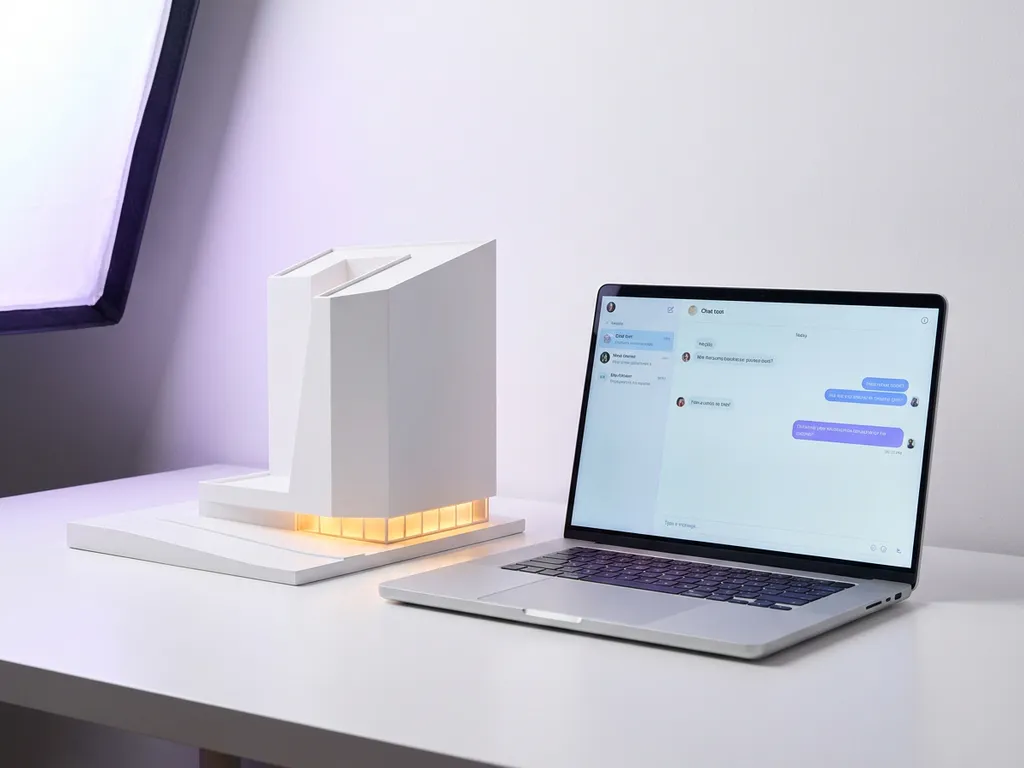
ChatGPT cannot generate 3D models directly. It is a large language model that produces text, code, and, in some versions, 2D images, but it has no native capability to output 3D geometry, meshes, or model files. That said, ChatGPT can play a meaningful supporting role in a 3D modeling workflow by generating code, writing prompts for dedicated tools, or helping structure a production pipeline.
Understanding exactly what ChatGPT can and cannot do matters enormously for creative teams building immersive experiences, interactive installations, or AR and VR content. The sections below unpack the real capabilities, the right tools for the job, and how AI fits into professional 3D and immersive production in 2026.
What can ChatGPT actually generate when asked for a 3D model?
When asked to create a 3D model, ChatGPT can generate text-based representations of geometry, such as code in OpenSCAD, Python scripts using libraries like Blender’s bpy API, or raw vertex and face data in plain text. It cannot produce a rendered mesh, a textured asset, or a downloadable model file. What it outputs is always text, never geometry.
In practice, this means ChatGPT can write a Blender Python script that, when run inside Blender, generates a parametric shape. It can produce OpenSCAD code that describes a 3D-printable object. It can also write Three.js or Babylon.js code that renders a simple geometric form in a browser. These are genuinely useful outputs, but they require a separate application to interpret and render the result.
For teams working on immersive experiences, this distinction is critical. ChatGPT is a code generator and workflow assistant, not a geometry engine. Expecting it to hand you a usable 3D asset will lead to frustration. Using it to accelerate the scripting and technical side of a 3D pipeline, however, can save real time.
What’s the difference between ChatGPT and dedicated AI 3D modeling tools?
The core difference is that ChatGPT is a general-purpose language model, while dedicated AI 3D modeling tools are purpose-built to generate actual 3D geometry from text or image prompts. Tools like Meshy, Luma AI, Kaedim, and Tripo3D output mesh files, UV maps, and textures, the actual building blocks of a 3D asset. ChatGPT outputs text that describes or scripts geometry.
Dedicated AI 3D tools use diffusion models, neural radiance fields (NeRFs), or multiview reconstruction techniques trained specifically on 3D datasets. This gives them the ability to infer spatial structure, generate topology, and produce files in formats like OBJ, FBX, or GLB. ChatGPT has no equivalent training on 3D geometry and no generation pipeline for spatial data.
Another meaningful difference is quality control and artistic fidelity. Dedicated tools are improving rapidly in 2026 and can now produce assets suitable for use in real-time AR and VR environments, though they still often require cleanup by a human artist. ChatGPT-generated code, by contrast, tends to produce simple parametric shapes rather than organic, detailed, or stylistically nuanced models.
For teams building immersive experiences that require high-quality, emotionally resonant environments, neither ChatGPT nor current AI 3D tools fully replace skilled 3D artists. They are accelerants, not replacements.
How can ChatGPT assist in a 3D modeling workflow?
ChatGPT can assist in a 3D modeling workflow by handling the surrounding technical and creative tasks that do not require geometry generation: writing scripts, generating prompts for other AI tools, drafting scene descriptions, debugging shader code, and helping artists move faster through repetitive or complex technical steps.
Concrete use cases include:
- Blender scripting: Automating repetitive tasks like batch renaming objects, generating procedural geometry, or setting up lighting rigs via Python scripts
- Prompt engineering: Writing detailed, optimized text prompts for dedicated AI 3D tools like Meshy or Tripo3D to improve output quality
- Shader and material code: Writing GLSL or HLSL shader code for custom visual effects in game engines like Unreal Engine or Unity
- Scene planning: Helping art directors structure a scene hierarchy, define asset lists, or write creative briefs for 3D artists
- Documentation: Generating technical documentation for 3D pipelines, naming conventions, or asset delivery specifications
- Three.js and WebXR development: Writing JavaScript code that places and animates 3D objects in browser-based AR or VR experiences
For immersive experience studios, the most practical application is using ChatGPT as a technical co-pilot alongside the artists and developers who own the actual creative output. It reduces friction in the workflow without replacing the human judgment that gives a 3D environment its emotional depth.
What file formats can ChatGPT output for 3D use?
ChatGPT cannot output binary 3D file formats like OBJ, FBX, GLB, GLTF, STL, or USD. It can only produce text. However, some 3D formats are text-based, and ChatGPT can generate content in those formats, most notably OpenSCAD (.scad), basic OBJ files written as plain text, and SVG files for 2D shapes used in 3D extrusion workflows.
A plain-text OBJ file is technically possible for very simple geometry, a cube, a cylinder, a flat plane, because OBJ stores vertex positions and face indices as human-readable numbers. ChatGPT can write this by hand for basic shapes. For anything complex, the output becomes unwieldy and error-prone.
The more reliable approach is using ChatGPT to write code that generates and exports 3D files. A Blender Python script, for example, can create geometry programmatically and then export it as a GLB file ready for use in AR or VR. The script itself is what ChatGPT produces; Blender does the actual geometry work and file export.
For teams building assets for AR experiences or real-time 3D environments, GLB and GLTF are the most practical formats because they are web-native and widely supported across AR frameworks. ChatGPT can help write the export logic for these formats within a Blender or Three.js pipeline.
Which AI tools actually generate 3D models from text prompts?
Several dedicated AI tools now generate usable 3D models from text or image prompts. The leading options in 2026 include Meshy, Tripo3D, Luma AI, Kaedim, CSM (Common Sense Machines), and Stability AI’s Stable Zero123. Each takes a different technical approach and produces assets with varying levels of quality and editability.
Text-to-3D tools
Meshy and Tripo3D are among the most accessible text-to-3D tools, allowing users to type a description and receive a textured mesh within minutes. Output quality has improved substantially, and both tools now produce assets usable in real-time environments after moderate cleanup. They work best for environmental props, architectural elements, and stylized objects rather than highly detailed character models.
Image-to-3D tools
Luma AI and CSM take a different approach, reconstructing 3D geometry from one or more 2D images using neural radiance fields or multiview diffusion. This is particularly powerful for digitizing real-world objects, a capability directly relevant to creating digital twins of products or spaces. The output can be refined into production-ready assets for use in AR overlays, virtual showrooms, or interactive installations.
It is worth noting that all current AI 3D tools produce assets that typically require some degree of manual refinement by a skilled 3D artist before they are ready for high-quality immersive use. Topology, UV mapping, and texture fidelity still benefit from human oversight, particularly when the asset will be experienced up close in a VR headset or AR overlay.
Should creative and immersive experience teams use AI for 3D asset creation?
Yes, creative and immersive experience teams should integrate AI into their 3D asset creation workflows, but as a production accelerant rather than a replacement for skilled artists. AI tools reduce the time and cost of generating base assets, prototyping environments, and exploring visual directions, freeing human artists to focus on the refinement, storytelling, and emotional nuance that make an immersive experience genuinely compelling.
The strongest case for AI-assisted 3D creation is in early-stage concepting and rapid prototyping. Being able to generate a rough 3D environment from a text description in minutes, rather than hours, compresses the creative iteration cycle significantly. Teams can explore more directions, make better decisions earlier, and arrive at a stronger final concept with less wasted effort.
There are genuine limitations to keep in mind. AI-generated assets often lack the intentionality that skilled 3D artists bring to topology, material behavior, and spatial composition. In experiences designed to create emotional impact, trigger empathy, or communicate complex ideas, the quality of the environment matters deeply. A slightly wrong scale, an unconvincing material, or a geometry artifact can break the sense of presence that makes an immersive experience work.
The most effective approach in 2026 is a hybrid pipeline: use AI tools to generate base assets and rough environments, use ChatGPT to accelerate scripting and technical workflows, and invest skilled human artistry in the final mile of quality, storytelling, and spatial design. This is the philosophy we bring to every project at Rooftop Immersive, where the technology serves the experience rather than defining its limits.
If you are building an immersive project that requires high-quality 3D assets, whether for an AR activation, a VR education module, or a spatial installation, the right combination of AI tools and human craft makes all the difference. We would love to explore what that looks like for your specific goals, so feel free to contact us and start the conversation.
Gerelateerde artikelen
- How can engagement with a visitor show be measured?
- How do you make an experience center interactive?
- What kind of technology is used in museums?
- What is the relationship between sensory experience learning and retention?
- How do you optimize spatial design for different audiences?
- How do you align immersive experiences with brand identity?
- Should I use AR filters for my product launch?
- How to create an immersive experience?
- Do 3D artists get paid well?