
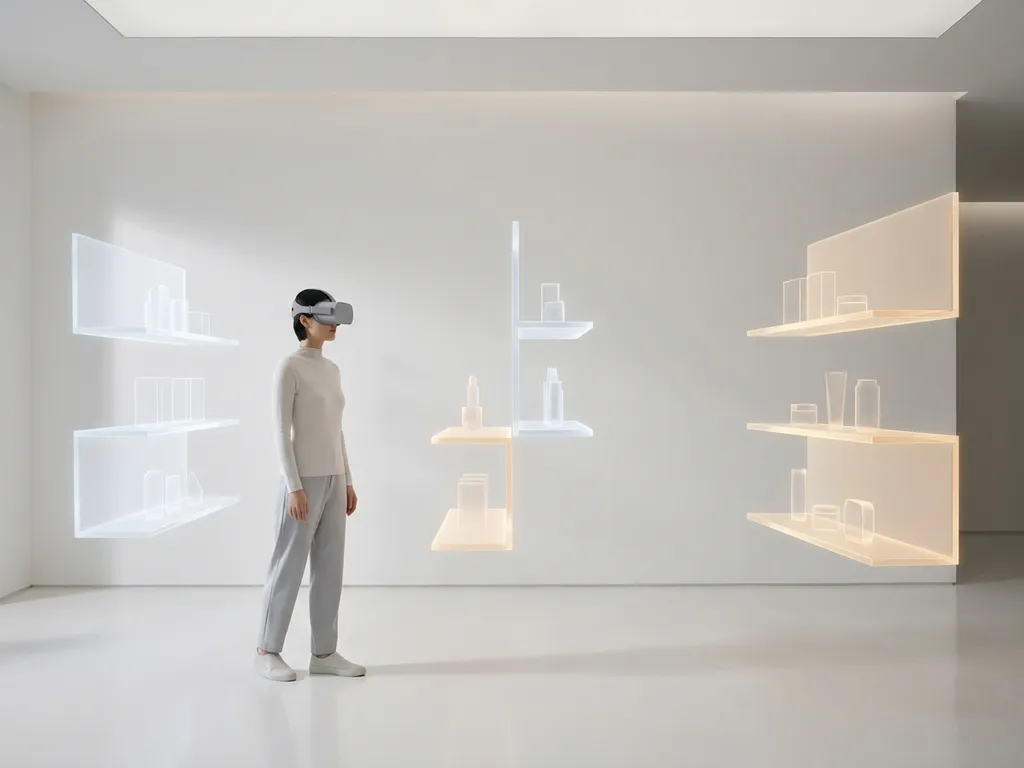
One well-known example of VR in retail is the virtual showroom: a fully navigable, three-dimensional space where customers explore products, configure options, and make purchasing decisions without ever entering a physical store. Brands across automotive, fashion, furniture, and luxury goods have deployed this format to extend their reach, reduce physical infrastructure costs, and create experiences that feel genuinely memorable rather than transactional. The sections below unpack exactly how these applications work, where they deliver the strongest results, and when VR is the right investment over other immersive formats.
How are retailers actually using VR today?
Retailers are using VR today primarily in three ways: virtual showrooms that replace or supplement physical stores, interactive product configuration tools that let customers personalise items before purchase, and immersive brand storytelling experiences that deepen emotional connection. These applications share a common goal: turning passive browsing into active, memorable engagement that influences buying decisions.
In practice, automotive brands allow customers to sit inside a car model, change the paint finish, open the sunroof, and explore the interior in full spatial detail, all from a dealership kiosk or from home. Furniture retailers let shoppers place true-to-scale virtual sofas inside a representation of their own living room. Luxury fashion houses have used VR runway experiences to transport guests to virtual show venues, creating exclusivity and emotional resonance that a product page simply cannot replicate.
What distinguishes effective retail VR from a novelty gimmick is purposeful design. The technology works when it solves a real friction point in the buying journey, whether that is the inability to see a product at full scale, the difficulty of imagining how something fits in a personal space, or the challenge of conveying craftsmanship and quality through flat imagery. When VR removes that friction, it earns its place in the retail experience.
What is a virtual showroom and how does it work in retail?
A virtual showroom is a digitally rendered, three-dimensional environment that replicates or reimagines a physical retail or exhibition space. Customers navigate it using a VR headset, a desktop browser, or a mobile device, exploring products at realistic scale, interacting with them, and often completing a purchase within the same experience. It works by combining 3D modelling, spatial audio, and interactive logic to simulate the sensory richness of a physical visit.
The build process typically begins with high-fidelity 3D models of the products themselves, whether created from scratch or generated through photogrammetric scanning of real objects. These assets are then placed inside a designed environment, which might be a faithful digital replica of a flagship store, an entirely conceptual space, or a brand world that could never exist physically. Navigation is built around intuitive controls so that users with no prior VR experience can move through the space naturally.
The most commercially effective virtual showrooms integrate product configuration directly into the experience. A customer does not just look at a chair; they choose the fabric, the leg finish, and the dimensions, then see the final version rendered in real time. This configuration layer transforms the showroom from a viewing experience into a decision-making tool, which is where the measurable commercial value is generated.
For brands with wide product ranges or geographically dispersed audiences, virtual showrooms also solve a logistics problem. A single digital environment can serve thousands of simultaneous visitors across different markets, in multiple languages, without the overhead of physical retail space. That scalability is one of the most compelling arguments for the format.
How do virtual fitting rooms work?
Virtual fitting rooms use augmented or virtual reality to overlay clothing, accessories, or cosmetics onto a digital representation of the customer, allowing them to see how items look on their body before purchasing. The technology works by mapping the customer’s body dimensions, skin tone, or facial features and then applying a real-time rendered version of the product to that representation.
There are two main technical approaches in use today. The first uses a smartphone camera and AR to overlay items directly onto a live video feed of the customer, a method common in cosmetics and accessories where precise fit matters less than visual appearance. The second uses a more detailed body scan or avatar, either through a dedicated in-store kiosk or a depth-sensing camera, to create a proportionally accurate model onto which garments are draped with realistic fabric simulation.
The challenge virtual fitting rooms address is the high return rate in online fashion retail, which is driven largely by fit uncertainty. When customers can see how a garment falls on a body close to their own proportions, the decision becomes more confident and returns decrease. Retailers that have deployed these systems consistently report improvements in conversion rates and reductions in post-purchase regret, not because the technology is perfect, but because it reduces the gap between expectation and reality.
In-store kiosks take this further by allowing customers to try on entire outfits in seconds, without the effort of a physical changing room. This speeds up the browsing process and encourages customers to experiment with combinations they might not have considered, which tends to increase average basket size.
What’s the difference between VR and AR in a retail context?
In retail, the key difference between VR and AR is the relationship to the physical environment. VR replaces the physical world entirely with a digital one, requiring a headset and creating a fully enclosed experience. AR overlays digital content onto the real world, typically through a smartphone camera or AR glasses, allowing the customer to remain in their actual environment while interacting with virtual elements.
This distinction has direct implications for where each technology fits in the retail journey. VR is best suited to experiences that benefit from full immersion: a virtual showroom where the brand controls every visual element, a product demonstration that requires spatial scale, or a storytelling experience designed to create deep emotional engagement. The enclosed nature of VR demands that the customer actively chooses to enter the experience, which makes it more appropriate for considered purchases or high-involvement brand moments.
AR, by contrast, integrates into the customer’s existing context. Pointing a phone at a living room and seeing a virtual sofa placed within it, scanning a product label to unlock additional information, or using a beauty app to try on a lipstick shade are all AR interactions that happen within the customer’s real environment. The lower barrier to entry makes AR more suitable for everyday retail touchpoints, impulse-driven categories, and top-of-funnel brand awareness.
The two technologies are not in competition. Retailers with sophisticated immersive strategies often use AR for broad reach and low-friction engagement, then deploy VR for deeper, higher-commitment experiences at key moments in the customer journey, such as a flagship store visit, a trade show activation, or a premium product launch.
Which retail sectors benefit most from VR experiences?
The retail sectors that benefit most from VR are those where the gap between a product’s digital representation and its physical reality is widest. Automotive, luxury goods, furniture and interiors, fashion, and real estate consistently see the strongest results, because in each of these categories the customer’s inability to fully evaluate a product remotely is a significant barrier to purchase.
Automotive is arguably the most mature retail VR sector. The cost and logistics of maintaining full physical inventory across every configuration make virtual showrooms commercially compelling, and the considered, high-involvement nature of a car purchase means customers are willing to invest time in an immersive experience. Luxury goods benefit for different reasons: VR can communicate craftsmanship, heritage, and brand world in ways that photography cannot, making it a powerful tool for premium positioning.
Furniture and interiors gain from VR’s ability to render products at true scale within a spatial context. Seeing a dining table at actual dimensions in a virtual room eliminates the guesswork that drives hesitation and returns. Fashion benefits through virtual fitting and styling experiences, particularly for categories like tailoring, outerwear, and footwear where fit is a primary concern.
Beyond these, sectors with complex or technical products, industrial equipment, medical devices, architectural spaces, and bespoke manufacturing also find VR valuable for sales enablement and client presentations, even when the end customer is a business rather than a consumer.
What results do brands see from VR retail activations?
Brands that deploy VR retail activations typically report improvements across three areas: engagement depth, purchase confidence, and brand recall. Customers who experience a product in VR spend more time with it, ask more informed questions, and convert at higher rates than those who engage through standard digital channels. The immersive format creates a quality of attention that flat media cannot reliably produce.
Purchase confidence increases because VR reduces the ambiguity that causes hesitation. When a customer has navigated a virtual showroom, configured a product, and experienced it at scale, the decision to buy carries less uncertainty. This effect is particularly pronounced for high-value, low-frequency purchases where the stakes of getting it wrong are high.
Brand recall is where immersive experiences consistently outperform traditional media. The multisensory, spatially engaged nature of VR activates more cognitive pathways than passive viewing, which means the experience is encoded more deeply in memory. A customer who walked through a virtual brand world remembers it differently, and more durably, than one who watched a product video.
Operational results vary by sector and execution quality. Retailers that integrate VR tightly into their sales process, training staff to use it as a selling tool and connecting it to their product catalogue and checkout flow, see the strongest commercial outcomes. Brands that deploy VR as a standalone novelty, disconnected from the buying journey, see engagement but struggle to translate it into measurable revenue impact.
When should a retail brand invest in VR over other immersive formats?
A retail brand should invest in VR over other immersive formats when full environmental control, spatial scale, or deep immersion is essential to the experience goal. If the brand needs to transport a customer into a world, communicate a product’s physical presence at true scale, or create a high-commitment brand moment that demands undivided attention, VR is the right choice. For lower-friction, higher-frequency touchpoints, AR or interactive screen-based formats are usually more appropriate.
The investment decision should be driven by three practical questions. First, does the product or brand story require a level of spatial or sensory detail that flat media cannot convey? Second, is the customer willing to invest the time and engagement that VR requires? Third, does the commercial value of the purchase or the brand relationship justify the production investment?
Budget and timeline are real considerations. VR experiences require more production depth than AR overlays or interactive digital content, and the factors that influence cost, including the complexity of the 3D environment, the degree of interactivity, the number of product configurations supported, and the hardware deployment model, can vary significantly. Brands that treat VR as a long-term platform rather than a one-off activation tend to achieve better returns, because the core assets and environments can be updated and redeployed across multiple campaigns and contexts.
The strongest signal that VR is the right investment is when the brand has a genuine story to tell that benefits from immersion, and when the audience is in a mindset to receive it. A product launch event, a flagship store experience, a trade show activation, or a premium client presentation are all contexts where the conditions for VR are right. If you are considering how immersive technology could serve your retail or brand strategy, we would welcome the conversation. Contact us to explore what the right format looks like for your specific goals.
Gerelateerde artikelen
- What is an example of an immersive experience?
- How to make museums more interactive?
- Can installation art be interactive?
- What are the three types of VR?
- What is XR (extended reality)?
- Does AR VR require coding?
- How does virtual reality impact society?
- What is an example of immersive training?
- What are branded immersive experiences?