
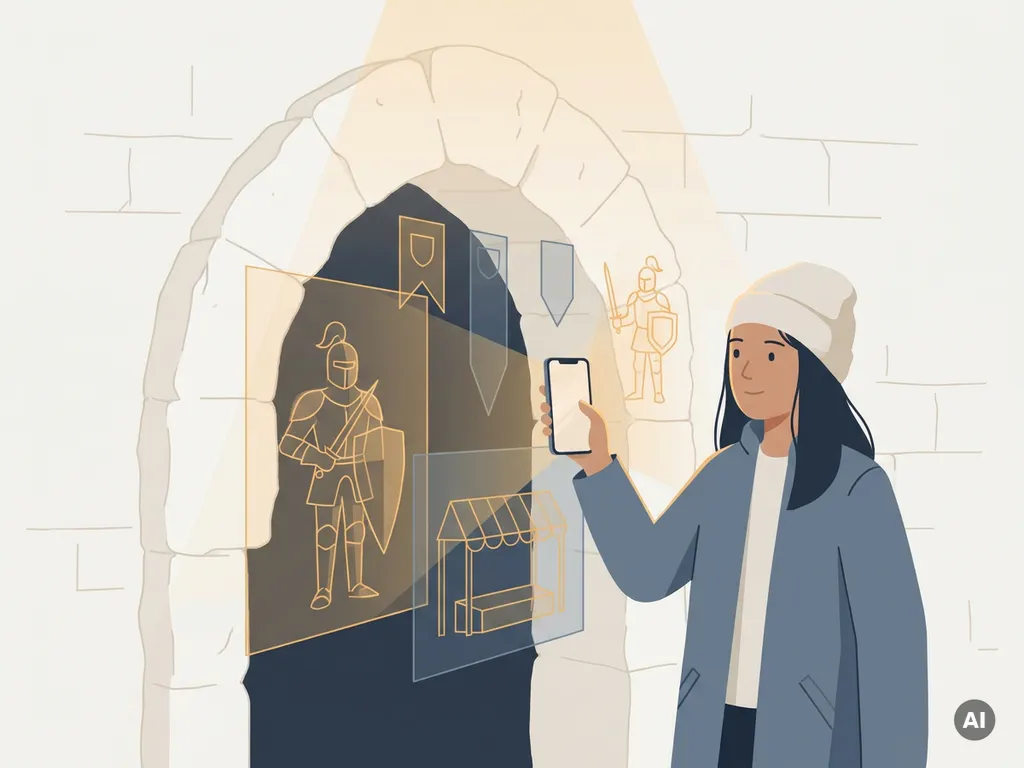
Augmented reality makes heritage accessible to young people by layering interactive digital content directly onto physical spaces and objects, transforming passive observation into active exploration. Instead of reading a label or listening to an audio guide, young visitors can point a device at an artefact and watch it animate, speak, or reveal hidden stories. The sections below unpack exactly how this works, what it looks like in practice, and how cultural institutions can implement it thoughtfully.
Why do young people struggle to connect with traditional heritage?
Young people struggle to connect with traditional heritage because conventional presentation formats, static displays, dense text panels, and guided tours, do not match the interactive, participatory media experiences they grow up with. When a museum or historic site offers only one-way communication, younger audiences disengage quickly, not because they lack curiosity, but because the format fails to meet them where they are.
Several factors compound this disconnect. First, heritage content is often presented in isolation from personal relevance. A Bronze Age tool or a colonial-era document carries enormous significance, but that significance is rarely translated into language or experience that speaks to a teenager’s frame of reference. Second, the physical environment of many heritage institutions, hushed rooms, “do not touch” signs, low lighting, signals that this is not a space designed for active participation. Third, attention spans shaped by interactive digital media make sustained passive engagement genuinely difficult, regardless of intellectual interest.
None of this means young people are indifferent to history, culture, or identity. Research consistently shows that when heritage content is made personally relevant and experientially engaging, younger audiences respond with deep enthusiasm. The challenge is not the audience, it is the delivery mechanism.
What does AR actually do inside a heritage space?
Inside a heritage space, augmented reality overlays digital content, animation, audio, 3D models, video, or interactive prompts, onto the real physical environment, visible through a smartphone, tablet, or AR headset. The physical artefact or space remains fully present; AR adds an interpretive layer on top of it without replacing or obscuring the original.
In practical terms, this means a visitor standing in front of a medieval tapestry can hold up a device and see the figures in the weaving begin to move, narrating the scene they depict. A child walking through an archaeological site can see a digital reconstruction of the original building rise from its foundations. A student examining a historical portrait can trigger a first-person monologue from the subject, delivered by an AI-driven avatar.
The technology works through several underlying mechanisms. Image tracking identifies a specific object or surface and anchors digital content to it. Geospatial AR places content at precise GPS coordinates outdoors, so visitors encounter digital layers tied to exact locations. Marker-free surface detection allows AR content to populate open spaces without requiring QR codes or printed triggers. Each approach serves different heritage contexts, and the most effective implementations choose the mechanism that best serves the story being told rather than the technology for its own sake.
How does AR make heritage content more engaging for younger audiences?
AR makes heritage content more engaging for younger audiences by converting observation into participation. Rather than receiving information, young visitors actively trigger, explore, and interact with content, a shift that dramatically increases attention, emotional investment, and retention. The format speaks a visual and interactive language that younger generations already use fluently.
Several specific mechanisms drive this engagement. Interactivity creates a sense of agency: when a young person causes something to happen, an animation plays, a puzzle unlocks, a hidden layer reveals itself, they feel ownership over the discovery. Gamification elements, such as AR treasure hunts or challenge-based exploration, introduce motivation structures that sustain engagement across an entire visit rather than peaking at one exhibit and fading.
Emotional resonance is equally important. AR can make abstract historical events feel immediate and personal. Seeing a street as it looked a century ago, layered over the same street today, creates a visceral sense of time passing that no text panel can replicate. Hearing a historical figure speak directly to you through an AR hologram twin creates empathy in a way that reading a biography cannot.
Finally, AR is inherently social. Young people naturally share what they discover on their devices, and AR experiences designed with shareable moments extend the heritage institution’s reach far beyond its physical walls, turning visitors into advocates.
What types of heritage experiences can AR enhance?
AR can enhance a wide range of heritage experiences, from indoor museum collections and historic house tours to outdoor archaeological sites, cultural festivals, and public art installations. Any environment where physical context and digital storytelling can reinforce each other is a strong candidate for AR enhancement.
- Museum collections: AR brings individual artefacts to life through animation, contextual reconstruction, and interactive narrative. Visitors engage with objects rather than simply viewing them.
- Historic buildings and sites: AR overlays reconstructions of original structures onto ruins or altered buildings, restoring visual context that time has removed.
- Outdoor heritage trails: Geospatial AR places content at precise locations along a trail, turning a walk through a historic district into a layered journey through different time periods.
- Temporary exhibitions: AR activations can transform a standard exhibition into an immersive event, adding depth and interactivity without permanent infrastructure changes.
- Cultural festivals and public events: AR portals and activations create memorable participatory moments that connect audiences with cultural heritage in unexpected public settings.
- Educational programmes: Schools visiting heritage sites can use AR-guided learning modules that align with curriculum objectives while making the experience genuinely memorable.
The common thread across all these applications is that AR works best when the digital layer serves the physical context rather than competing with it. The strongest heritage AR experiences deepen the meaning of what is already there.
What’s the difference between AR and VR for heritage education?
The key difference between AR and VR for heritage education is presence in the physical space. AR keeps visitors in the real environment and adds digital layers to it; VR replaces the physical environment entirely with a simulated one. Both are powerful tools, but they serve different educational purposes and create different types of engagement.
When AR is the stronger choice
AR is most effective when the physical heritage site or object is itself the primary experience. Standing in a real historic location and seeing AR content anchored to that exact place creates a connection between past and present that is uniquely powerful. AR also scales more easily, visitors use their own devices, no headset distribution is required, and the experience can reach people before and after a physical visit through a downloaded app.
When VR is the stronger choice
VR excels when the physical environment no longer exists or cannot be safely accessed, a destroyed city, a deep archaeological site, a historical event that requires full environmental immersion to understand. VR also enables shared group experiences through synchronised headsets, making it well suited to structured educational programmes where a facilitator guides a cohort through a carefully sequenced narrative. Our immersive experience projects demonstrate how both technologies can be deployed in complementary ways, with AR handling on-site engagement and VR delivering deeper contextual journeys.
For most heritage institutions, the most effective approach is not a choice between AR and VR but a considered combination: AR for broad, accessible, on-site engagement, and VR for deeper, facilitated educational experiences with defined groups.
How can heritage institutions implement AR without losing authenticity?
Heritage institutions can implement AR without losing authenticity by treating the technology as a servant of the story rather than the story itself. The guiding principle is that every digital layer should deepen understanding of what is physically present, never distract from it, trivialise it, or replace the visitor’s direct encounter with the real thing.
Practical implementation requires several deliberate choices. Content development should be led by curatorial and academic expertise, not technology teams alone. The historical accuracy, cultural sensitivity, and interpretive framing of AR content must meet the same standards as any other institutional publication. Technology partners need to understand this and work within it rather than pushing creative directions that prioritise spectacle over substance.
Accessibility is also an authenticity issue. AR experiences that require expensive devices, strong data connections, or high levels of digital literacy exclude the very audiences institutions are trying to reach. Thoughtful implementation designs for the broadest possible access, including offline functionality, multiple language options, and interfaces that work for visitors with varying levels of digital confidence.
Finally, institutions should be transparent with visitors about what is digital interpretation and what is historical record. AR reconstructions are informed interpretations, not certainties, and framing them honestly builds rather than undermines institutional trust.
Which heritage organisations are already using AR successfully?
A growing number of heritage organisations across Europe and beyond are already using AR to deepen visitor engagement, with museums, historic sites, and cultural foundations leading the way. While specific outcomes vary by context, the pattern of adoption is clear: institutions that invest in AR as a core interpretive tool, rather than a temporary novelty, see sustained improvements in visitor engagement, particularly among younger audiences.
Natural history museums have used AR to animate fossil specimens, allowing visitors to see reconstructed creatures move in the space around them. Archaeological sites have deployed geospatial AR to overlay digital reconstructions of original structures onto their ruins. Art museums have used image-tracking AR to reveal the layered history of paintings, underdrawings, earlier compositions, conservation records, in ways that make the curatorial process visible and fascinating to non-specialist visitors.
Cultural heritage foundations working with UNESCO and similar bodies have used AR portals and immersive installations to bring endangered or inaccessible heritage to global audiences, extending the reach of sites that cannot absorb unlimited physical visitors. In the NGO and education space, organisations like UNICEF have explored immersive technologies to build empathy around complex humanitarian contexts, an approach that translates directly into heritage education when institutions want visitors to understand not just what happened, but what it felt like.
The common factor in successful implementations is institutional commitment: AR works when it is integrated into the visitor journey from the ground up, not bolted on as an afterthought.
What should cultural leaders look for in an AR partner?
Cultural leaders should look for an AR partner with demonstrated expertise in both the technology and the storytelling, a studio that understands heritage context, works collaboratively with curatorial teams, and builds experiences that enhance institutional authenticity rather than compromise it. Technical capability alone is not enough; the partner must share the institution’s values around accuracy, accessibility, and long-term impact.
Specifically, evaluate potential partners on the following criteria:
- Portfolio depth: Has the partner delivered AR projects in heritage, education, or cultural contexts? Do their previous projects demonstrate sensitivity to institutional voice and mission?
- End-to-end capability: Can they handle concept development, content creation, technical build, hardware considerations, and ongoing support, or will you be managing multiple vendors?
- Co-creation approach: Do they build with you or for you? The best partners treat curatorial and educational expertise as essential input, not a constraint.
- Accessibility thinking: Do they design for broad access from the outset, including multilingual content, offline functionality, and inclusive interface design?
- Scalability: Can the solution grow with your institution, across multiple galleries, multiple sites, or multiple languages, without requiring a complete rebuild?
- Ethical alignment: For heritage institutions working with sensitive cultural material, does the partner demonstrate genuine understanding of cultural responsibility and data ethics?
We work with cultural institutions, museums, and heritage organisations as a full-service immersive experience studio, from initial concept through to delivery and beyond. If you are exploring how AR can open your collection to younger audiences while honouring the depth and integrity of your heritage, we would welcome the conversation. Reach out through our contact page to start exploring what is possible.
Gerelateerde artikelen
- How do you design an immersive installation for public spaces?
- What are the different types of immersive theater experiences?
- How to make museums more interactive?
- What is an immersive art installation?
- What is the strongest trigger to memory?
- What part of the brain is responsible for sensory memory?
- Can AI make AR?
- What are the benefits of immersive installations for brands?
- How does interactive storytelling engage audiences?