
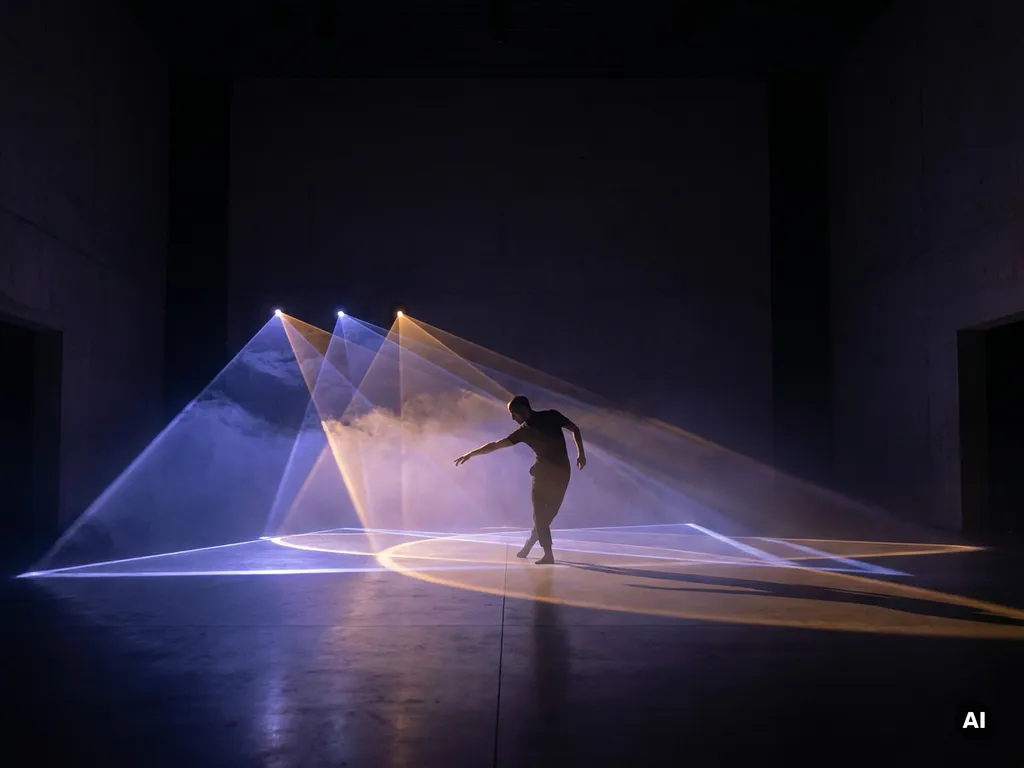
You combine live performance with immersive visuals by integrating real-time rendering engines, projection mapping, LED volumes, and synchronization systems that respond dynamically to what performers do on stage. The result is a unified experience where the digital environment and the human presence feel inseparable rather than layered on top of each other. The questions below unpack the specific technologies, creative decisions, and team structures that make this possible.
What technologies are used to create immersive visuals for live performances?
The core technologies behind immersive live event visuals include real-time rendering engines such as Unreal Engine and Notch, projection mapping systems, high-resolution LED volumes, motion tracking, and spatial audio platforms. These tools work together to transform a physical stage into a living, responsive environment that reacts to performers and audiences in real time.
Each technology serves a distinct role. Rendering engines generate and process visual content on the fly, allowing designers to modify scenes without pre-rendering. Projection mapping wraps imagery onto three-dimensional surfaces, including set pieces, architecture, and even performers themselves. LED volumes, popularized by film and television production, provide high-brightness, physically present light sources that interact naturally with performers and cameras. Motion capture and tracking systems feed positional data back into the visual pipeline so that content can respond to where a performer stands or how they move.
Beyond the visual layer, spatial audio systems, haptic floors, and scent delivery are increasingly part of what defines a truly immersive live event. When all of these elements are designed together from the outset rather than bolted on separately, the experience achieves a depth that audiences feel rather than merely observe.
How does real-time rendering change what’s possible on stage?
Real-time rendering removes the fixed boundary between pre-produced content and live performance by generating visuals frame by frame in response to inputs such as performer position, audio levels, or audience interaction. This means the visual environment can change in the moment, making every performance genuinely unique rather than a replay of a recorded backdrop.
Before real-time pipelines became viable for live stages, designers had to pre-render every visual sequence and trigger it on cue. That approach works well for tightly choreographed productions, but it leaves no room for improvisation, technical adjustment, or audience-driven variation. Real-time engines like Unreal Engine and Notch changed this by allowing visual artists to operate more like musicians in an ensemble: responding, adapting, and improvising within a defined framework.
The practical implications for immersive visuals stage design are significant. Lighting data can drive particle systems. A performer’s heartbeat, captured via a wearable sensor, can ripple through the visual environment. A live audience vote can reshape the narrative arc of a theatrical experience mid-show. Real-time rendering does not just improve quality; it fundamentally expands what a live performance can be.
What’s the difference between projection mapping and LED volumes for live events?
Projection mapping casts light onto physical surfaces to create the illusion of transformation, while LED volumes are self-illuminating panels that physically emit light and serve as both display and practical light source. The choice between them depends on the venue, the desired aesthetic, camera involvement, and the level of physical immersion required.
Projection mapping for live performance
Projection mapping excels at transforming existing architecture and set pieces without replacing them. A stone wall, a curved ceiling, or a performer’s costume can become a canvas. The technology is relatively flexible in terms of surface shape, and it creates a visual effect that the naked eye reads as magical because the surface itself appears to change. However, projection requires controlled ambient light, significant throw distance, and careful calibration. In bright or outdoor environments, image quality degrades quickly.
LED volumes for live events
LED volumes, by contrast, perform in any lighting condition and produce physically present light that wraps around performers and objects in the space. This is why film productions use them to replace green screens. On a live stage, an LED volume creates an environment that performers genuinely inhabit rather than stand in front of. The limitation is cost and physical scale: large LED installations require substantial infrastructure and are less easily reshaped than a projected surface. For touring productions or events with changing venues, this can be a meaningful constraint.
Many of the most ambitious immersive live events now combine both approaches, using LED volumes for primary environments and projection mapping for architectural detail, audience immersion, or moments that require wrapping light around non-flat surfaces.
How do immersive visuals stay in sync with live performers?
Immersive visuals stay in sync with live performers through a combination of timecode systems, real-time tracking, and human operators who manage the visual pipeline during the show. The specific synchronization method depends on whether the performance follows a fixed timeline or allows for improvisation and variation.
For productions with a fixed structure, SMPTE timecode is the industry standard. A master clock drives audio, lighting, video, and automation simultaneously, ensuring that a visual cue fires at the same millisecond every night. This works beautifully for concerts, theatrical productions, and ceremonies where the sequence is locked.
When live improvisation or performer freedom is part of the design, tracking systems take over. Optical tracking, infrared sensors, and even AI-driven computer vision can follow a performer’s position and feed that data into the rendering engine in real time. The visual environment then responds to where the performer is rather than to a pre-set timeline. This approach requires more sophisticated technical design but produces a sense of genuine connection between the human and digital elements that timecode alone cannot achieve.
A skilled video operator, often called a VJ or media server operator, remains essential in either scenario. Technology provides the infrastructure, but a human with creative judgment is still the most reliable way to handle the unexpected moments that define live performance.
Can AR and VR be integrated into live audience experiences?
Yes, both augmented reality and virtual reality can be integrated into live audience experiences, though they serve different purposes and create different relationships between the audience and the performance. AR enhances what audiences see in the physical space, while VR transports individuals into a separate digital environment, which requires careful design to avoid disconnecting them from the live event.
AR is increasingly practical for large-scale live events. Audiences using smartphones or AR glasses can see digital layers overlaid on the stage, revealing hidden narratives, character information, or interactive elements that deepen their engagement without removing them from the shared physical experience. Rooftop Immersive designs AR activations precisely for this kind of layered storytelling, where the physical and digital reinforce each other rather than compete.
VR in a live context works best when it is designed as a complementary experience rather than a simultaneous one. SDG Pods, for example, combine physical installations with VR content that audiences engage with in dedicated stations within the event space. This allows the immersive depth of VR to coexist with the social energy of a live event, giving audiences the choice to go deeper without mandating it. XR live performance design is at its most powerful when it respects the audience’s desire to remain connected to the room, the performers, and each other.
What creative challenges come with merging live and digital elements?
The central creative challenge of merging live and digital elements is maintaining coherence: ensuring that the digital environment feels like an extension of the human performance rather than a competing spectacle. When technology overwhelms the performer, audiences disengage from the human story and become passive observers of a light show.
Timing is another persistent challenge. Live performers breathe, hesitate, improvise, and respond to the energy of the room. Digital systems, unless designed with flexibility built in, run on fixed sequences. Bridging this gap requires both technical solutions and creative restraint: knowing when to lock the visuals to a timeline and when to give operators the freedom to follow the performer.
There is also the challenge of physical integration. Digital visuals exist in a screen or projection layer that performers cannot touch or interact with in a physically meaningful way unless the design specifically accounts for this. Haptic feedback, physical props that trigger digital responses, and spatial audio that shifts based on performer position are all ways to close this gap and create a sense that the performer and the environment are in genuine dialogue.
Finally, the risk of technical failure is amplified in live settings. Unlike a film, a live performance cannot be paused and restarted. Every system in the visual pipeline must have a fallback, and every operator must know what to do when something goes wrong. This is why experienced immersive experience design teams treat resilience as a creative value, not just a technical requirement.
Who should be involved in designing an immersive live performance?
Designing an immersive live performance requires a multidisciplinary team that includes a creative director, a technical director, a visual designer, a media server operator, a sound designer, and ideally a spatial designer who understands how audiences move through and experience physical space. The earlier these roles collaborate, the more integrated the final result will be.
The creative director holds the vision and ensures that every technical decision serves the narrative. The technical director translates that vision into a system architecture that can be reliably executed live. Visual designers and motion graphics artists create the actual content, while the media server operator manages its delivery during the show. Sound designers are often undervalued in this process, but spatial audio is one of the most powerful tools for creating genuine immersion, and it must be designed in parallel with the visual layer, not added afterward.
For productions that incorporate AR, VR, or AI-driven personalization, additional specialists in XR development, real-time 3D, and interaction design become essential. Our projects bring all of these disciplines together under one creative roof, which is one of the most significant advantages in this kind of work: when concept, content, and technical execution are developed by the same team, the result is far more coherent than when they are assembled from separate vendors.
Performers and directors from the live side must also be involved from the earliest stages. The most technically sophisticated visual system will fail if the performers do not understand how to work with it, or if the director has not had the opportunity to shape how the digital environment responds to the human story at the center of the experience. If you are planning a production that merges live performance with immersive technology, we would love to help you build it from the ground up. Contact us to start the conversation.
Gerelateerde artikelen
- What is 360-degree dome projection?
- What are the 4 types of memory in the brain?
- Does AR VR require coding?
- What are two examples of experiential marketing?
- How does virtual reality impact society?
- What is AR content production?
- How can I create shareable brand moments without requiring app downloads?
- How do immersive experiences improve experiential marketing?
- What is the ROI of immersive brand activations?