
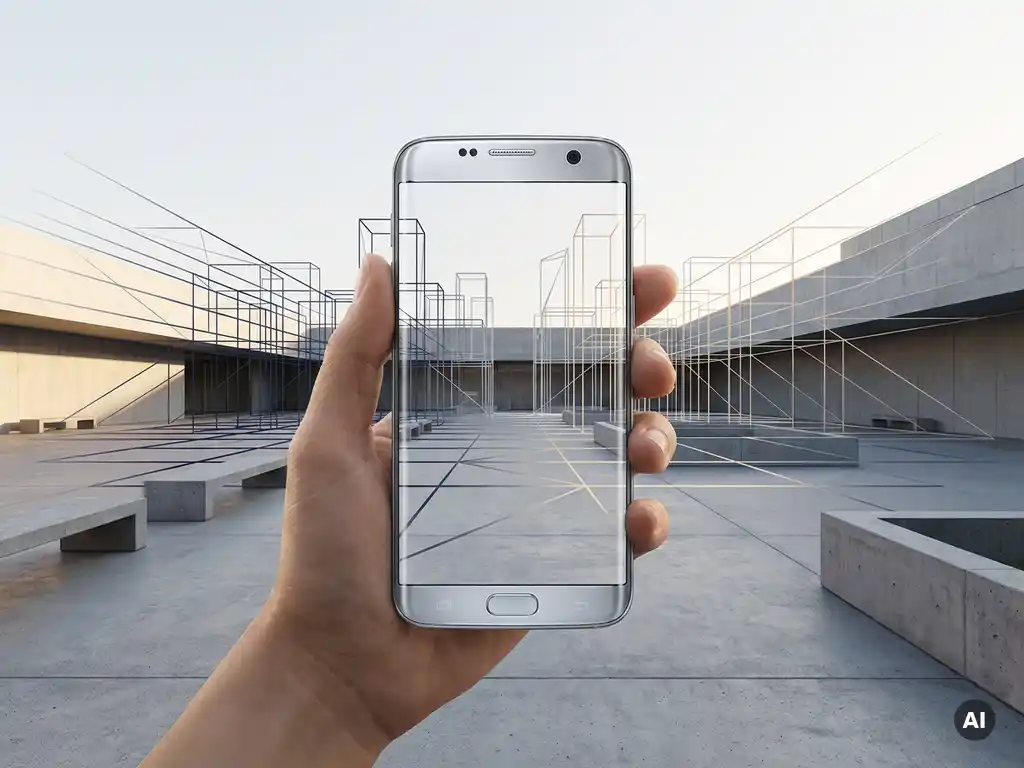
Augmented reality is being used today across retail, healthcare, education, marketing, manufacturing, and cultural institutions, in practical, measurable ways that go well beyond novelty. From IKEA’s furniture visualization tool to surgical training simulations and museum AR overlays, real-world AR applications are reshaping how people learn, shop, work, and experience the world around them. Below, we break down the most compelling augmented reality examples by sector, so you can see exactly how this technology is being applied right now.
Where is augmented reality actually being used today?
Augmented reality is being used today in retail, medicine, education, marketing, manufacturing, tourism, and cultural heritage. Rather than replacing the physical world, AR layers digital information, imagery, or interaction on top of it, making it immediately useful across almost any context where people need to understand, decide, or engage more deeply. In 2026, AR has moved firmly from experimental pilot to mainstream deployment.
The sectors driving the most meaningful adoption include consumer retail, where AR helps shoppers make confident decisions; healthcare, where it supports training and surgical precision; and education, where it turns abstract concepts into tangible, explorable environments. Brands and marketing teams have also embraced AR activations as a way to generate genuine engagement rather than passive impressions. Meanwhile, museums, NGOs, and industrial trainers are using AR to communicate complex ideas in ways that stick.
What unites all these augmented reality use cases is a shared goal: making information more accessible, more emotionally resonant, and more actionable by anchoring it to the real world people already inhabit.
How does IKEA use AR to let shoppers visualize furniture?
IKEA uses AR through its IKEA Place app, which allows shoppers to point their smartphone camera at any room in their home and place true-to-scale 3D models of furniture directly into that space. The app uses the phone’s camera and spatial mapping to anchor virtual objects to real surfaces, so users can walk around the item, check proportions, and assess whether it fits both physically and aesthetically before purchasing.
This is one of the most widely cited real-world AR examples because it solves a genuine, everyday consumer problem: uncertainty about whether a piece of furniture will look right or fit in a specific room. By removing that doubt at the point of consideration, IKEA reduces return rates and increases buyer confidence, a commercially meaningful outcome, not just a technological showcase.
The IKEA Place model has since influenced how other retailers approach product visualization. Home improvement brands, paint companies, eyewear retailers, and automotive manufacturers have all developed comparable AR tools that let customers “try before they buy” in their own environment. The core principle, anchoring a digital product to a real-world context, is now a foundational pattern in retail AR strategy.
What role does AR play in modern surgical and medical training?
In medical training, AR overlays anatomical data, procedural guidance, or real-time imaging onto a trainee’s physical view of a patient or model, allowing them to practice complex procedures with contextual digital information layered directly into their field of vision. This creates a training environment that is both realistic and richly informative, without requiring a live patient.
Medical institutions are using AR headsets and mixed reality platforms to teach surgical techniques, anatomy, and emergency response. Trainees can see a 3D rendering of a heart valve positioned over a physical model, or receive step-by-step procedural prompts while performing a simulated operation. The result is faster skill acquisition and fewer errors when trainees transition to real clinical environments.
Beyond initial training, AR is also being used in operating rooms themselves. Surgeons can view pre-operative imaging, MRI or CT scan data, projected as a spatial overlay during a procedure, helping them navigate anatomy with greater precision. This application of augmented reality in real life represents one of the highest-stakes and most consequential deployments of the technology, where the difference between accurate and inaccurate information has direct consequences for patient outcomes.
How do museums and cultural institutions use AR to enrich exhibitions?
Museums and cultural institutions use AR to add interpretive layers to physical exhibits, bringing artifacts to life with animation, historical context, audio narration, or interactive storytelling that visitors access through a smartphone or AR headset. Rather than replacing the original object, AR deepens the visitor’s relationship with it.
A visitor standing in front of a Roman mosaic might use an AR app to see the mosaic reconstructed in its original colors, or watch an animated scene depicting how it was used in daily life. A natural history museum might overlay a living dinosaur onto a fossil skeleton. A contemporary art institution might use AR to reveal hidden layers of a painting or unlock an artist’s commentary on their own work.
These augmented reality applications serve a strategic purpose beyond engagement: they help museums attract younger, digitally native audiences who expect interactive, participatory experiences. They also allow institutions to tell richer stories without physically altering or endangering irreplaceable objects. At Rooftop Immersive, we design AR museum experiences that treat technology as a storytelling tool, one that amplifies the cultural artifact rather than competing with it. The goal is always to deepen emotional impact, not to distract from it.
What are examples of AR in education and classroom learning?
AR in education includes interactive textbooks where 3D models emerge from the page, virtual field trips to historical sites or ecosystems, science simulations that let students manipulate molecular structures or explore the solar system, and language learning tools that label real-world objects in a target language. These augmented reality applications transform passive reading into active, spatial exploration.
AR in science and STEM learning
Biology students can use AR to explore a fully rendered human body, peeling back layers of tissue to examine organs and systems in three dimensions. Chemistry learners can visualize molecular bonds and reactions at a scale that makes abstract concepts tangible. Physics simulations allow students to manipulate variables, gravity, velocity, mass, and observe outcomes in real time. These experiences make difficult concepts accessible to students who struggle with purely text-based instruction.
AR in history and social studies
History classrooms are using AR to transport students to significant moments and places. A student studying ancient Egypt might point their tablet at a textbook image and watch a pyramid being constructed, or walk through a reconstructed marketplace. Social studies lessons can use AR portals to place students virtually inside communities or environments they would never otherwise encounter, building empathy alongside factual knowledge.
The educational value of these augmented reality examples lies not just in novelty but in retention. Experiential learning, where students interact with content rather than simply receiving it, consistently produces deeper understanding and longer-lasting recall. AR makes experiential learning scalable in ways that physical field trips and laboratory equipment cannot always match.
How do brands use AR for marketing activations and product launches?
Brands use AR for marketing activations by creating interactive experiences, through smartphones, social media filters, or physical installations, that allow consumers to engage with a product, brand world, or campaign narrative in a participatory way. Rather than watching an advertisement, the consumer becomes part of it. This shift from passive to active engagement is the core reason AR has become a serious tool in experiential marketing.
Common augmented reality use cases in brand marketing include virtual try-on (cosmetics, eyewear, footwear), AR product launches where a 3D model of a new product appears in a consumer’s physical space, and event activations where AR triggers unlock exclusive content or experiences. Social media platforms have made AR filters a mainstream behavior, millions of users interact with branded AR effects every day without thinking of it as “augmented reality.”
For product launches specifically, AR allows a brand to create a global, scalable moment of discovery. A consumer in Amsterdam and one in Tokyo can both experience the same AR activation simultaneously, each in their own physical environment. This combination of personalization and scale is difficult to achieve with traditional marketing formats. The most effective brand AR activations are those where the technology serves the story, where the experience reveals something meaningful about the product rather than simply demonstrating that AR is possible.
What is geospatial AR and how is it used in outdoor campaigns?
Geospatial AR is a form of augmented reality that anchors digital content to specific geographic coordinates in the real world, so that AR experiences appear at precise physical locations without requiring QR codes or image markers. Users simply point their device at the right place, and the content appears, tied to latitude, longitude, and altitude rather than to a printed trigger.
In outdoor campaigns, geospatial AR allows brands, NGOs, and city planners to place AR content directly in the environments where it is most relevant. A climate campaign might overlay visualizations of rising sea levels onto actual coastal locations. A tourism board might populate city landmarks with historical reconstructions or guided AR narratives. A brand might create a city-wide AR treasure hunt that drives foot traffic to specific locations.
The absence of QR codes makes geospatial AR feel seamless and discovery-driven, users encounter content naturally as they move through a space, rather than being directed to scan something. This creates a fundamentally different user experience: one that rewards exploration and embeds the brand or message into the fabric of a real place. As a creative immersive studio, we use geospatial AR to design outdoor activations that make cities themselves the canvas for storytelling.
How is AR used in industrial training and workforce development?
In industrial settings, AR is used to overlay step-by-step instructions, safety warnings, equipment schematics, and real-time diagnostic data directly onto machinery and workspaces, allowing technicians and trainees to learn and perform complex tasks without needing to cross-reference printed manuals or pause to consult a supervisor. This hands-free, in-context guidance dramatically reduces errors and accelerates skill development.
Manufacturing companies use AR headsets to guide assembly line workers through precise procedures, highlighting the exact component to be installed and the correct sequence of actions. Maintenance technicians use AR to diagnose equipment faults, with digital overlays identifying failing parts and displaying repair protocols. Energy companies and aerospace firms have deployed AR for safety-critical inspections, where accuracy is non-negotiable.
Workforce development programs are also using AR to onboard new employees faster. Rather than spending weeks in classroom training before touching real equipment, new hires can begin supervised, AR-guided practice on actual machinery from day one, with digital guardrails ensuring they do not make costly or dangerous mistakes. The result is a more confident workforce, a shorter time-to-competency, and a measurable reduction in training-related incidents.
These industrial augmented reality applications share a common thread with every other real-world AR example explored in this article: the technology is most powerful not when it impresses, but when it solves a real problem in a real context. If you are exploring how AR could work for your organization, whether in education, culture, marketing, or training, we would be glad to help you find the right approach. Contact us to start the conversation.
Gerelateerde artikelen
- How to make an interactive exhibit?
- What are the positive effects of virtual reality?
- What is XR vs VR vs AR?
- What part of the brain is responsible for sensory memory?
- What's the difference between VR and immersion?
- How to create a virtual reality experience?
- Is immersive the same as virtual reality?
- Do 3D artists get paid well?
- What equipment is needed for AR content production?