
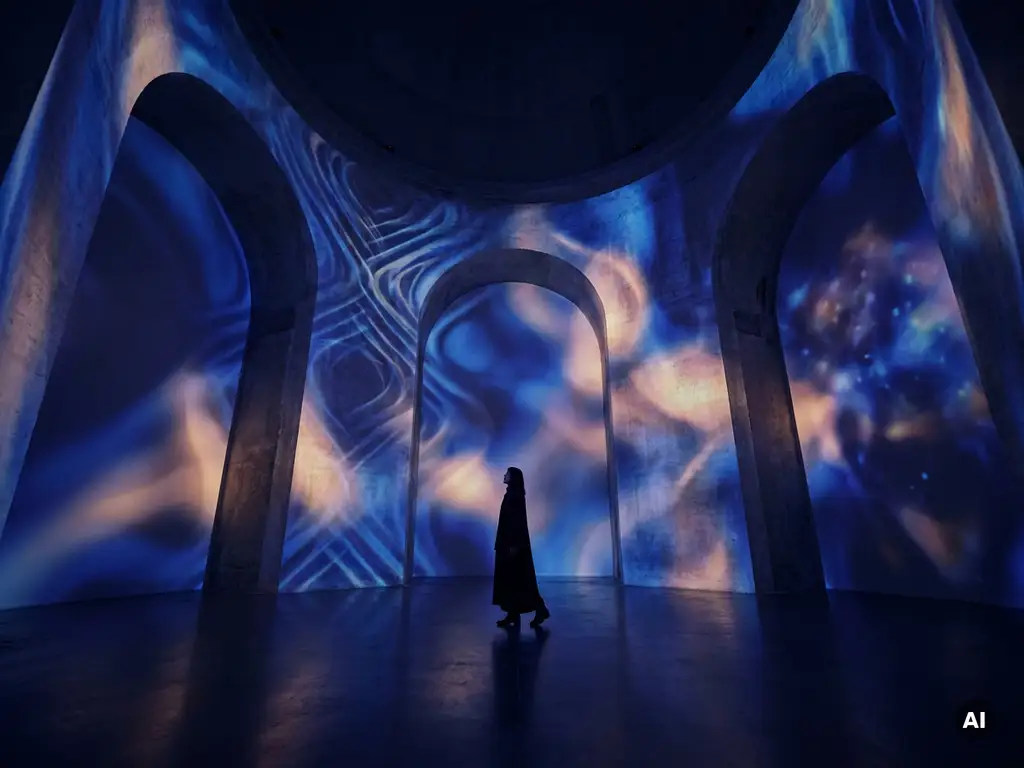
Immersive art refers to artistic experiences that surround and envelop the viewer, transforming passive observation into full sensory participation. Rather than looking at a piece from a distance, audiences step inside the work itself, engaging with light, sound, space, scent, and sometimes touch. Examples range from large-scale projection environments and walk-through installations to virtual reality artworks and multi-sensory theatrical spaces.
What unites all immersive art examples is the shift in relationship between artwork and audience: the viewer becomes part of the composition. This guide works through the most common questions about immersive art, from what defines it to how institutions commission it.
What makes an art experience truly immersive?
An art experience is truly immersive when it displaces the viewer’s ordinary environment and replaces it with a deliberately designed sensory world. The defining quality is spatial envelopment: the artwork surrounds you on multiple sides, removing the conventional frame that separates observer from object. True immersion engages at least three senses simultaneously and demands active presence rather than passive viewing.
Several elements work together to achieve this effect:
- Scale: The work must be large enough to occupy the viewer’s full field of perception, making it impossible to stand outside and observe from a safe distance.
- Sensory layering: Sound, light, scent, temperature, and tactile elements reinforce one another to create a coherent alternative reality.
- Temporal duration: Immersive experiences unfold over time, inviting visitors to linger, explore, and discover rather than glance and move on.
- Responsive feedback: The most powerful examples react to the viewer’s presence, movement, or choices, making each person’s encounter unique.
Emotional resonance is the ultimate test. A technically sophisticated installation that leaves visitors unmoved has not achieved true immersion. The experience needs to create a felt shift in the viewer’s sense of where they are and what they are part of.
What are the most well-known examples of immersive art?
The most recognized immersive art examples include teamLab’s digital nature environments in Tokyo, Yayoi Kusama’s Infinity Mirror Rooms, Random International’s Rain Room, and the large-scale projection experiences pioneered by venues such as Atelier des Lumières in Paris. These works share the ability to transform architectural spaces into living, breathing environments that visitors inhabit rather than merely visit.
Digital and projection-based installations
teamLab Borderless and Planets in Tokyo are among the most visited immersive art installations in the world. Their rooms of flowing digital light and sound respond to visitor movement in real time, creating the sensation of walking through a living painting. Similarly, the Atelier des Lumières format projects the works of historical masters across every surface of a converted industrial space, allowing thousands of people at once to feel enclosed within a Van Gogh or Klimt composition.
Object-based and sculptural immersion
Yayoi Kusama’s Infinity Mirror Rooms use mirrors, LED lights, and reflective pools to dissolve the boundaries of a small chamber into an apparently infinite cosmos. The experience is intensely personal despite its simplicity. James Turrell’s Skyspaces take a different approach, using architectural apertures and precisely controlled light to alter the visitor’s perception of color and sky in ways that feel almost physiological.
These examples demonstrate that immersive art does not require digital technology. What it does require is intentional design of the viewer’s total perceptual environment.
How do museums use immersive art to engage visitors?
Museums use immersive art to deepen emotional connection with collections, attract new and younger audiences, and create shareable moments that extend the institution’s reach beyond its physical walls. By transforming gallery spaces into walk-through environments, museums shift the visitor from passive recipient to active participant, which research consistently links to stronger memory formation and longer dwell times.
Practical applications in museum contexts include:
- Augmented reality overlays that bring historical artifacts to life with additional narrative layers, letting visitors see an object in its original context without leaving the gallery.
- 360-degree projection rooms that place visitors inside a period, a landscape, or an artist’s creative process.
- Interactive digital reconstructions of lost or inaccessible heritage sites, making them experientially present for the first time.
- Sensory enhancement of permanent collections through ambient sound design, scent, and temperature that reinforce the emotional world of specific works or periods.
The most effective museum immersive art programs treat technology as a servant of the story, not the story itself. The goal is always to deepen the visitor’s relationship with the collection, not to distract from it.
What’s the difference between immersive art and interactive art?
Immersive art and interactive art overlap but are not the same. Immersive art prioritizes enveloping the viewer in a designed sensory environment, whether or not they actively control it. Interactive art specifically requires viewer input to function, placing agency and participation at the center of the experience. You can be inside an immersive work without doing anything; interactive art only comes alive through what you do.
A useful way to think about the distinction: all interactive art can be immersive, but not all immersive art is interactive. A vast projection environment that surrounds you with moving imagery is immersive even if you stand still. A pressure-sensitive floor that generates sound only when you walk on it is interactive, and may also be immersive depending on its scale and sensory depth.
In practice, the most compelling contemporary installations combine both qualities. They envelop visitors in a complete sensory world while also responding to individual presence and choice, creating experiences that feel both epic in scale and personally meaningful.
How does technology power immersive art installations?
Technology powers immersive art installations through the integration of spatial computing, real-time rendering, sensor networks, and multi-channel audiovisual systems. The specific tools vary widely, but the underlying principle is consistent: technology is used to control every variable in the viewer’s perceptual environment simultaneously, creating coherence across senses that would be impossible to achieve through physical materials alone.
Key technologies driving immersive art experiences in 2026 include:
- Real-time 3D rendering engines such as Unreal Engine and Unity, which generate responsive visual environments that react to input without pre-rendering delays.
- Spatial audio systems that position sound in three-dimensional space, making the sonic environment as enveloping as the visual one.
- Computer vision and depth sensors that track visitor movement and feed that data into responsive systems, enabling the artwork to adapt to each person’s presence.
- Projection mapping onto complex architectural surfaces, making walls, floors, and ceilings part of the canvas.
- Virtual and augmented reality headsets that create fully portable immersive environments independent of any physical installation.
- AI-driven personalization that adapts the narrative, pacing, or content of an experience based on who is engaging with it.
The most sophisticated installations layer several of these technologies, with each system informing the others in real time. The result is an environment that feels alive and responsive rather than pre-programmed.
Can immersive art be used outside of galleries and museums?
Immersive art can absolutely be used outside of galleries and museums, and some of the most impactful examples exist in entirely different contexts. Brand activations, public space installations, educational environments, corporate events, festivals, and NGO awareness campaigns have all embraced immersive art as a powerful communication tool. The format travels wherever there is a need to create genuine emotional engagement.
In commercial settings, brands use immersive brand experiences to create memorable product launches and experiential campaigns that generate both in-person impact and social sharing. In education, immersive environments allow students to walk through historical events, biological systems, or abstract mathematical concepts in ways that no textbook or screen can replicate. In the public sector and NGO space, immersive storytelling has proven particularly effective at building empathy around complex social issues, shifting audiences from intellectual awareness to felt understanding.
Outdoor and geospatial applications are expanding rapidly. Augmented reality experiences tied to GPS coordinates can transform city streets, parks, and heritage sites into layered narrative environments without any permanent physical infrastructure. This portability and scalability make immersive art one of the most versatile formats available to communicators working across sectors.
What should you look for when commissioning an immersive art experience?
When commissioning an immersive art experience, the most important factors are creative alignment, technical capability, and the partner’s ability to serve the story rather than showcase the technology. The best immersive art commissions begin with a clear understanding of what emotional or educational outcome the experience should produce, and every subsequent decision flows from that intention.
Practical considerations to evaluate include:
- End-to-end capability: Can the partner take the project from concept through design, production, and installation without handing off critical creative decisions to subcontractors who may not share the original vision?
- Sensory range: Does the team think beyond visuals? The most resonant immersive experiences engage sound, space, and, where appropriate, scent and touch.
- Audience understanding: Has the partner worked with audiences similar to yours? The needs of a museum visitor differ significantly from those of a festival attendee or a corporate training participant.
- Scalability and logistics: Can the experience be adapted for different venues, group sizes, or formats without losing its essential quality?
- Measurement and impact: Does the partner think about how success will be evaluated, not just how the experience will look?
Cost factors in immersive art commissions vary considerably based on the scale of the physical installation, the complexity of the technology stack, the degree of interactivity, and whether the experience is built for a single venue or designed to travel. A clear brief and an honest conversation about ambition versus budget early in the process saves significant time and protects the creative integrity of the final work.
At Rooftop Immersive, we bring together spatial design, digital technology, and purposeful storytelling to create immersive art experiences that genuinely move people, whether for cultural institutions, brands, or educational programs. If you are exploring what an immersive art experience could look like for your project, we would love to think through it with you. Contact us to start the conversation.
Gerelateerde artikelen
- What are the different types of interactive museums?
- What is 360-degree dome projection?
- What are some examples of interactive museum exhibits?
- How to attract people in an exhibition?
- Can AI make AR?
- What are branded immersive experiences?
- What is spatial design in immersive experiences?
- How do you create VR content for marketing campaigns?
- What is immersive learning?