
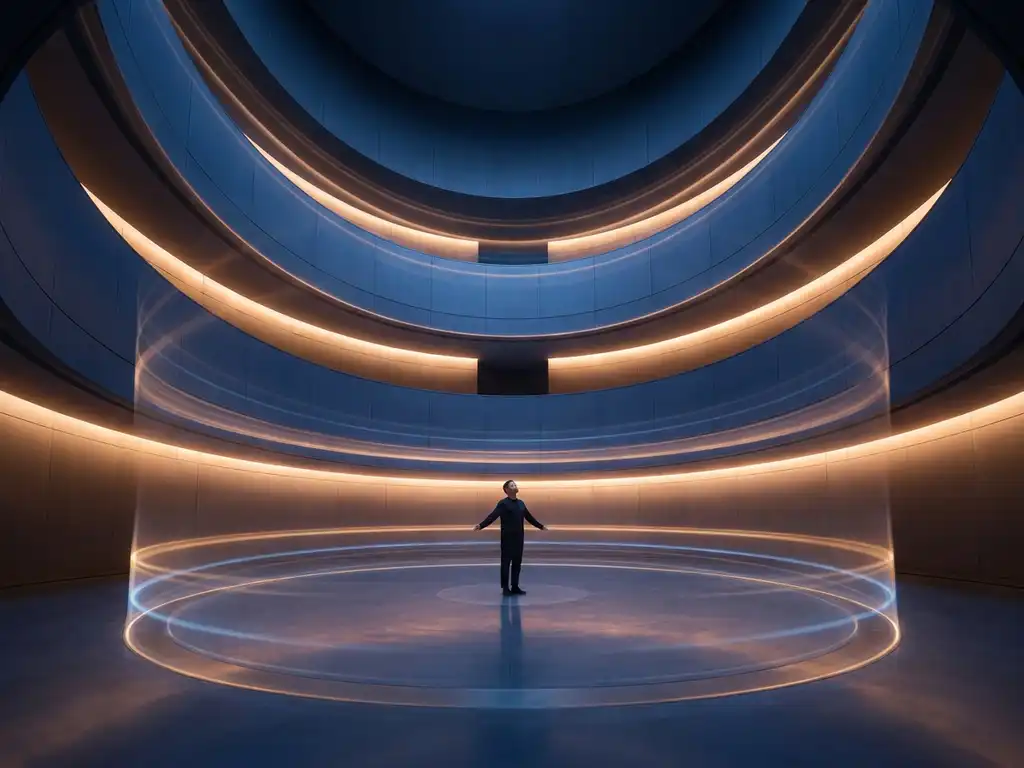
Immersive experiences are designed environments or digital interactions that surround participants with sensory stimuli, drawing them into a narrative, space, or world beyond the boundaries of a screen. They span a wide spectrum of formats, from augmented reality overlays on a smartphone to full-scale physical installations with scent, sound, and motion. This article unpacks the main types, how they differ, and how to choose the right one for your goal.
How do immersive experiences differ from traditional media?
Traditional media delivers content to a passive audience. Immersive experiences place the audience inside the content. Instead of watching a story unfold on a screen, participants become part of it, making choices, moving through space, and engaging multiple senses simultaneously. This shift from passive consumption to active participation is what defines the immersive experience meaning at its core.
The difference is not merely aesthetic. Research in cognitive science consistently shows that people retain information more effectively when they learn through experience rather than observation. When the brain processes information through movement, emotion, and multisensory engagement, memory formation deepens. This is why immersive experiences work so powerfully in education, brand activation, and social impact campaigns alike.
Traditional advertising or classroom instruction typically engages two senses at most: sight and hearing. Immersive design activates touch, smell, spatial awareness, and proprioception alongside these. The result is not just more engaging content; it is content that resonates long after the experience ends. That lasting emotional imprint is what separates immersive experience from traditional media at a fundamental level.
What are the main types of AR experience?
Augmented reality (AR) experiences overlay digital content onto the real world, typically viewed through a smartphone, tablet, or headset. The main types include location-based AR, image tracking, AR portals, AR games, hologram twins, and geospatial AR. Each type serves a different purpose, from outdoor city activations to interactive product catalogues and educational storytelling.
Location-based and geospatial AR
Geospatial AR places digital content at precise GPS coordinates in the physical world, with no QR code or marker required. This makes it ideal for outdoor campaigns, heritage trails, and city-wide activations where visitors discover layered digital content simply by being in a specific location. AR treasure hunts and AR portals use similar spatial logic, guiding users through environments with GPS-triggered puzzles or virtual gateways that transport them to another world entirely.
Marker-based and object AR
Image tracking AR activates when a camera recognises a specific image, such as a poster, book cover, or product label. This unlocks animations, video, or additional storytelling directly on top of the physical object. AR miniatures take this further, rendering full three-dimensional scale models of buildings or products in a physical space, making them powerful tools for architecture, real estate, and urban planning presentations. AR children’s books apply the same principle to education, bringing illustrated pages to life with animated characters that respond to a child’s interaction.
AR hologram twins represent one of the most technically sophisticated AR formats, using volumetric video to create photorealistic three-dimensional versions of real people. These are used for virtual hosts, product launches, and live events where physical presence is not possible but human connection still matters.
What are the different types of VR experience?
Virtual reality (VR) experiences replace the real world entirely with a computer-generated environment, viewed through a headset. The main types are passive VR (cinematic 360-degree video), interactive VR, location-based VR for groups, and purpose-built educational or social impact VR. Each type offers a different level of agency and is suited to different goals.
Passive VR, sometimes called cinematic VR, places the viewer inside a pre-rendered environment. They can look in any direction but cannot alter the narrative. This format excels at storytelling, brand films, and empathy-building experiences where a guided emotional journey is the goal. A 360-degree experience of a humanitarian crisis, for example, creates visceral understanding in ways that a flat video simply cannot replicate.
Interactive VR gives participants genuine agency. They can move through environments, make decisions, manipulate objects, and shape outcomes. This format is particularly effective for training simulations, educational modules, and entertainment experiences where engagement depends on consequence and choice. VR training for complex or high-risk scenarios, from medical procedures to emergency response, benefits enormously from this interactivity.
Location-based VR scales the experience to groups. Synchronised headsets allow dozens or even hundreds of people to share the same virtual environment simultaneously, making it viable for events, exhibitions, and large-scale awareness campaigns. We have developed SDG Pods that combine physical installations with group VR experiences, deployed globally to drive social awareness and behaviour change at scale.
What is mixed reality and how does it differ from AR and VR?
Mixed reality (MR) is a technology that anchors digital objects to the physical world in real time, allowing them to interact with real surfaces, light, and people. Unlike AR, which overlays digital content on top of reality without physical interaction, and unlike VR, which replaces reality entirely, mixed reality blends both so convincingly that virtual and physical elements coexist and respond to each other.
The clearest way to understand the difference is through spatial computing. In AR, a virtual character might appear on your screen hovering above a table. In mixed reality, that character understands the table is there, can walk around it, sit on it, or be blocked by it. The digital and physical obey the same spatial rules. This is what makes platforms like Apple Vision Pro so significant for the next generation of immersive experience design.
Extended reality (XR) is the umbrella term that encompasses AR, VR, and MR together. When organisations talk about XR strategy, they are considering the full spectrum of reality-altering technologies and how to deploy them in combination. For cultural institutions, this might mean MR guides that walk visitors through an exhibition. For brands, it might mean an interactive product experience that works across both physical retail and digital environments simultaneously.
What types of immersive installations exist for physical spaces?
Immersive installations are purpose-built physical environments designed to surround visitors with sensory experience. The main types include interactive 360-degree projection domes, 4D cinemas, and large-scale multisensory environments that combine spatial design with digital technology. These installations are permanent or temporary, scalable from intimate museum rooms to event spaces accommodating thousands of visitors.
Interactive 360 domes project content across an entire hemispherical surface, enveloping audiences in imagery and sound from every angle. They are widely used in science museums, cultural exhibitions, and corporate events where the goal is collective awe and shared narrative. The format removes the boundary between screen and audience entirely, making it one of the most powerful tools for group immersion.
4D cinemas extend the sensory experience beyond sight and sound. Scent, temperature, vibration, wind, and tactile feedback are synchronised with on-screen content to create full-body engagement. This multisensory layering is what elevates a 4D experience from entertainment to genuine emotional impact, particularly in contexts where empathy or visceral understanding is the objective.
Beyond these formats, physical immersive installations increasingly incorporate AI-driven personalisation, allowing the environment itself to adapt to the individual visitor, changing language, pacing, narrative depth, or sensory intensity based on real-time input. This transforms a static installation into a living, responsive experience.
How does immersive film and animation fit into experiential design?
Immersive film and animation serve as the narrative backbone of many experiential projects. Rather than standalone cinema, they function as content layers within broader immersive environments, providing the visual and emotional foundation that AR, VR, and physical installations build upon. Formats range from hyperrealistic animation and anamorphic 3D displays to brand films and full feature documentaries.
Anamorphic animation creates the illusion of three-dimensional objects emerging from flat screens using depth and perspective tricks. These are increasingly common in outdoor advertising, event backdrops, and exhibition spaces, where the goal is to stop people in their tracks without requiring any device or headset. The effect is immediate, public, and shareable.
Hyperrealistic animation and visual effects bring photographic quality to entirely digital content, making it indistinguishable from live footage. For brands, this means the ability to tell stories that would be physically impossible to film. For cultural institutions, it means reconstructing historical moments, lost artefacts, or invisible phenomena with cinematic precision.
Brand movies and feature documentaries anchor long-form storytelling within immersive campaigns. When a visitor has experienced a VR journey through a humanitarian crisis, a documentary that deepens that story becomes far more powerful than it would be in isolation. Film and animation do not replace immersive technology; they amplify it.
Which type of immersive experience is right for your goal?
The right type of immersive experience depends on three factors: your audience, your objective, and your context. There is no single best format. AR works best for public-facing, device-accessible activations. VR excels when deep emotional immersion or training simulation is required. Mixed reality suits environments where digital and physical interaction must coexist. Physical installations are most powerful for collective, shared experiences at scale.
For educational goals, interactive VR and immersive AR learning modules deliver measurable improvements in engagement and knowledge retention, particularly for abstract or emotionally complex subjects. For brand activation in crowded event environments, AR games, geospatial activations, and anamorphic animation create immediate impact and social shareability. For cultural institutions, a layered approach combining AR art overlays, 360 projection, and interactive screens can refresh visitor journeys without compromising the integrity of collections.
For NGOs and public sector organisations, the most effective immersive experiences are those that build empathy and drive behaviour change. Passive VR storytelling, 4D installations, and AI-driven personalised narratives have all demonstrated strong results in awareness campaigns where the goal is not just to inform but to move people to act.
Choosing the right format also means considering practical factors: venue constraints, audience size, available hardware, budget scope, and the longevity of the experience. A one-day event activation calls for different tools than a permanent museum installation or a curriculum-embedded educational programme. If you are ready to explore what the right immersive format could look like for your specific goal, we would love to help you shape it. Contact us to start the conversation.
Gerelateerde artikelen
- What is an example of immersive experience?
- How much does experiential marketing cost?
- How much does a planetarium dome cost?
- Who uses mixed reality?
- Is immersive the same as virtual reality?
- What is an example of immersive learning experience?
- What is the difference between interactive and immersive theatre?
- What technologies are used in immersive experiences?
- What are the ROI benefits of experiential marketing campaigns?