
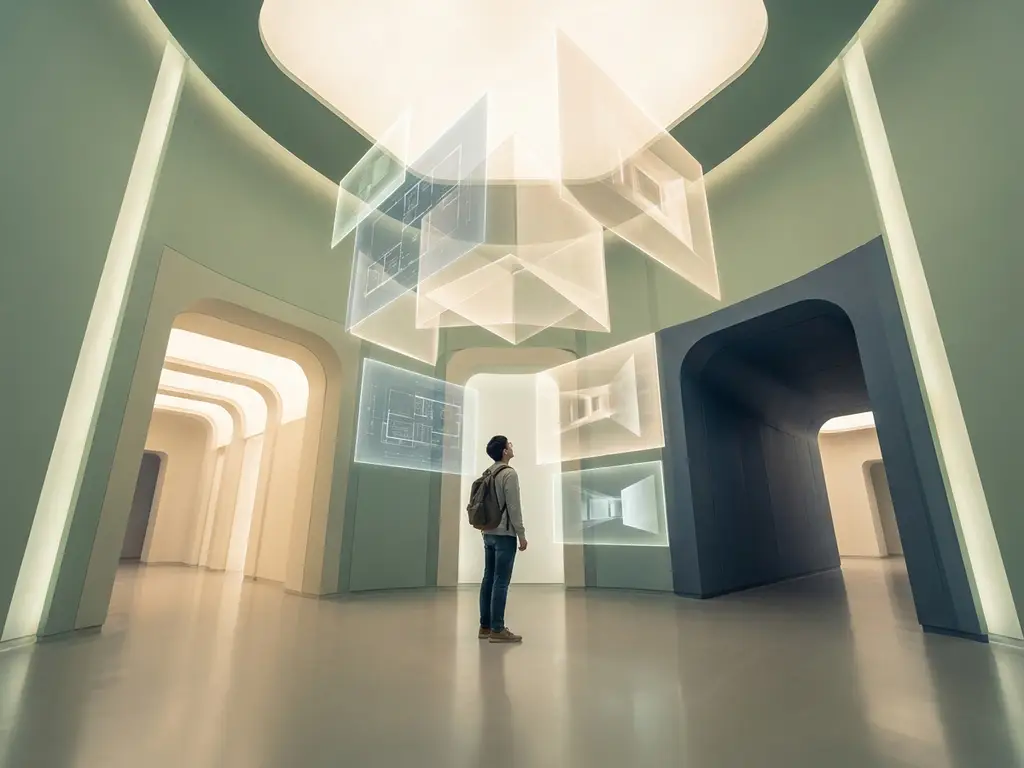
Immersive learning is an educational approach that places learners inside a simulated or richly designed environment, engaging multiple senses simultaneously to accelerate understanding and deepen retention. Rather than receiving information passively through a screen or textbook, participants experience it directly, whether through virtual reality, augmented reality, spatial installations, or interactive storytelling. This article unpacks the most important questions around immersive learning, from how it works to what it takes to implement it effectively.
How does immersive learning differ from traditional education?
Immersive learning differs from traditional education by shifting the learner from a passive recipient of information to an active participant inside the learning experience itself. Where conventional education delivers content to learners, immersive learning surrounds them with it, creating the conditions for deeper cognitive and emotional engagement that traditional classrooms rarely achieve.
In a standard educational setting, a student might read about the consequences of climate change or watch a documentary about it. In an immersive learning environment, that same student could stand inside a simulated Arctic landscape, witness ice shelf collapse in real time, and feel the temperature shift around them. The subject matter has not changed, but the relationship between the learner and the content has transformed entirely.
This distinction matters because learning is not purely an intellectual act. It is also emotional, physical, and contextual. Traditional education often isolates knowledge from the environment in which it would naturally be applied. Immersive learning restores that context, making abstract concepts concrete and complex systems navigable. The result is not just better understanding, but a stronger motivation to engage in the first place.
What are the main types of immersive learning experiences?
The main types of immersive learning experiences include virtual reality simulations, augmented reality overlays, mixed reality environments, interactive 360-degree installations, and AI-driven scenario-based learning. Each type offers a different balance of immersion depth, physical presence, and interactivity, and the right choice depends on learning objectives, audience, and context.
Virtual reality learning environments
VR places learners inside fully rendered three-dimensional worlds where they can interact with objects, navigate spaces, and practise skills in conditions that closely mirror real-world scenarios. Medical training, emergency response, and safety inductions are particularly well suited to VR because the stakes of real-world errors are high and repetition in a safe environment is invaluable.
Augmented reality and mixed reality learning
AR overlays digital information onto the physical world through a smartphone, tablet, or headset, allowing learners to explore additional layers of content without leaving their environment. Mixed reality, increasingly delivered through platforms like Apple Vision Pro, goes further by enabling real-time interaction between virtual and physical elements simultaneously. Both are powerful for field-based learning, museum education, and technical training where context and location matter.
Interactive installations and 360-degree environments
Large-scale physical installations, including 360-degree projection domes and 4D cinema environments, create shared immersive experiences for groups. These are especially effective in educational settings where collective engagement and discussion are part of the learning design, such as school excursions, public awareness campaigns, or museum exhibitions.
Why does immersive learning improve knowledge retention?
Immersive learning improves knowledge retention because it engages multiple sensory and cognitive systems at once, creating richer memory traces that are easier to recall. When learners see, hear, and physically interact with information rather than simply reading or listening to it, the brain encodes that experience across more neural pathways, making retrieval more reliable and durable over time.
This connects directly to what learning scientists refer to as the forgetting curve, the well-documented tendency for humans to lose most newly acquired information within days if it is not reinforced or contextualised meaningfully. Passive learning formats accelerate this forgetting because the information arrives without emotional weight or physical association. Immersive experiences counteract this by attaching knowledge to sensory memory and emotional response, two of the most powerful anchors for long-term recall.
There is also the factor of active processing. When a learner must make decisions, navigate a scenario, or respond to stimuli within an immersive environment, they are not just receiving information but applying it in real time. This kind of active engagement forces deeper cognitive processing, which consolidates understanding far more effectively than passive consumption. The experience becomes a memory, not just a lesson.
What subjects and industries benefit most from immersive learning?
Immersive learning delivers the greatest impact in fields where context, empathy, or high-stakes practice are central to the learning objective. Healthcare, safety training, education, social impact, cultural heritage, and corporate learning and development all see measurable gains when immersive methods replace or supplement conventional instruction.
In healthcare and emergency services, VR simulations allow practitioners to rehearse complex procedures or crisis responses without risk to real patients. In corporate training, immersive scenarios help employees navigate difficult conversations, compliance situations, or technical processes in ways that role-play or video training simply cannot replicate. The embodied nature of the experience builds both competence and confidence.
In the education sector, immersive learning opens up subjects that are otherwise difficult to teach compellingly. History becomes visceral when students can explore a reconstructed ancient city. Environmental science becomes urgent when they witness ecological systems collapse in real time. For NGOs and public sector organisations, immersive storytelling is increasingly used to build empathy around complex social issues, shifting audiences from intellectual understanding to genuine emotional engagement that motivates action.
Museums and cultural institutions are also discovering that immersive digital layers breathe new life into collections, attracting younger audiences who expect interactive, participatory experiences rather than static displays. Our work with institutions in this space consistently shows that when technology serves the story, visitor engagement deepens rather than diminishes.
How is AI changing the future of immersive learning?
AI is transforming immersive learning by enabling experiences that adapt in real time to each individual learner, responding to their pace, language, prior knowledge, and emotional state. Rather than delivering a fixed sequence of content, AI-powered immersive environments can shift difficulty, offer alternative explanations, and personalise narrative pathways, making every learner’s journey unique and optimally effective.
One of the most significant developments in 2026 is the emergence of AI avatars and non-player characters capable of holding genuine, contextually aware conversations with learners. These virtual characters can serve as guides, mentors, or even challenging counterparts within a scenario, providing the kind of responsive, dynamic interaction that previously required a human facilitator. For scaling educational programmes across large or geographically dispersed audiences, this is transformative.
AI also strengthens the analytical dimension of immersive learning. By tracking how learners move through an experience, where they hesitate, which choices they make, and how long they spend on specific elements, AI systems can surface insights that help programme designers continuously refine their content. Learning becomes not just more personalised but more evidence-based over time.
The convergence of AI with spatial computing platforms represents the next frontier. As mixed reality hardware matures, AI will increasingly power environments that are not just visually immersive but genuinely responsive, capable of understanding a learner’s actions and adapting the world around them accordingly.
What does it take to implement an immersive learning programme?
Implementing an immersive learning programme requires four core elements: a clearly defined learning objective, appropriate technology selection, high-quality content design, and a deployment and support strategy. Without all four working in alignment, even technically impressive immersive experiences fail to deliver meaningful educational outcomes.
The starting point is always the learning objective, not the technology. The most effective immersive programmes begin by asking what change in knowledge, behaviour, or perspective the experience needs to produce, and then working backwards to determine which immersive format best serves that goal. Choosing VR because it is impressive rather than because it is the right tool for the outcome is one of the most common and costly mistakes in immersive learning design.
Content design is where the real complexity lies. Immersive learning experiences must be pedagogically sound as well as technically polished. This means structuring scenarios that challenge learners appropriately, embedding feedback mechanisms that reinforce correct understanding, and designing for emotional engagement without sacrificing clarity. The storytelling and the learning architecture must work together seamlessly.
On the practical side, implementation involves decisions around hardware access, whether experiences will run on shared devices, personal smartphones, or dedicated headsets, as well as considerations around accessibility, language, and the varying technical literacy of the audience. Ongoing support, content updates, and the ability to measure impact over time are equally important factors. The investment required varies considerably depending on the scope, complexity, and scale of the programme, with bespoke VR productions naturally sitting at a different level than AR-enhanced print materials or interactive screen installations.
If you are exploring what an immersive learning programme could look like for your organisation, we would welcome the conversation. Contact us to discuss your learning objectives and discover how immersive experiences can make your content genuinely unforgettable.
Gerelateerde artikelen
- What are the different types of interactive museums?
- What are immersive experiences and how do they enhance user interaction?
- What are the benefits of experiential marketing?
- What can provide immersive training experiences?
- What are two examples of experiential marketing?
- What is an example of immersive training?
- What is spatial design in immersive experiences?
- How do you align immersive experiences with brand identity?
- How do dome installations create immersive experiences?