
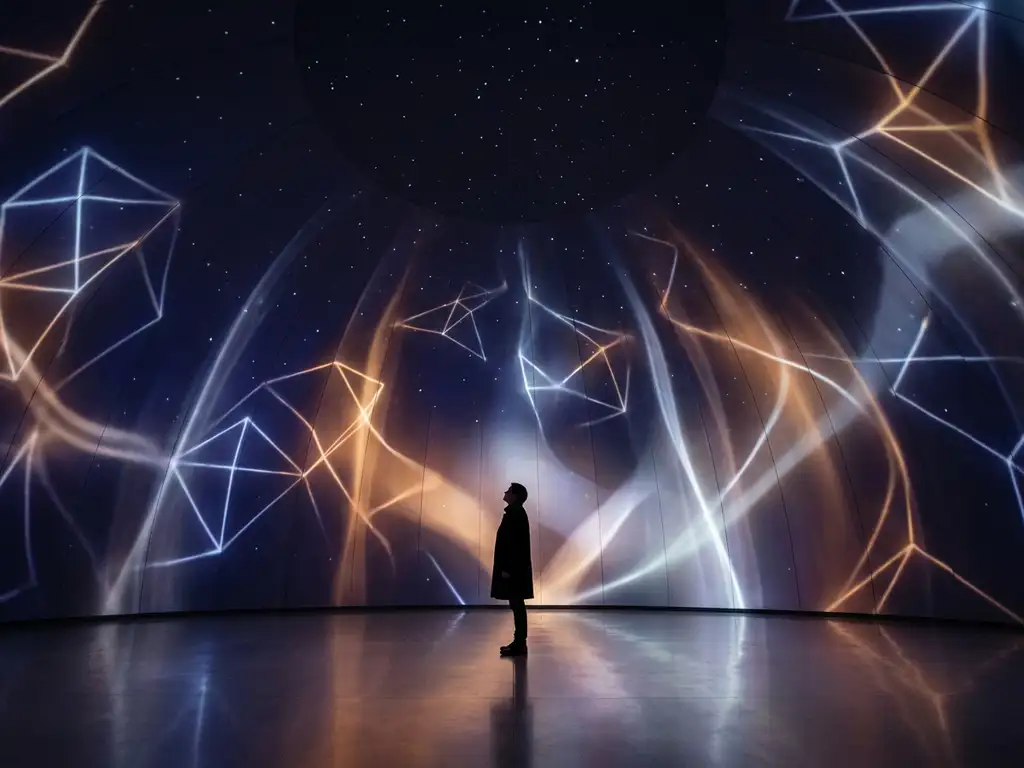
The immersive experience industry is growing rapidly, with the global market valued in the tens of billions of dollars and expanding at double-digit annual rates through the mid-2020s. Consumer appetite for experiences over passive entertainment is accelerating that growth, driven by advances in AR, VR, and spatial computing that make immersive formats more accessible, more convincing, and more emotionally powerful than ever before. The sections below unpack the key statistics, sector trends, and future projections shaping this transformation.
How fast is the immersive experience industry growing?
The immersive experience industry is one of the fastest-growing segments in the global technology and entertainment economy. Market research consistently places the extended reality (XR) sector on a trajectory that sees it multiplying several times over between 2023 and 2030, with compound annual growth rates frequently cited in the 25 to 35 percent range across AR, VR, and mixed reality combined. That pace of growth outstrips most other technology categories.
Several forces are converging to sustain this momentum. Hardware costs are falling as headsets become lighter, more powerful, and more affordable. Software ecosystems have matured, making it faster and less expensive to develop high-quality immersive content. And critically, a broad range of industries, from healthcare and education to retail and cultural heritage, have moved beyond experimentation and begun deploying immersive technology at scale.
Location-based immersive experiences, meaning physical venues purpose-built for group immersion, are also expanding rapidly. Pop-up installations, immersive theatre, and branded experiential spaces have become mainstream cultural events, with major cities across Europe and North America hosting permanent or semi-permanent immersive venues that attract tens of thousands of visitors annually. The industry is no longer niche. It has become a significant pillar of the experience economy.
How many people have tried a VR or AR experience?
Hundreds of millions of people worldwide have now had at least one VR or AR experience. AR reached mass adoption earlier than VR, largely through smartphone applications and social media filters that introduced augmented reality to everyday users without requiring specialist hardware. VR adoption has grown more steadily, driven by gaming, location-based entertainment, and enterprise training programs.
In Europe, consumer awareness of VR and AR has risen sharply over the past five years. Surveys conducted across major markets consistently show that a significant majority of adults under 45 have encountered some form of immersive technology, whether through a museum installation, a brand activation, a gaming experience, or an educational program. Younger demographics show the highest engagement rates, but adoption is broadening across age groups as experiences become more intuitive and accessible.
Enterprise and institutional adoption adds another substantial layer to the total user base. Corporations running VR-based training programs, hospitals using immersive simulation for medical education, and schools deploying AR tools for science and history lessons collectively expose millions of people each year to immersive formats in professional or educational contexts. The cumulative installed base of people with meaningful immersive experience is now large enough to constitute a genuinely mainstream audience.
What percentage of consumers prefer experiential over traditional entertainment?
Consumer preference research consistently shows that the majority of people, particularly millennials and Gen Z, prioritize experiences over products or passive entertainment. Studies across multiple markets indicate that between 70 and 80 percent of consumers in these demographics would rather spend money on a memorable experience than on a physical purchase, a trend that has accelerated since the pandemic fundamentally reshaped how people think about time and presence.
This preference extends directly to how people engage with brands and cultural institutions. Audiences increasingly expect to participate rather than observe. They want to be inside the story, not watching it from a distance. Passive formats, whether a television advertisement or a static museum exhibit, struggle to generate the emotional resonance and lasting memory that an interactive, multisensory experience creates almost automatically.
What makes this preference shift so significant for organizations is that it is not simply about novelty. Research into memory and emotional engagement consistently shows that people retain experiential encounters far longer than information they receive passively. When an experience activates multiple senses, invites physical participation, and places the individual at the center of a narrative, the emotional imprint it leaves is measurably deeper. Preference for experiential formats is therefore not a trend that will fade. It reflects something fundamental about how human memory and motivation work.
How effective are immersive experiences for learning and behavior change?
Immersive experiences are significantly more effective than traditional instructional formats for both knowledge retention and behavior change. The underlying reason is rooted in how the brain processes and stores information. Experiences that engage multiple senses simultaneously, place the learner in a realistic context, and require active decision-making create stronger, more durable memory traces than passive listening or reading.
Learning retention and the forgetting curve
The concept of the forgetting curve, developed by psychologist Hermann Ebbinghaus, demonstrates that people forget the majority of passively received information within days if it is not reinforced. Immersive learning environments counteract this by creating what cognitive scientists call embodied memory. When a learner physically navigates a simulated environment, makes choices with visible consequences, and experiences emotional stakes, the learning is encoded more deeply and recalled more reliably over time.
Training programs that incorporate VR simulation consistently outperform classroom-based equivalents on both retention and confidence metrics. This has been demonstrated across fields as varied as surgical training, fire safety, conflict de-escalation, and customer service. The advantage is not marginal. Learners in immersive programs frequently demonstrate retention rates two to four times higher than those in conventional training settings.
Behavior change and empathy development
For organizations working on social impact, public health, or community engagement, immersive experiences offer a particularly powerful mechanism for behavior change. Placing someone inside the perspective of another person, whether a refugee navigating displacement, a patient experiencing a medical condition, or a child in an unfamiliar environment, generates empathy at a level that statistics and written accounts rarely achieve.
NGOs and public sector organizations have used perspective-shifting VR experiences to measurably increase donation intent, volunteer sign-ups, and support for policy changes. The effect is not simply emotional in the moment. Follow-up research shows that attitudinal changes generated through immersive empathy experiences persist for weeks and months after the encounter, making immersive formats one of the most durable tools available for genuine behavior change communication.
What industries are investing most in immersive technology?
The industries investing most heavily in immersive technology in 2026 are healthcare and medical training, enterprise learning and development, retail and brand experience, education, defense and public safety, and cultural and heritage institutions. Each of these sectors has identified specific, high-value problems that immersive technology solves better than any existing alternative.
Healthcare leads in terms of enterprise investment, using VR for surgical simulation, patient therapy, and clinical training at scale. The ability to practice complex procedures in a risk-free environment with immediate feedback has made immersive simulation the standard of care for training in many medical institutions.
Enterprise learning and development represents the second major investment hub. Organizations across financial services, manufacturing, logistics, and professional services have deployed VR training programs to reduce onboarding time, improve safety compliance, and build soft skills that are difficult to teach in a classroom. The scalability of digital immersive content, once produced, means it can be deployed to thousands of learners simultaneously, making the return on investment compelling.
Retail and brand experience is the third major growth area. Brands competing for attention in an oversaturated media landscape are investing in AR product visualization, immersive pop-up activations, and mixed reality showrooms that allow consumers to interact with products in ways that no digital advertisement can replicate. Cultural institutions, including museums, heritage sites, and galleries, are also increasing investment as they face pressure to attract younger and more diverse audiences.
How do immersive brand experiences compare to traditional advertising in impact?
Immersive brand experiences consistently outperform traditional advertising on every meaningful engagement metric: attention duration, emotional recall, brand association, and conversion intent. A consumer who spends five minutes inside a well-crafted brand experience will remember that brand more vividly, associate it with more positive emotions, and be more likely to recommend it than a consumer exposed to the same brand through a television commercial or digital display advertisement.
The core difference lies in agency. Traditional advertising delivers a message to a passive audience. An immersive brand experience invites the audience to participate, explore, and co-create a story. When people feel active rather than passive, their emotional investment rises dramatically. They are not consuming content about a brand. They are having an experience with it, and that distinction is fundamental to how the encounter is encoded in memory.
Measurability has historically been cited as a challenge for experiential marketing, but this gap has narrowed considerably. Modern immersive installations generate rich behavioral data, tracking how participants move through a space, which interactions they engage with most, how long they dwell in specific zones, and what emotional responses they express. This data allows brands to optimize experiences in real time and demonstrate impact with the same rigor applied to digital campaigns. The combination of emotional depth and measurable engagement makes immersive brand activations one of the highest-performing formats available in the contemporary marketing toolkit.
What does the future of immersive experiences look like by 2030?
By 2030, immersive experiences will be woven into the fabric of everyday life across education, culture, commerce, and public communication. The convergence of spatial computing, AI-driven personalization, and increasingly lightweight hardware will make high-quality immersive encounters available in contexts that currently rely on screens and static content. The question will no longer be whether to use immersive technology, but how to use it most meaningfully.
Spatial computing platforms, led by devices like the Apple Vision Pro and its successors, will blur the boundary between physical and digital environments in ways that make today’s AR applications look rudimentary. Entire learning environments, retail spaces, and cultural exhibitions will exist as layered spatial experiences that adapt in real time to the individual user’s context, language, pace, and prior knowledge.
AI-driven personalization will be the defining capability that separates the next generation of immersive experiences from the current one. Rather than delivering the same experience to every participant, adaptive systems will adjust narrative paths, difficulty levels, language, and emotional tone based on continuous feedback from the user. This is already a core part of how we design our experiences at Rooftop Immersive, and the technology supporting it will only become more sophisticated and more accessible over the next four years.
The social dimension of immersive experiences will also expand significantly. Shared, multi-user immersive environments will become standard formats for education, corporate collaboration, and cultural programming. Groups of people in different physical locations will inhabit the same virtual space, working through scenarios, exploring exhibitions, or participating in training together with a sense of genuine co-presence that video conferencing cannot approach.
For organizations in education, culture, the public sector, and brand marketing, the window to establish meaningful expertise with immersive formats is now. The organizations that invest in building immersive literacy and developing high-quality experiential content in the next few years will be positioned to lead in a world where the ability to create compelling spatial experiences is as foundational as the ability to create a compelling website is today. If you are ready to explore what that future looks like for your organization, we would love to hear from you. Contact us to start the conversation.
Gerelateerde artikelen
- How much does it cost to build an interactive museum?
- Can installation art be interactive?
- What is the strongest trigger to memory?
- What is the relationship between sensory experience learning and retention?
- What can provide immersive training experiences?
- How do I create an immersive experience?
- What equipment is needed for 360-degree content creation?
- How long does AR content production take?
- What are the technical requirements for immersive installations?