
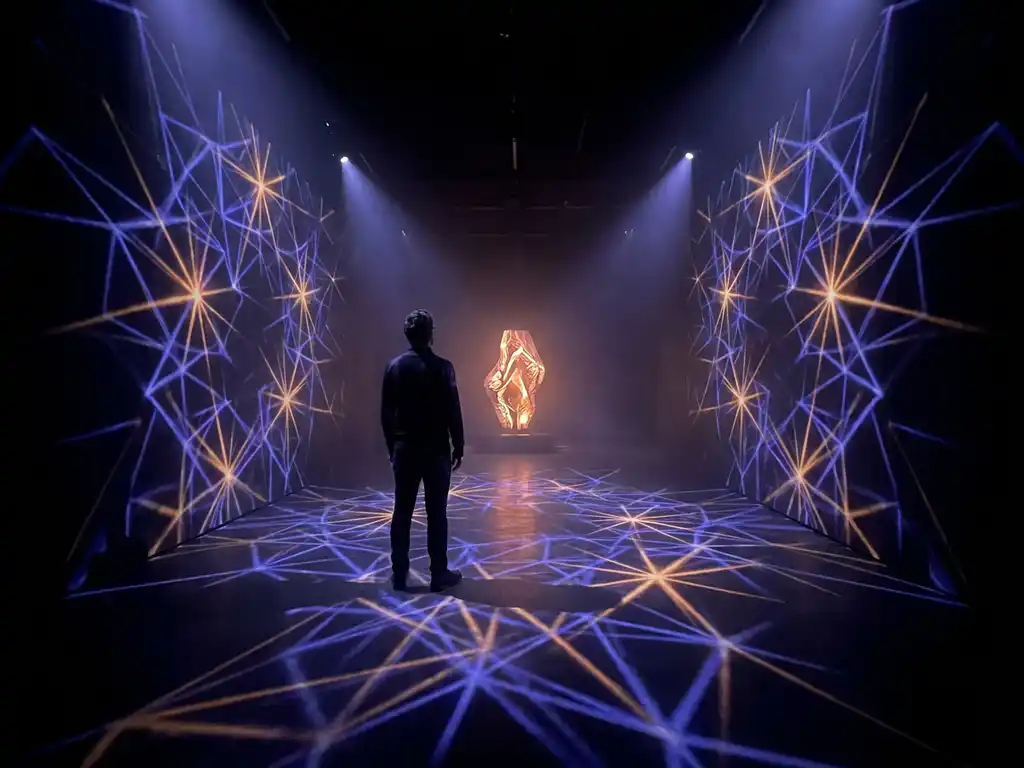
Immersive museum experiences deliver measurable benefits across visitor engagement, learning outcomes, audience reach, and institutional revenue. By activating multiple senses and placing visitors inside the story rather than in front of it, immersive environments transform passive observation into active participation. The questions below unpack exactly how and why this transformation works.
How do immersive experiences change the way visitors engage with exhibits?
Immersive experiences shift visitor engagement from passive observation to active participation. Instead of reading a label and moving on, visitors step inside a narrative, make choices, and interact with content in ways that feel personal and immediate. This shift fundamentally changes the emotional relationship between a visitor and the subject matter they encounter.
Traditional exhibition design asks visitors to bring their own imagination to static objects. Immersive design does the opposite: it constructs the context around the visitor, using spatial storytelling, sound design, projected visuals, and sometimes scent or haptic feedback to create a world that feels inhabited rather than displayed. The result is that visitors spend longer with individual exhibits, ask more questions, and report stronger emotional responses.
The distinction between immersive and interactive is worth clarifying here. Interactive simply means a visitor can trigger a response, tapping a screen or pressing a button. Immersive means the environment itself responds to and surrounds the visitor, making them feel present within the content rather than adjacent to it. The most effective museum experiences combine both: they are immersive in atmosphere and interactive in agency.
What makes an experience truly immersive is the degree to which it eliminates the distance between the visitor and the subject. A painting behind glass creates distance. A 360-degree environment that places a visitor inside the world depicted in that painting removes it entirely. That removal of distance is where genuine engagement begins.
What are the proven learning benefits of immersive museum environments?
Immersive museum environments improve knowledge retention, deepen conceptual understanding, and increase emotional engagement with subject matter. When visitors learn through experience rather than description, they form stronger and longer-lasting memories. This is because multisensory input creates richer memory traces than single-channel information delivery.
The science behind this is well established in educational psychology. Passive learning, reading a panel or watching a video, activates limited cognitive pathways. Experiential learning that involves movement, decision-making, and sensory engagement activates multiple regions simultaneously, strengthening the encoding of new information. Museums that leverage this through immersive design are effectively applying the same principles that drive modern experiential education.
The role of emotional resonance in retention
Emotion is one of the most powerful memory consolidators available. When a visitor feels something during an exhibit, whether awe, empathy, curiosity, or even mild discomfort, that emotional state signals to the brain that the experience is worth remembering. Immersive environments are uniquely equipped to trigger these states because they control the full sensory context, not just the informational content.
Empathy as a learning outcome
For museums dealing with history, social justice, or human stories, immersive experiences offer something that no display case can: the ability to place a visitor in someone else’s perspective. VR experiences that simulate historical events or the lived conditions of another person generate empathy in ways that written accounts rarely achieve. This is not simply a more engaging way to deliver the same information; it is a fundamentally different category of learning outcome, one that changes how visitors relate to the subject long after they leave.
How do immersive exhibitions attract younger and more diverse audiences?
Immersive exhibitions attract younger and more diverse audiences by offering the kind of participatory, technology-forward experiences that these groups already seek in entertainment and digital culture. For younger visitors in particular, an exhibition that feels like a game, a film set, or a social experience is far more compelling than one that asks them to walk quietly past objects.
Museums have faced a documented challenge with audience diversification for years. Traditional formats tend to favour visitors who already feel culturally at home in institutional spaces. Immersive design can lower that barrier by making the entry point sensory and experiential rather than textual and hierarchical. When understanding an exhibit does not require prior knowledge or literacy in a specific cultural tradition, a much broader range of visitors can engage meaningfully.
There is also a strong social dimension to immersive experiences. Shared VR journeys, interactive dome installations, and AR activations that visitors photograph and share generate organic social reach that traditional exhibitions rarely produce. In 2026, the social shareability of an experience is itself a form of audience development, turning visitors into advocates who bring new audiences through the door.
For younger audiences specifically, the expectation of agency is high. They are accustomed to interactive media and expect to influence what happens next. Immersive exhibitions that offer genuine interactivity, not just novelty, meet this expectation and create the kind of memorable visit that earns repeat attendance and word-of-mouth recommendations.
What’s the difference between AR and VR in a museum context?
In a museum context, AR (Augmented Reality) layers digital content onto the physical environment, enriching what visitors already see, while VR (Virtual Reality) replaces the physical environment entirely with a simulated one. The choice between them depends on whether the museum wants to enhance the existing collection or transport visitors to a completely different world.
When AR is the right choice
AR is ideal when the physical artifact or space is itself the anchor of the experience. A visitor pointing a device at a historical painting can watch it animate, hear the artist speak, or see the scene it depicts come to life around them. The physical object remains central; the digital layer adds depth without replacing it. This makes AR particularly well suited to collections where the integrity and presence of the original work must be preserved. AR portals, image tracking, and hologram overlays all fall within this category, each offering a different degree of digital enrichment on top of a physical foundation.
When VR is the right choice
VR is the right tool when the museum wants to take visitors somewhere they cannot physically go: inside a historical event, across a geographical boundary, or into a reconstructed world that no longer exists. A museum exploring ancient civilisations can use VR to place visitors in a reconstructed city. A natural history institution can simulate an ecosystem. The power of VR lies in its ability to create presence, the psychological sense of actually being somewhere, which is impossible to achieve through any other medium. For group experiences, synchronised VR headsets allow cohorts of visitors to share the same journey simultaneously, creating a collective emotional experience that becomes a shared memory.
Mixed Reality, which blends real and virtual elements in real time, represents the next frontier. Platforms like Apple Vision Pro allow visitors to interact with virtual objects that appear to exist in the same physical space, opening new possibilities for exhibitions that want to go beyond the binary of AR or VR.
How do immersive technologies support revenue and operational goals?
Immersive technologies support museum revenue by creating new ticketing tiers, extending the lifespan of exhibitions, enabling travelling formats, and generating the kind of visitor experience that drives repeat attendance and premium pricing. Operationally, they can reduce the physical footprint required to deliver a compelling experience while increasing throughput for high-demand content.
A well-designed immersive exhibition can command a higher ticket price than a standard gallery visit because the perceived value is significantly greater. Visitors understand they are paying for an experience, not just access, and the emotional impact of that experience justifies the premium. This is a proven model in the entertainment sector that museums are increasingly adopting.
From a programming perspective, immersive content is more modular than physical installations. A VR experience or an AR layer built for one venue can be adapted, translated, or repackaged for touring without the logistical and conservation challenges of moving physical objects. This scalability is particularly valuable for institutions with limited physical space or multiple sites.
Immersive technologies also support operational goals around accessibility. Remote or virtual access to exhibitions can extend the institution’s reach to audiences who cannot visit in person, whether due to geography, disability, or cost. This broadens the social impact of the museum’s mission while also expanding the potential audience for digital memberships and online programming.
How can museums implement immersive experiences without compromising collection integrity?
Museums can implement immersive experiences without compromising collection integrity by treating digital technology as a layer that enriches rather than replaces the physical collection. The key principle is that immersive content should deepen the visitor’s relationship with original works and artefacts, not compete with them for attention or authority.
This starts with a clear creative brief that places the collection’s story at the centre of the immersive design. Technology choices should follow narrative intent, not the other way around. When a museum begins by asking what story it wants visitors to carry away, and then asks which immersive tools best serve that story, the result is an experience that feels coherent and purposeful rather than technology-driven.
Practical safeguards matter too. AR experiences that work through visitor devices rather than permanent projections avoid any physical alteration to the space or collection. Digital twins, photogrammetric 3D scans of objects and spaces, allow virtual interaction with collection items without any risk to the originals. These approaches give visitors an extraordinary level of access while keeping the physical collection entirely protected.
Curatorial involvement throughout the design process is essential. When curators and creative technologists work together from the outset rather than in sequence, the resulting experience reflects genuine institutional knowledge and maintains the interpretive authority that visitors trust. The technology becomes a vehicle for curatorial voice, not a replacement for it.
We work closely with cultural institutions to ensure that every immersive layer we design serves the collection’s story first. If you are exploring how immersive technology could transform your visitors’ experience while honouring what makes your institution distinctive, we would welcome the conversation. Contact us to start exploring what is possible.
Gerelateerde artikelen
- What is digital cultural heritage?
- What is an immersive show?
- How much does a virtual tour cost?
- Who is the leader in augmented reality?
- What are the three levels of immersion?
- How to create a virtual reality experience?
- What is the difference between experiential learning and immersive learning?
- How to create an immersive room?
- What is spatial design in immersive experiences?