
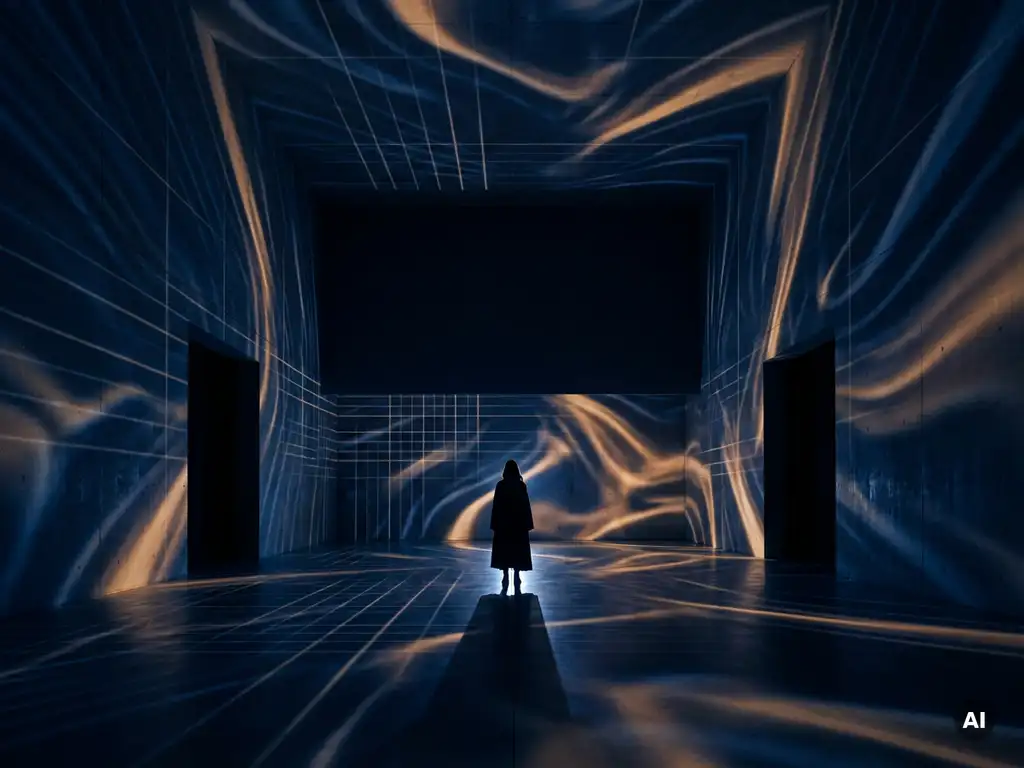
Immersive entertainment is a category of experience design in which audiences move from passive observation to active participation, becoming physically, emotionally, and sensorially part of the story or environment itself. Unlike watching a film or attending a concert, immersive entertainment places people inside the experience rather than in front of it. The questions below unpack how it works, what drives it, and why it is reshaping the way organisations across culture, education, and marketing connect with their audiences.
How is immersive entertainment different from traditional entertainment?
Traditional entertainment is built on a clear separation between performer and audience. You sit, watch, and receive. Immersive entertainment dissolves that boundary entirely, placing participants inside the narrative, environment, or event so that their choices, movements, and reactions become part of the experience itself. The audience is not a spectator, it is a protagonist.
This shift has profound consequences for how people process and retain what they experience. When someone walks through a reconstructed historical environment, navigates a virtual world, or interacts with a responsive installation, they engage multiple cognitive and sensory systems simultaneously. The experience is felt, not just observed.
Traditional entertainment also tends to deliver a fixed, linear narrative. Immersive experiences, by contrast, can be non-linear, personalised, and spatially distributed. A visitor to an immersive exhibition may take a completely different path than the person beside them, discovering different story layers and forming different emotional connections. That variability is a feature, not a flaw, it reflects the way human attention and curiosity actually work.
What technologies power immersive entertainment experiences?
Immersive entertainment experiences are powered by a combination of spatial computing, real-time rendering, sensor technology, and artificial intelligence. The specific technology stack depends on the format and goal of the experience, but several core technologies appear consistently across the field.
Extended reality: VR, AR, and mixed reality
Virtual reality (VR) places users inside fully digital environments using headsets that block out the physical world. Augmented reality (AR) overlays digital content onto the real world through smartphones or AR glasses. Mixed reality, as demonstrated by hardware like Apple Vision Pro, blends both in real time, allowing virtual objects to interact with physical surfaces and people. Each technology serves different use cases, VR is ideal for deep narrative immersion and training simulations, while AR excels in location-based activations and interactive public installations.
Spatial audio, haptics, and sensory design
True immersive entertainment engages more than vision. Spatial audio systems create three-dimensional soundscapes that shift as a visitor moves through a space. Haptic feedback adds the sense of touch to digital interactions. Scent diffusion, temperature variation, and even taste have been incorporated into advanced installations. These multi-sensory layers are what separate a genuinely immersive experience from one that is simply visually impressive.
AI and real-time personalisation
Artificial intelligence is increasingly central to immersive entertainment. AI-driven avatars can hold real-time conversations with visitors. Adaptive systems can adjust the pace, language, and content of an experience based on who is engaging with it. This capacity for personalisation at scale is one of the most significant technological developments in the field, enabling experiences that feel individual even when they serve thousands of people.
What are the most common types of immersive entertainment?
The most common types of immersive entertainment include VR experiences, AR activations, immersive theatre and live events, interactive installations, 360-degree projection environments, and location-based experiences. Each format prioritises a different combination of technology, physical space, and audience participation.
- VR experiences – from passive cinematic journeys to fully interactive simulations, delivered via headsets in dedicated spaces or at events
- AR activations – digital layers added to physical environments, accessible through smartphones or AR glasses, used widely in retail, museums, and outdoor campaigns
- Immersive theatre – live performances in which audiences move freely through a space and interact with performers and environments
- Interactive installations – sensor-driven or touch-responsive physical structures that react to visitor behaviour
- 360-degree projection domes and rooms – large-scale environments where floor-to-ceiling projection creates total visual immersion for groups
- Location-based experiences – geospatially anchored AR or mixed reality content tied to specific physical coordinates, used in outdoor campaigns and cultural trails
- 4D cinema environments – theatrical spaces enhanced with scent, airflow, temperature, and movement to complement on-screen content
These formats are not mutually exclusive. The most powerful immersive experiences often combine several of them, for example, a museum installation might use projection mapping, spatial audio, and AR-enabled objects together within a single walk-through environment.
Where is immersive entertainment being used today?
In 2026, immersive entertainment is being used across museums, brand activations, education, healthcare, public sector campaigns, live events, and entertainment venues. What began as a niche technology showcase has matured into a versatile medium applied wherever organisations need to move people from awareness to genuine engagement.
Museums and cultural institutions use immersive technology to bring collections to life, attract younger audiences, and add interpretive depth to permanent exhibitions. Brands use experiential entertainment to create shareable, emotionally resonant activations that generate impact far beyond a campaign’s physical footprint. Educational institutions deploy VR and AR to make abstract or difficult-to-access subjects tangible, from molecular biology to historical events. NGOs and public sector bodies use immersive storytelling to build empathy around complex social issues, helping audiences understand experiences that are remote from their own lives.
Live events and entertainment venues are also significant adopters, using immersive technology to extend the audience experience before, during, and after events. Sports, music, and theatre are all exploring how spatial computing can deepen fan engagement in ways that broadcast media cannot replicate. The breadth of application is a signal of the medium’s maturity, immersive entertainment is no longer experimental; it is strategic.
Why do immersive experiences create stronger emotional impact than screens?
Immersive experiences create stronger emotional impact than screens because they engage the body, not just the eyes. When a person physically inhabits an environment, even a virtual or augmented one, the brain processes it with greater depth and intensity than it does a flat image or video. Embodied presence triggers emotional responses that passive viewing simply cannot replicate.
Cognitive science offers a useful frame here. The brain distinguishes between information that is received and information that is experienced. Watching footage of a refugee camp activates understanding. Standing inside a spatial recreation of one, surrounded by ambient sound and spatial detail, activates something closer to empathy. That distinction is not cosmetic, it changes how people feel, what they remember, and how they subsequently behave.
Agency also plays a significant role. When participants can make choices within an immersive environment, which path to take, which object to examine, which character to speak to, they invest personally in the outcome. That investment deepens emotional connection and dramatically improves retention. The experience becomes a memory rather than a piece of consumed content.
Finally, immersive entertainment removes the psychological distance that screens create. A screen is always a frame, a reminder that what you are seeing is separate from you. Immersive environments collapse that frame, creating a sense of presence that is qualitatively different from any screen-based medium.
What does it cost to create an immersive entertainment experience?
The cost of creating an immersive entertainment experience varies significantly depending on the scale, technology, duration, and level of customisation involved. There is no single price point, the investment is shaped by a combination of creative, technical, and logistical factors that differ for every project.
Key factors that influence the scope and budget of an immersive project include:
- Technology platform – VR, AR, mixed reality, projection mapping, and multi-sensory installations each carry different development and hardware costs
- Content complexity – a linear cinematic VR experience requires different resources than a fully interactive, branching narrative with AI-driven characters
- Physical environment – bespoke installations in custom-built spaces involve architecture, fabrication, and infrastructure that purely digital experiences do not
- Audience scale – experiences designed for individual or small-group use differ significantly in cost from those built for thousands of concurrent visitors
- Duration and longevity – a one-off event activation has a different cost profile than a permanent museum installation or a deployable educational programme
- Personalisation and AI integration – real-time adaptive experiences powered by AI require additional development investment but deliver considerably greater depth and reusability
- End-to-end versus modular delivery – working with a partner who handles concept, design, development, and deployment under one roof typically offers greater cost efficiency than assembling multiple specialist vendors
The most important question is not what an immersive experience costs, but what it delivers relative to that investment. Experiences that drive measurable behaviour change, generate sustained audience engagement, or serve educational goals across multiple years represent a fundamentally different value proposition than a single-use campaign asset.
Is immersive entertainment suitable for educational and social impact goals?
Yes, immersive entertainment is exceptionally well suited to educational and social impact goals. The same qualities that make it emotionally powerful in entertainment contexts, embodied presence, active participation, sensory engagement, and narrative depth, make it one of the most effective tools available for learning, empathy-building, and behaviour change.
For educational institutions, immersive technology transforms subjects that are difficult to teach through conventional means. A student who virtually walks through the chambers of the human heart, or who experiences the environmental consequences of deforestation from within a simulated ecosystem, does not just understand the concept, they feel it. That experiential dimension dramatically improves both comprehension and long-term retention compared to text- or video-based instruction.
For NGOs and public sector organisations, immersive storytelling addresses one of the most persistent challenges in social communication: making distant or abstract issues feel real and urgent to people who have no direct experience of them. When audiences are placed inside a situation rather than told about it, the emotional distance that typically separates them from complex social issues collapses. That collapse is the foundation of genuine empathy, and empathy is the precondition for meaningful behaviour change.
We design immersive experiences specifically for educational and impact-driven contexts, working with organisations including UNICEF, PwC, and leading universities to develop programmes that are not only emotionally resonant but pedagogically rigorous and ethically grounded. The technology serves the mission, never the other way around.
If you are exploring how immersive entertainment could serve your organisation’s educational, cultural, or social impact goals, we would be glad to think through the possibilities with you. Contact us to start the conversation.
Gerelateerde artikelen
- What is an example of an immersive experience?
- What are the benefits of having sensory experiences?
- Does AR VR require coding?
- What is immersive and interactive media?
- How to create a virtual reality experience?
- How do you align immersive experiences with brand identity?
- What are the principles of good spatial design?
- What are the technical requirements for immersive installations?
- Do 3D artists get paid well?