
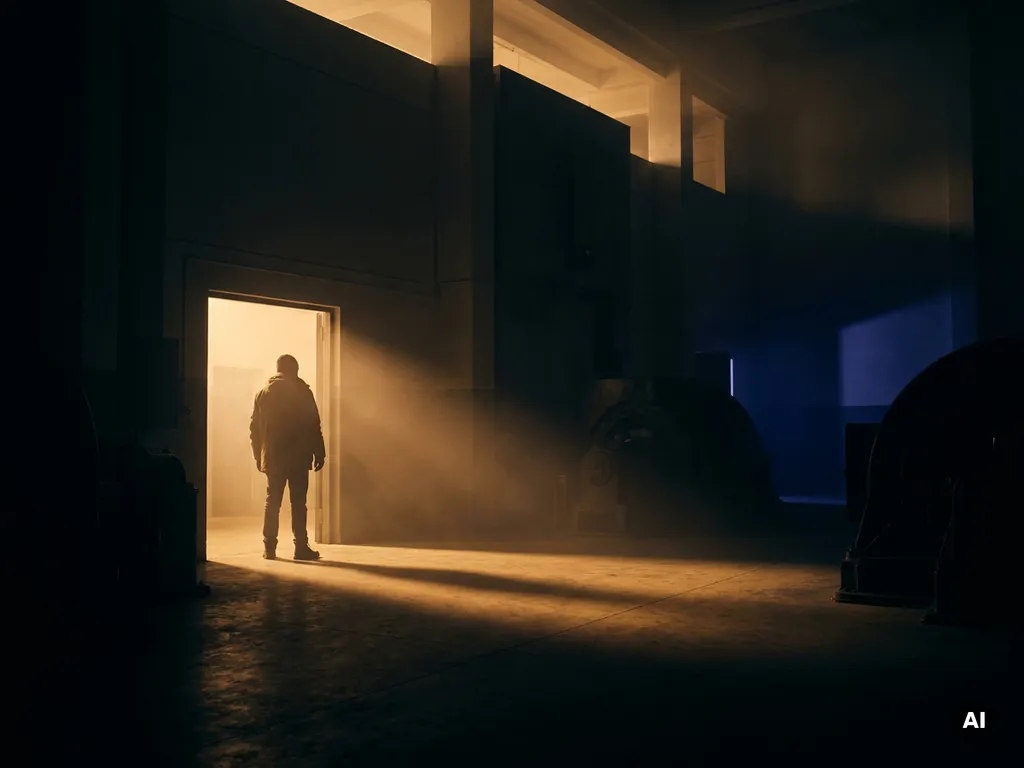
An immersive show is a live or installation-based experience that places the audience inside the story, environment, or artwork rather than positioning them as passive observers watching from a distance. Instead of a fixed stage and seated rows, participants move through, interact with, and become part of the experience itself. The format spans theatre, art, education, and brand activations, and the questions below unpack exactly how it works.
How is an immersive show different from a traditional performance?
The defining difference is the relationship between audience and content. In a traditional performance, a clear boundary separates performer from spectator: you sit, watch, and applaud. In an immersive show, that boundary dissolves. Participants enter the world of the experience, often moving freely, making choices, and shaping what they encounter. The audience is not a witness; it is a participant.
Traditional theatre and exhibitions are built around a single fixed perspective: everyone sees roughly the same thing from roughly the same angle. Immersive entertainment is built around multiple, personal perspectives. Two people moving through the same immersive exhibition may have entirely different journeys, encounter different characters, and leave with different emotional impressions. That variability is not a flaw; it is the design.
The spatial logic is also fundamentally different. A traditional performance happens on a stage framed by a proscenium arch or a screen. An immersive show happens in the round, across multiple rooms, outdoors, or inside purpose-built environments where every wall, floor, and ceiling is part of the storytelling. The architecture itself becomes narrative.
What elements make a show truly immersive?
A show becomes truly immersive when it engages multiple senses simultaneously, invites active participation, and creates a coherent world the audience believes in. No single technology or technique achieves this alone. It is the combination of spatial design, sensory layering, narrative structure, and interactivity that produces genuine immersion.
The most effective immersive experiences share several core elements:
- Multi-sensory engagement: Beyond sight and sound, immersive design activates smell, touch, temperature, and spatial awareness. Scent, for example, is one of the most powerful memory triggers available to a designer.
- Environmental storytelling: Every detail of the physical space carries meaning. Props, lighting, textures, and layout all communicate narrative without a single word of dialogue.
- Audience agency: Participants make choices that affect their path, their discoveries, or the outcome. This sense of agency deepens emotional investment.
- Coherent world-building: The experience must sustain its internal logic. If one element breaks the illusion, a jarring transition, an inconsistent detail, the immersion collapses.
- Emotional resonance: The most memorable immersive art and theatre does not just impress; it moves. The goal is not spectacle for its own sake but an emotional truth the participant carries with them.
What types of immersive shows exist?
Immersive shows span a wide spectrum of formats, each designed for a different context, audience, and purpose. The category includes immersive theatre, immersive exhibitions, location-based VR, interactive installations, and large-scale experiential events, all united by the principle of placing the participant inside the experience.
Immersive theatre
Immersive theatre productions like the globally influential Sleep No More place audiences inside a narrative environment where they follow performers, open drawers, and piece together a story through exploration. There is no single script to follow: each audience member constructs their own version of events. The format has grown significantly in Europe and North America, with productions ranging from intimate site-specific pieces to large multi-room theatrical worlds.
Immersive exhibitions and art installations
Immersive art exhibitions transform gallery spaces into environments visitors walk through rather than past. Digital projections, responsive soundscapes, and interactive surfaces turn passive viewing into active exploration. Museums and cultural institutions increasingly commission these formats to attract younger audiences and breathe new life into permanent collections.
Location-based VR and XR experiences
Location-based immersive entertainment uses virtual reality headsets, augmented reality overlays, or mixed reality systems within a physical venue. Participants move through real space while perceiving a digitally layered world. This format is particularly powerful for educational storytelling, heritage sites, and brand activations where transporting someone to another time or place is the goal.
4D cinemas and sensory installations
At the more technologically intensive end of the spectrum, 4D cinema environments combine synchronised sound, scent, warmth, and movement with projected content. Visitors do not just watch: they feel the experience physically. Purpose-built domes and 360-degree projection spaces fall into this category, offering full sensory immersion for groups ranging from small gatherings to thousands.
How does technology power an immersive show?
Technology is the infrastructure of modern immersive entertainment, but its role is to serve the story rather than to become it. The most effective immersive shows use technology invisibly: the audience feels the magic without seeing the machinery. Underneath that seamlessness, a sophisticated stack of tools is at work.
Projection mapping transforms irregular surfaces, walls, sculptures, architecture, into dynamic canvases. Spatial audio creates three-dimensional soundscapes that respond to where a participant stands. Augmented reality layers digital content onto the physical world through smartphones or headsets, while virtual reality replaces the physical environment entirely with a computer-generated one. Real-time game engines like Unreal Engine and Unity power interactive VR environments that respond to participant choices in the moment.
Artificial intelligence is increasingly central to immersive experience design. AI-driven avatars and non-player characters can hold real-time conversations with participants, adapting their responses based on what is said. AI also enables personalisation at scale, adjusting the language, pace, or narrative path of an experience to suit the individual moving through it. This means a single installation can deliver genuinely different experiences to a school group, a corporate team, and an individual visitor without requiring separate productions.
Sensors, RFID, GPS, and biometric feedback add further layers of responsiveness. An environment can detect where participants are, what they are looking at, or how they are moving, and shift its behaviour accordingly. The result is an experience that feels alive and aware, rather than pre-recorded and static.
Where are immersive shows typically held?
Immersive shows are held in an expanding range of venues, from purpose-built experience centres to repurposed industrial spaces, museums, outdoor public areas, and temporary event structures. The venue is not incidental: it is part of the design. Immersive creators often choose or transform spaces specifically because their architecture amplifies the narrative.
Warehouses, historic buildings, and decommissioned factories are popular choices for large-scale immersive theatre and art because their raw, atmospheric quality adds texture that a conventional theatre cannot replicate. Museums and galleries host immersive exhibitions that sit alongside permanent collections, using digital layers to deepen engagement with physical artefacts. Outdoor environments, city squares, parks, heritage sites, are increasingly used for geospatial augmented reality experiences that embed storytelling directly into the landscape.
Portable and modular formats have expanded the geography of immersive entertainment significantly. Geodesic domes, inflatable structures, and containerised VR pods can be deployed at festivals, trade fairs, schools, and public events worldwide. This mobility means immersive experiences are no longer confined to major cultural capitals: they travel to the audiences that need them most.
Who creates immersive shows, and what does that process look like?
Immersive shows are created by multidisciplinary teams that combine expertise rarely found under one roof in traditional production. A typical team includes creative directors, spatial designers, narrative writers, software engineers, sound designers, projection specialists, and producers, all working in close collaboration from concept through to delivery.
The creation process typically moves through several distinct phases. It begins with a conceptual phase where the core idea, emotional intent, and audience journey are defined. This is followed by spatial and narrative design, mapping the physical environment against the story arc and identifying the moments of discovery, surprise, and emotional peak. Technical design then translates those creative intentions into a buildable, deliverable system.
Prototyping and testing are critical. Because immersive experiences depend on how real people move through and respond to a space, assumptions made at the design stage frequently need revision once the environment is built. Iteration is built into the process, not treated as a sign of failure. The final phase is production and installation, followed by calibration, fine-tuning every sensory element until the experience performs as intended.
At Rooftop Immersive, we handle this entire journey under one roof, from the first creative conversation to the moment a participant steps inside the finished world. That end-to-end ownership means creative intent is never lost in translation between agencies, and the experience that launches matches the experience that was imagined.
What are immersive shows used for beyond entertainment?
Immersive shows are used extensively for education, social impact, corporate training, public awareness campaigns, and cultural preservation, often with outcomes that traditional media formats cannot achieve. The same principles that make immersive entertainment emotionally compelling make it a uniquely powerful tool for behaviour change, knowledge transfer, and empathy building.
In education, immersive experiences allow learners to step inside historical events, scientific processes, or social scenarios that are impossible to visit in person. A student who walks through a reconstruction of a historical environment retains far more than one who reads about it. For subjects that are abstract, sensitive, or difficult to visualise, immersive learning creates the concrete, felt understanding that transforms knowledge into insight.
NGOs and public sector organisations use immersive exhibitions and VR experiences to build empathy for causes that statistics alone cannot communicate. Placing someone inside the experience of displacement, climate change, or social inequality creates an emotional response that motivates action in ways that a report or advertisement rarely does. Organisations like UNICEF have worked with immersive partners to deploy these experiences at scale across multiple countries.
In the corporate world, immersive training simulations allow employees to practise high-stakes scenarios, safety procedures, leadership decisions, customer interactions, in environments that feel real without carrying real consequences. The learning transfer is deeper, and the engagement levels are measurably higher than with conventional e-learning formats.
Museums use immersive technology to extend the life and reach of their collections, attracting audiences who might not engage with traditional exhibition formats. Brands use immersive activations to create the kind of shared, memorable experience that generates genuine advocacy rather than passive awareness. Across all of these contexts, the immersive show is not a novelty: it is a strategic tool for connection. If you are exploring what an immersive experience could do for your organisation, we would welcome the conversation: reach out through our contact page and let us know what you are trying to achieve.
Gerelateerde artikelen
- How can I create a digital museum?
- What are planetarium domes made of?
- What are some ideas for interactive museum exhibits?
- What is an example of augmented reality advertising?
- What are immersive experiences and how do they enhance user interaction?
- What are the psychological effects of immersion?
- What is the difference between interactive and immersive theatre?
- What is interactive storytelling?
- What technology is used in immersive installations?