
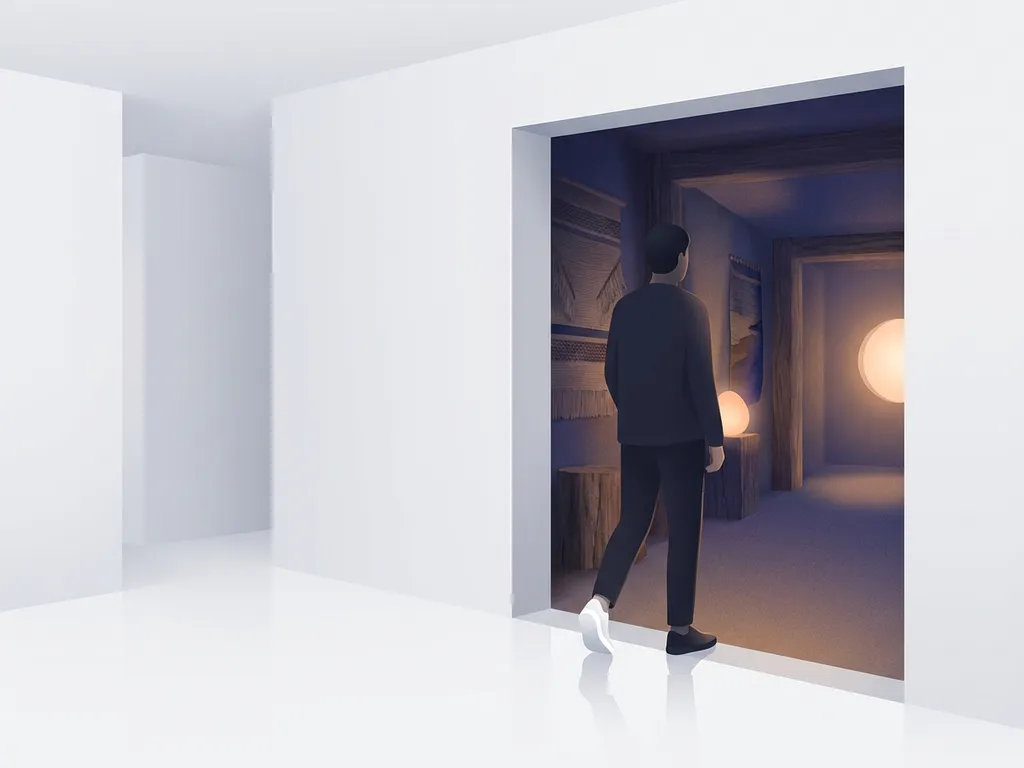
VR and immersion are not the same thing. VR is a technology that places users inside a digital environment, while immersion is the quality of an experience that makes a person feel fully absorbed, emotionally present, and mentally engaged. VR can produce immersion, but it does not guarantee it, and immersion can be achieved without VR at all. The sections below unpack this distinction and explore what actually drives deep, lasting immersive experiences.
Does VR always create true immersion?
No, VR does not always create true immersion. Wearing a headset places you inside a virtual environment, but that technical enclosure does not automatically produce the feeling of genuine presence. Immersion is a psychological state, not a hardware specification. A poorly designed VR experience can feel flat, disconnected, and even alienating, while a well-crafted non-VR installation can leave a person completely absorbed.
The gap between VR as a medium and VR as an immersive experience comes down to design quality. Factors like narrative coherence, sensory consistency, interaction design, and emotional resonance determine whether a user crosses the threshold from “watching a 3D environment” to “being somewhere.” Low frame rates, weak storytelling, or the absence of meaningful interaction all break that threshold instantly.
There is also the question of context. A passive 360-degree video in a headset may technically qualify as VR, but if the user has no agency, no sensory feedback beyond sight and sound, and no emotional stake in what unfolds, the experience remains fundamentally passive. True immersion requires more than visual enclosure. It requires the experience to meet the user where they are, emotionally and cognitively.
What does ‘immersion’ actually mean in experience design?
In experience design, immersion means the state in which a person is so fully engaged by an environment or narrative that their awareness of the outside world recedes. It is the point at which attention becomes effortless, curiosity drives behavior, and the experience feels real in the ways that matter most. Immersion is not about fooling the senses; it is about holding the whole person.
Experience designers use the term to describe a spectrum, not a binary. At one end sits light engagement, where a person is interested but still aware of their surroundings. At the other end sits deep presence, where the body, mind, and emotions are all oriented toward the experience. The goal of immersive design is to move people along that spectrum as intentionally as possible.
What makes immersion distinct from interactivity or entertainment is its emphasis on felt reality. An experience can be highly interactive without being immersive, and it can be immersive without requiring any physical interaction at all. The defining quality is whether the experience creates a coherent, believable world that the participant’s mind accepts as worthy of full attention. Narrative, spatial design, sensory layering, and emotional stakes all contribute to that acceptance.
What technologies create immersive experiences beyond VR?
Many technologies create immersive experiences beyond VR, including augmented reality, projection mapping, spatial audio, interactive installations, mixed reality platforms, and multisensory environments that combine scent, temperature, and haptic feedback. The technology itself is secondary; what matters is how it is used to construct a coherent, absorbing world for the participant.
Augmented and mixed reality
AR layers digital content onto the physical world, allowing participants to remain in their real environment while interacting with virtual elements. This approach is particularly powerful in cultural and educational settings where the physical context carries meaning that should not be replaced. Mixed reality platforms, including spatial computing devices, take this further by enabling real-time interaction between virtual objects and physical surfaces, creating experiences that blur the boundary between the two worlds in a seamless, responsive way.
Spatial and multisensory installations
360-degree projection domes, 4D cinema environments, and custom physical installations can produce deep immersion without any wearable technology. These formats work at scale, engaging groups of hundreds or even thousands simultaneously. When combined with spatial audio that tracks movement, scent diffusion, temperature variation, and tactile elements, a physical space becomes a fully realized alternative reality. The absence of a headset actually lowers the barrier to entry for many audiences, making the experience more accessible and socially shared.
How does sensory depth affect the quality of immersion?
Sensory depth directly determines the quality of immersion because the brain builds its model of reality from multiple simultaneous inputs. When an experience engages only sight and sound, the brain continues to receive contradictory signals from touch, smell, and proprioception that remind it where it actually is. Adding more sensory channels reduces that contradiction and deepens the sense of presence.
This is why a well-designed 4D environment, where participants feel warmth, smell relevant scents, and hear spatially accurate audio, often produces a stronger felt sense of reality than a visually sophisticated VR experience that engages only two senses. Each additional sensory layer does not simply add to the experience; it multiplies the credibility of the world being constructed.
Memory is also deeply tied to multisensory input. Scent in particular has a direct pathway to the brain’s emotional and memory centers, which is why a carefully chosen fragrance in an immersive installation can anchor an emotional memory far more durably than a visual alone. Designers who understand this do not treat scent, temperature, or texture as decorative additions. They treat them as core narrative tools that shape how the experience is encoded and recalled.
The practical implication is that immersive experience design is fundamentally a sensory architecture problem. Every choice about what a participant sees, hears, touches, smells, and moves through contributes to or detracts from the coherence of the world being built. We approach this from the outset, designing with all the senses rather than treating non-visual elements as afterthoughts.
When should a project use VR instead of other immersive formats?
A project should use VR when it needs to transport participants to an environment that cannot exist physically, when individual perspective and presence are central to the experience, or when the content requires complete visual isolation from the real world. VR is the right tool for empathy-driven experiences, training simulations, and narratives where the participant must inhabit a specific point of view.
The format also suits scenarios where content needs to be deployed consistently across multiple locations without rebuilding a physical environment each time. A VR experience can be distributed to schools, museums, or offices globally, with each participant receiving an identical, controlled experience regardless of where they are.
However, VR is not the right choice when the experience needs to be social and shared in an unmediated way, when the audience includes people with low tolerance for headsets, or when the physical environment itself is part of the story. In those cases, AR, projection-based installations, or mixed reality formats will often deliver stronger results with broader accessibility.
The honest answer is that format selection should follow the experience’s emotional and narrative goals, not the other way around. Choosing VR because it signals innovation, rather than because it serves the story, is one of the most common mistakes in immersive project planning.
What makes an immersive experience emotionally memorable?
An immersive experience becomes emotionally memorable when it places a person inside a story rather than in front of it, when it demands active participation rather than passive consumption, and when it engages the body and senses alongside the mind. Emotional memory is formed when experience carries personal relevance, novelty, and felt stakes, all of which immersive design can deliberately engineer.
Research into how people learn and remember consistently shows that experiences involving movement, emotion, and multiple senses are retained far more durably than information delivered through screens or text. This is the core reason why immersive formats outperform traditional media for behavior change, learning outcomes, and brand recall. The experience becomes part of the participant’s story, not just content they consumed.
Narrative structure plays a critical role. Experiences that create genuine tension, offer meaningful choices, or allow participants to witness consequences from a first-person perspective generate the kind of emotional engagement that lodges in long-term memory. The participant is not an observer; they are an agent, and that shift in role changes how the experience is encoded entirely.
Finally, the moment of transition matters enormously. The point at which a person crosses from the ordinary world into the immersive environment sets the emotional tone for everything that follows. A well-designed threshold, whether physical, sonic, or narrative, signals to the brain that something significant is beginning. That signal primes the participant for deeper engagement and makes the entire experience more memorable as a result.
If you are exploring how immersive design could serve your next project, whether in education, culture, or brand experience, we would be glad to think through it with you. Reach out through our contact page and let us know what you are building.
Gerelateerde artikelen
- What is XR vs VR vs AR?
- What part of the brain is responsible for sensory memory?
- What is the role of sound in immersive experiences?
- What are the three levels of immersion?
- Can immersive experiences reduce anxiety?
- What are the benefits of taking a virtual field trip in immersive virtual reality?
- What is immersive experience design?
- What are the principles of good spatial design?
- How do you measure success in experiential marketing?