
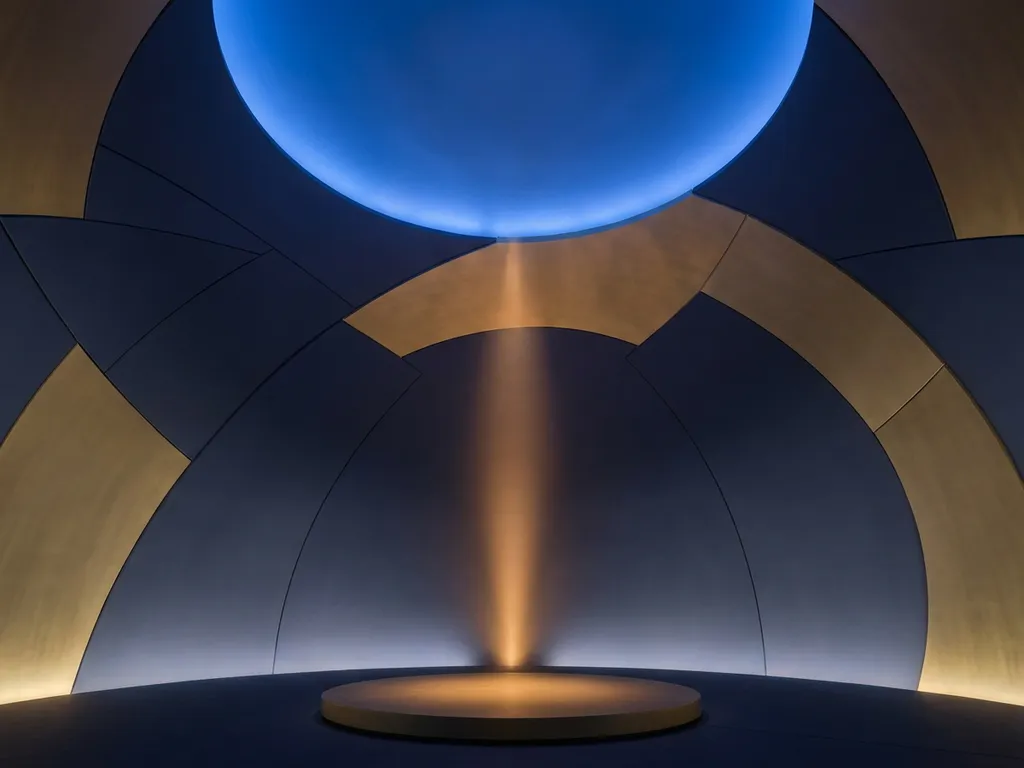
The best content for dome installations combines wide-field panoramic visuals, spatial audio, and narrative formats specifically designed for 360° immersive environments. Flat-screen content repurposed for a dome almost always underperforms. Dome installations reward content built from the ground up to use the full spherical canvas, envelop the audience in sound, and guide attention without a fixed frame. The questions below unpack exactly what that looks like in practice.
What types of visuals perform best inside a 360° dome?
Visuals that perform best inside a 360° dome are wide, slow-moving, and compositionally distributed across the entire spherical surface rather than concentrated in a single focal point. The dome is not a large flat screen. It is a spatial environment, and content designed to fill it must treat every direction as potentially meaningful.
The most effective visual approaches for dome installations include:
- Fluid, flowing motion – gradual camera movements, particle systems, and organic transitions that feel natural as the eye travels across the curved surface
- Environmental immersion – underwater worlds, cosmic landscapes, forest canopies, and architectural interiors that surround rather than confront the viewer
- Zenith and nadir engagement – content that uses the overhead and underfoot zones deliberately, not just the equatorial band where flat-screen habits tend to concentrate attention
- High-contrast, rich-color palettes – dome projection systems typically split the image across multiple projectors, so visual clarity and color depth matter more than fine detail
- Abstract and generative visuals – data visualizations, fractal animations, and procedurally generated environments translate exceptionally well to the dome’s curved geometry
What consistently underperforms is content with hard edges, tight close-ups, or fast cuts borrowed from cinema or advertising. The dome punishes rapid editing because the audience has no single fixed gaze point. Slow reveals, atmospheric transitions, and layered depth create a sense of genuine presence that quick cuts destroy.
How does spatial audio change the dome experience?
Spatial audio transforms a dome installation from a visual spectacle into a fully immersive experience by anchoring sound to specific locations in three-dimensional space. When audio moves around, above, and below the audience in sync with the visuals, the brain stops processing the environment as a projection and starts treating it as a real place.
Standard stereo or even surround sound formats designed for cinema fall short in a dome context. What the dome requires is object-based or ambisonics audio, where individual sounds are placed as three-dimensional objects in the mix rather than assigned to fixed speaker channels. This means a thunderclap can roll across the ceiling, a whispered voice can emerge from directly behind a single audience member, and the hum of a city can rise from beneath the floor.
The practical impact on audience perception is significant. Spatial audio dramatically increases the sense of presence, which is the feeling of actually being somewhere rather than watching it. It also guides attention. In an environment where the audience can look anywhere, sound becomes a directional cue that draws the eye toward the part of the visual field where the narrative is developing. Used skillfully, spatial audio reduces the disorientation that some audiences feel in their first dome experience and replaces it with a feeling of being held inside the world.
For educational and awareness content in particular, the emotional register of spatially placed sound deepens empathy in ways that flat audio cannot match. Hearing a child’s voice come from directly to your left, at ear height, creates a proximity that visual content alone cannot manufacture.
What storytelling formats work in a dome versus a flat screen?
The storytelling formats that work in a dome are fundamentally different from those designed for flat screens. Flat-screen narrative relies on framing, cutting, and directed gaze. Dome narrative relies on environmental immersion, atmospheric progression, and audience-led exploration. The most effective dome formats are experiential rather than cinematic.
Formats that succeed in the dome
Journey narratives work exceptionally well. Taking an audience through a sequence of environments, whether a deep ocean descent, a migration route, or a historical period, uses the dome’s spatial quality to create genuine forward momentum without requiring cuts. The transition between environments becomes part of the story.
Perspective-shift storytelling is another high-performing format. Placing the audience inside the point of view of another person, creature, or entity uses the dome’s enveloping quality to build empathy. The audience is not watching someone else’s experience. They are inhabiting it.
Formats that struggle in the dome
Dialogue-heavy narrative is difficult to execute because the dome offers no natural place to anchor a speaker’s face. Audiences look for the source of a voice, and if the visual does not match the audio location, the experience breaks. Narration works far better than conversation in dome environments.
Text-heavy content also fails, since curved projection surfaces distort text at the edges and audiences at different positions in the dome read text from different angles. Any information conveyed through text should be minimal, large, and placed in the zenith or central band.
What content themes resonate most with dome audiences?
The content themes that resonate most with dome audiences are those that benefit from scale, perspective, and the feeling of being somewhere unreachable in ordinary life. The dome is at its most powerful when it takes people somewhere they cannot otherwise go.
Themes that consistently generate strong audience responses include:
- Natural environments at scale – deep ocean, outer space, ancient landscapes, extreme weather, and ecosystems too vast or too microscopic to experience directly
- Historical and cultural immersion – placing audiences inside historical moments, lost civilizations, or living cultural traditions that would otherwise require significant travel or imagination
- Social empathy and human rights – first-person perspective content that places audiences inside the lived experience of others, particularly effective for NGOs, awareness campaigns, and educational programs addressing complex social issues
- Scientific and data visualization – making invisible systems visible, from climate data to neural activity to urban growth patterns, rendered as navigable environments rather than charts
- Spiritual and contemplative experience – meditative content, sacred spaces, and philosophical themes that use the dome’s enveloping quality to create a sense of awe or reflection
What these themes share is that they all benefit from the audience feeling small in relation to something vast, or intimately close to something usually distant. The dome’s geometry makes both of those emotional states physically real.
How long should dome installation content be?
Dome installation content should typically run between eight and twenty minutes for a single experience. This range reflects both the cognitive limits of sustained immersive attention and the practical logistics of audience throughput in venue settings. Shorter pieces under five minutes rarely justify the setup and transition time. Longer pieces over thirty minutes risk sensory fatigue.
The right duration depends on context. A festival or public event installation with continuous visitor flow works best with content in the eight- to twelve-minute range, allowing multiple groups to experience the piece throughout a day. A museum or educational setting where groups are scheduled in advance can support content up to twenty minutes, particularly if the narrative arc warrants it.
Modular content design is increasingly common and practical. Rather than producing a single fixed-length piece, many effective dome installations are built as a series of thematic chapters, each five to seven minutes long, that can be combined or rearranged depending on the audience and context. This approach also extends the commercial lifespan of the content, since new chapters can be added without rebuilding the entire experience.
Pacing within the content matters as much as total duration. The dome demands slower pacing than flat-screen media. Audiences need time to explore the visual field, and transitions need space to breathe. A twelve-minute dome piece often carries the experiential weight of a much longer conventional film.
Should dome content be interactive or passive?
Dome content can be either interactive or passive, and the right choice depends entirely on the audience, the venue, and the purpose of the installation. Both formats deliver genuine value when designed correctly. The distinction is not about which is better, but about which serves the specific experience goal.
Passive dome content works best when the goal is collective emotional impact, contemplative experience, or narrative immersion. A group of visitors experiencing a shared journey together, without individual devices or controls, creates a communal atmosphere that interactive formats can disrupt. Passive content also scales more reliably across diverse audiences, including young children, older visitors, and groups with varying levels of digital literacy.
Interactive dome content works best when the goal is educational engagement, personalized exploration, or participatory storytelling. Audiences can influence the narrative direction, explore different layers of information, or make choices that shape what they see next. This format is particularly effective for learning environments and awareness campaigns where active participation deepens retention and behavior change.
A hybrid approach is also viable. A passive narrative arc can include interactive moments, such as a collective vote that shifts the story’s direction, or sensor-based responses to audience movement. These hybrid formats preserve the shared emotional atmosphere of passive content while introducing moments of agency that increase engagement and memorability.
What technical specifications must dome content meet?
Dome content must meet specific technical requirements that differ significantly from standard video or flat-screen production. The most critical specifications cover resolution, frame format, frame rate, and audio encoding. Getting these wrong means content that looks distorted, pixelated, or misaligned on the projection surface.
The key technical requirements for dome content include:
- Fisheye or fulldome format – dome content is typically rendered or converted into a circular fisheye projection format, usually at a 4K or 8K resolution minimum. The circular frame contains the full 180° or 360° field of view depending on the dome configuration
- High frame rate rendering – 60 fps is the standard minimum for dome content to avoid motion sickness. Some installations run at higher frame rates to further reduce vestibular discomfort, particularly for content with significant camera movement
- Seamless edge blending – multi-projector dome setups require content that is precisely calibrated for the specific projection geometry of the venue. Content produced for one dome may need warping adjustments for another
- Ambisonics or object-based audio – first- or second-order ambisonics is the standard for dome spatial audio, though higher-order formats are increasingly accessible and deliver more precise positional accuracy
- Color calibration profiles – dome projection surfaces and lamp types vary, so color grading must account for the specific projection hardware being used
Content producers new to dome formats often underestimate the rendering demands. A single frame of 8K fisheye content at 60 fps requires substantially more processing power than equivalent flat-screen production. Planning for longer render times and higher storage requirements from the start of production prevents delays at the delivery stage.
If you are developing dome content for an upcoming installation and want to ensure it meets both the technical and creative standards that make the format genuinely powerful, we would welcome the conversation. Contact us to explore what is possible.
Gerelateerde artikelen
- How do you avoid technical delays during audience interaction?
- What are examples of interactive activities?
- What is an example of an immersive experience?
- What is the strongest trigger to memory?
- What can provide immersive training experiences?
- Is VR an immersive experience?
- What is the salary of a 3D modeler?
- How do you align immersive experiences with brand identity?
- What technology is used in immersive installations?