
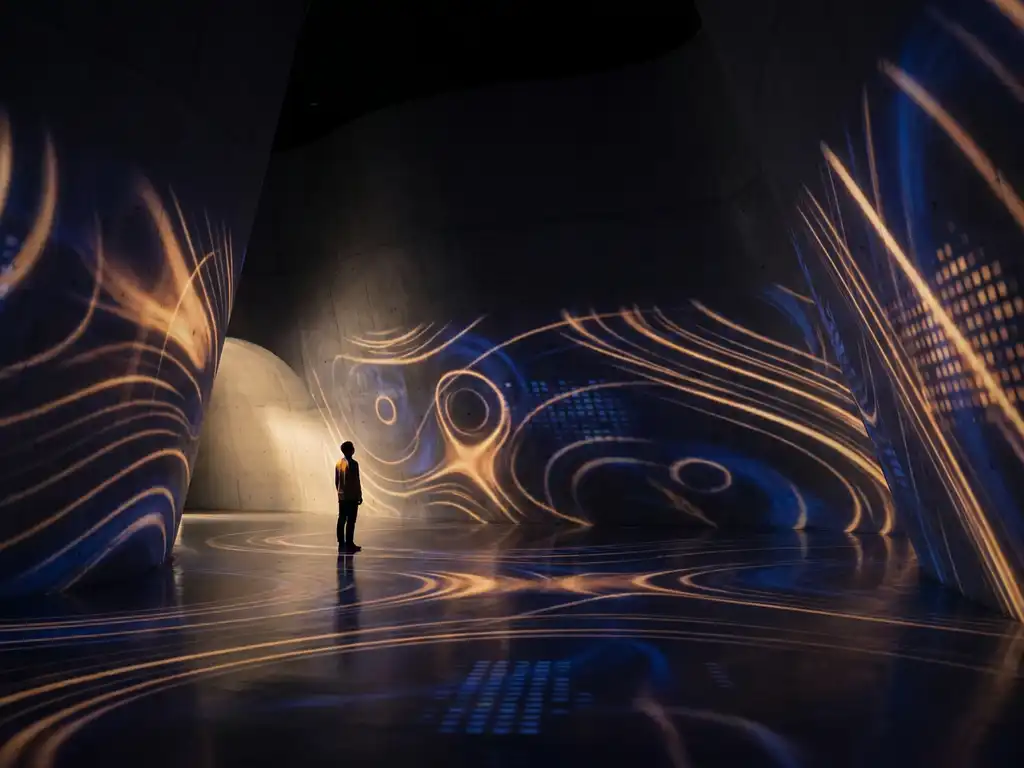
Branded immersive experiences are purpose-built environments or activations where a brand’s story, values, and identity are communicated through physical space, sensory engagement, and interactive technology rather than through passive advertising. Instead of showing an audience a message, these experiences place people inside one. They are used across marketing, retail, events, and cultural contexts to create emotional connections that traditional media cannot replicate.
The defining quality of a branded immersive experience is full engagement: visitors see, hear, touch, and sometimes smell or feel the brand world around them. This multi-sensory depth is what separates immersive work from a well-designed display stand or a compelling video ad. The sections below address the most common questions brands and agencies ask before commissioning this kind of work.
How do branded immersive experiences differ from traditional advertising?
Traditional advertising delivers a message to a passive audience. A branded immersive experience invites that audience to step inside the message and participate in it. The fundamental difference is agency: in a TV spot or banner ad, the viewer receives content; in an immersive activation, they navigate, interact, and make choices within a brand-designed world. That shift from passive reception to active participation changes how deeply the experience is processed and remembered.
Cognitive research consistently shows that people retain information far more effectively when they are emotionally involved and physically engaged. This is sometimes explained through the concept of the forgetting curve: information delivered passively fades quickly, while experiences tied to emotion and action leave lasting impressions. Branded immersive experiences exploit this by embedding brand narratives into moments that feel genuinely memorable rather than interruptive.
There is also a social dimension. Immersive activations generate organic sharing because people want to document and discuss unusual, beautiful, or surprising physical encounters. A thirty-second ad is skipped; a room that makes your brand’s sustainability story tangible is photographed, posted, and talked about. This extends reach far beyond the immediate audience without additional media spend.
What technologies power a branded immersive experience?
Branded immersive experiences are powered by a combination of spatial computing, extended reality (XR), projection mapping, spatial audio, AI, and physical set design working together. No single technology defines the category. What matters is how these tools are orchestrated to remove the distance between the audience and the brand’s story.
The most commonly used technologies include:
- Augmented Reality (AR): Digital content layered onto the physical world via smartphones, tablets, or headsets. AR activations are used for product launches, retail environments, and event overlays. Geospatial AR can anchor content to precise outdoor locations without QR codes.
- Virtual Reality (VR): Fully enclosed digital environments experienced through a headset. VR can be passive and cinematic or fully interactive, and it scales from individual experiences to synchronized group sessions for hundreds of visitors.
- Mixed Reality (MR): Real-time blending of physical and virtual elements, increasingly delivered through spatial computing hardware such as Apple Vision Pro. MR allows virtual objects to respond to and interact with the real environment around them.
- 360-degree projection: Large-scale visuals mapped onto domes, walls, or custom structures to surround visitors entirely. Ideal for brand storytelling at scale in exhibitions or events.
- AI and interactive characters: AI-driven avatars and non-player characters (NPCs) that hold real-time conversations with visitors, personalizing the experience based on language, interest, or context.
- Haptic and sensory layers: Physical elements including scent, temperature, vibration, and tactile materials that reinforce the digital narrative and engage senses that screens cannot reach.
Extended reality (XR) is the umbrella term covering AR, VR, and MR together. Spatial computing refers to the broader discipline of designing digital content that understands and responds to three-dimensional physical space. Together, these form the technical foundation of most contemporary branded immersive work.
What types of branded immersive experiences exist?
Branded immersive experiences span a wide spectrum, from compact AR activations on a smartphone to large-scale multi-room physical installations. The right format depends on the brand’s objectives, audience, location, and budget.
Common formats include:
- AR activations: Brand content triggered by image recognition, geospatial coordinates, or QR codes. Used at product launches, trade shows, and retail environments to add interactive digital layers to physical touchpoints.
- VR brand experiences: Visitors wear headsets and enter a fully designed brand world. These range from cinematic storytelling pieces to interactive simulations where choices drive the narrative.
- Immersive installations: Physical spaces transformed through projection, light, sound, and interactive elements. These can be pop-up activations, permanent exhibition rooms, or event centrepieces.
- 4D environments: Experiences that add sensory dimensions including scent, air movement, heat, and vibration to visual and audio content, creating full-body engagement.
- Interactive screens and digital twins: Smart surfaces that respond to visitor behaviour, and photogrammetric 3D models of real products or locations that visitors can explore digitally.
- Hologram and volumetric experiences: Three-dimensional representations of real people or objects, used for product launches or virtual hosts at events.
- Location-based experiences: Permanent or semi-permanent installations designed for a specific venue, such as a museum, flagship store, or public space, where the physical context is part of the experience design.
Which industries use branded immersive experiences most?
The industries that invest most heavily in branded immersive experiences are those where emotional connection, behaviour change, or memorable differentiation directly drives value. These include consumer brands and retail, cultural institutions, education, healthcare, NGOs, and the events sector.
Consumer brands use immersive activations to launch products, build loyalty, and create shareable moments at a time when traditional advertising struggles to hold attention. Automotive, fashion, and FMCG brands have been early adopters, using AR and VR to let customers experience products before purchase or to communicate brand values in ways that static media cannot.
Museums and cultural institutions use immersive technology to deepen engagement with collections, attract younger and more diverse audiences, and create experiences that extend the emotional resonance of physical artefacts. The challenge for these organisations is integrating digital layers without overshadowing the original works, which requires a partner who understands that technology should serve the story, not replace it.
Education and NGO sectors use immersive experiences to make abstract or difficult subjects accessible. VR has proven particularly effective at building empathy: placing a learner inside a scenario they would never otherwise encounter accelerates understanding in ways that text, video, and lectures cannot match. Organisations addressing climate change, social inequality, or public health increasingly commission immersive work to shift attitudes and inspire action.
Events and exhibitions represent another high-growth context, where producers need experiences that create genuine surprise and generate social sharing under tight logistical constraints.
How do you measure the impact of a branded immersive experience?
The impact of a branded immersive experience is measured through a combination of engagement metrics, behavioural data, emotional response indicators, and downstream business outcomes. The right measurement framework depends on the experience’s objectives, but the most effective approaches capture data at multiple stages: before, during, and after the activation.
Quantitative measures typically include:
- Dwell time and interaction depth within the experience
- Number of participants and completion rates
- Social sharing volume and earned media reach
- Lead generation, sign-ups, or direct conversions linked to the activation
- Return visit rates for location-based experiences
Qualitative measures add essential depth:
- Post-experience surveys measuring recall, sentiment, and attitude shift
- Observed behaviour changes for educational or NGO applications
- Facilitator or educator feedback on learning outcomes
- Brand perception tracking before and after an activation
One of the genuine advantages of technology-driven immersive experiences is that interaction data can be captured in real time. Unlike a billboard or a TV spot, a VR or AR experience can record exactly which moments held attention, where visitors paused, and which interactions they chose. This granularity makes optimization across a campaign or programme far more precise than traditional media allows.
What does it cost to create a branded immersive experience?
The cost of a branded immersive experience varies significantly and is shaped by a set of interconnected factors rather than a fixed price list. Understanding those factors helps brands set realistic expectations and prioritize where production investment will have the greatest impact.
The key factors that influence cost include:
- Scope and complexity: A single AR activation for a product launch involves far less production work than a multi-room immersive installation with custom physical set design, spatial audio, and real-time AI interaction.
- Technology stack: VR experiences requiring custom Unreal Engine or Unity development, volumetric video capture, or Apple Vision Pro integration carry higher development costs than smartphone-based AR built on established platforms.
- Duration and scalability: A one-day event activation has different cost dynamics than a permanent museum installation or a programme designed to run across multiple venues over several years.
- Content depth: Experiences built around original 3D modelling, hyperrealistic animation, or bespoke narrative scripting require more production time than those adapted from existing assets.
- Hardware and physical production: Some experiences require custom physical structures, projection hardware, haptic equipment, or on-site installation teams, all of which add to the overall investment.
- Personalization and AI integration: Building adaptive experiences that respond to individual users, languages, or learning styles adds development complexity but significantly increases the experience’s long-term value and reusability.
The most important question is not what an experience costs in isolation, but what return it generates relative to the alternatives. Brands that compare immersive production costs against equivalent media spend often find that the depth of engagement, the earned media value, and the longevity of the asset make immersive investment highly competitive.
When should a brand invest in an immersive experience over a digital campaign?
A brand should invest in an immersive experience over a digital campaign when the objective requires depth of engagement, emotional resonance, or behaviour change that passive media cannot reliably deliver. If the goal is reach alone, digital advertising is often more efficient. But when the goal is to shift perception, build genuine loyalty, explain something complex, or create a moment people will remember and share, immersive experiences consistently outperform.
Specific situations that favour immersive investment include:
- Product launches where tactile or spatial qualities matter and need to be felt rather than described
- Brand repositioning where a new identity needs to be experienced, not just communicated
- Educational programmes where passive information delivery has failed to produce understanding or behaviour change
- Campaigns targeting audiences who are actively resistant to traditional advertising
- High-value customer or stakeholder contexts where depth of impression matters more than breadth of reach
- Cultural or social impact work where empathy, not just awareness, is the intended outcome
The decision also depends on timing and lifecycle. Immersive experiences built on modular, reusable technology can serve multiple purposes across a campaign, an exhibition season, or an educational programme, making the per-use cost more competitive over time. A well-designed VR training module or AR activation does not expire after a media flight ends.
We design immersive experiences that balance creative ambition with practical delivery, from first concept through to final execution. If you are weighing whether an immersive approach is right for your next project, we are glad to think through it with you. Contact us to start the conversation.
Gerelateerde artikelen
- Does projection mapping require a custom animation?
- What are the advantages and disadvantages of immersive technology?
- What does an experiential marketing agency do?
- What exactly is experiential marketing?
- What are the 5 dimensions of experiential marketing?
- What are the guiding principles of immersive learning?
- What are two examples of experiential marketing?
- What is an immersive experience?
- What is immersive learning?