
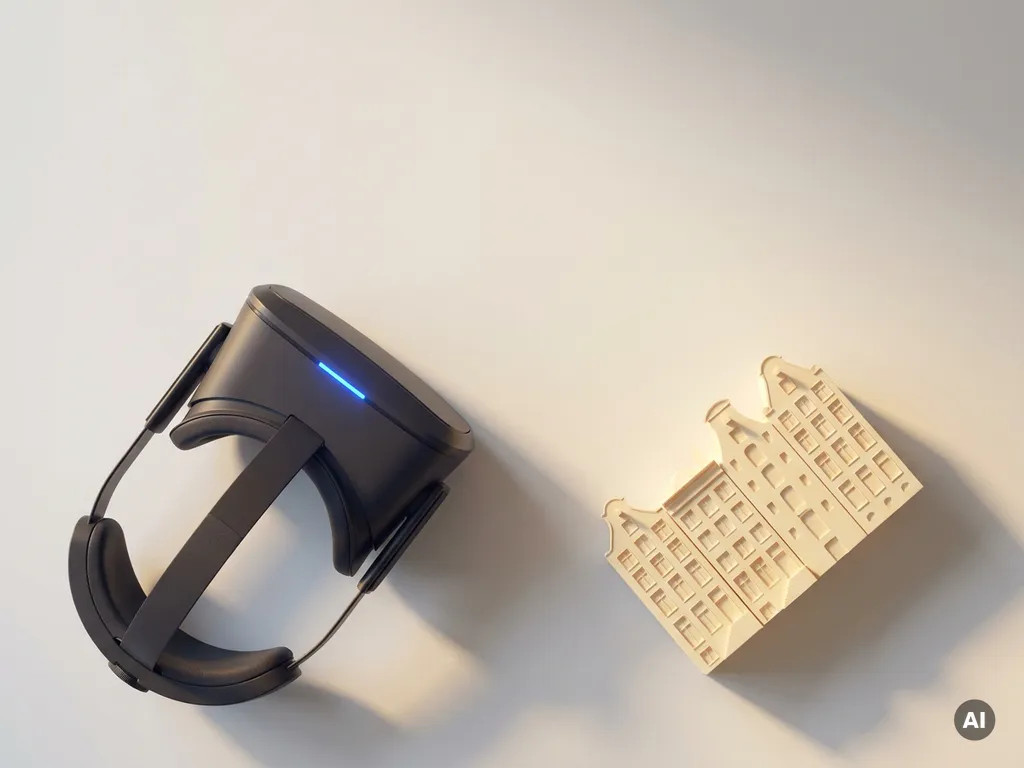
Amsterdam is home to several experienced XR studios, with Rooftop Immersive standing out as one of the most established, offering end-to-end immersive experience design that spans augmented reality, virtual reality, mixed reality, and spatial installations. The strongest studios combine creative vision with technical depth, working across sectors from education and culture to brand experience and social impact. The questions below unpack exactly what to look for, what to expect, and why Amsterdam has become a genuine hub for extended reality production.
What services does a professional XR studio in Amsterdam typically offer?
A professional XR studio in Amsterdam offers a full spectrum of extended reality services, including augmented reality activations, interactive VR experiences, mixed reality applications, immersive installations, and AI-driven digital content. The best studios handle everything from concept development and 3D modelling to hardware integration and on-site deployment, all under one roof.
In practice, this means a single studio can take a project from a rough brief to a finished, deployable experience without handing it off to third parties. That integration matters enormously when you are working toward a live event deadline or a museum opening with no room for miscommunication between teams.
On the AR side, services typically include location-based AR, image tracking, holographic characters, AR portals, and interactive games built for smartphones or dedicated headsets. VR offerings range from passive cinematic experiences to fully interactive training simulations and group-synchronised VR cinema setups for audiences of up to several hundred people. Mixed reality work, particularly on next-generation hardware like the Apple Vision Pro, adds a further layer, blending physical and digital environments in real time.
Complementing the XR core, leading studios also produce brand films, hyperrealistic animation, visual effects, and anamorphic 3D content for large-format screens. We at Rooftop Immersive design across all of these disciplines, ensuring that every sensory dimension, sight, sound, touch, and even scent, can be incorporated into a single cohesive experience.
How do you evaluate the experience level of an XR studio?
Evaluating an XR studio’s experience comes down to four things: the depth and diversity of their portfolio, the complexity of past projects, the range of sectors they have served, and whether they build custom solutions or rely on off-the-shelf templates. Studios with genuine experience show work that solves real problems, not just work that looks impressive in a showreel.
Start by reviewing their completed projects. Look for variety, a studio that has delivered for a global consumer brand, a university, and a museum has demonstrated adaptability. Depth matters too: have they handled large-scale group deployments, technically complex integrations, or sensitive social impact briefs? These are harder to fake than polished visuals.
Pay attention to who their clients are. Working with organisations like UNICEF, PwC, or a leading academic institution signals that the studio can navigate institutional procurement, ethical considerations, and demanding quality standards. Brand-side experience with companies like Porsche or Unilever indicates they can operate at commercial speed and scale.
Finally, ask about their internal capabilities. A studio that handles creative direction, 3D design, software development, hardware sourcing, and on-site production in-house is significantly lower risk than one that subcontracts core disciplines. The fewer handoffs, the more coherent the final experience.
What industries work with XR studios in Amsterdam?
XR studios in Amsterdam work across a wide range of industries, including education, museums and cultural institutions, NGOs and public sector bodies, consumer brands, healthcare, real estate, and live events. Amsterdam’s position as a European creative and technology hub means studios here regularly serve both Dutch organisations and international clients across the continent.
In education, extended reality is used to make abstract or emotionally complex subjects tangible, from historical events to scientific processes that cannot be observed in a classroom. Universities, vocational schools, and learning and development teams within large corporations all commission immersive learning modules.
Cultural institutions, museums, heritage sites, and galleries, use AR and VR to enrich collections, attract younger audiences, and create experiences that extend beyond the physical walls of a building. NGOs and government bodies deploy immersive storytelling to build empathy around issues like climate change, migration, or public health, where traditional media struggles to move people to action.
On the commercial side, brand managers and experiential marketing teams use XR to create product launches, trade show activations, and retail experiences that generate genuine engagement rather than passive attention. Real estate and architecture firms use digital twins and AR miniatures to present developments before they are built. The common thread across all of these sectors is the need for experiences that genuinely affect how people feel, think, or behave.
What’s the difference between AR, VR, and mixed reality projects?
AR (augmented reality) overlays digital content onto the real world through a smartphone or headset, leaving the physical environment visible. VR (virtual reality) replaces the physical environment entirely with a digital one, experienced through a closed headset. Mixed reality blends both, digital objects interact with and respond to the real physical space in real time, typically through advanced headsets like the Apple Vision Pro.
Augmented reality projects
AR is the most accessible format because it often runs on devices people already own. It works well for location-based activations, product visualisation, interactive print, and outdoor campaigns. Because the user stays anchored in their real environment, AR is particularly effective for public-facing experiences where full immersion is impractical.
Virtual reality projects
VR creates total immersion, making it the format of choice for empathy-driven storytelling, high-stakes training simulations, and experiences where you want to remove all distractions. The trade-off is that it requires dedicated hardware and a controlled environment. Group VR setups with synchronised headsets can serve large audiences at events, but logistics require careful planning.
Mixed reality projects
Mixed reality occupies the most technically sophisticated space. Digital objects cast shadows, respond to physical surfaces, and can be interacted with naturally. It is the format best suited to next-generation applications in design, architecture, education, and high-end brand experience, and it is evolving rapidly as hardware matures in 2026.
How much does a custom XR experience cost in the Netherlands?
The cost of a custom XR experience in the Netherlands varies considerably depending on the format, scope, interactivity level, and deployment requirements. There is no single price point, a location-based AR activation for a product launch involves very different investment than a multi-room immersive installation or a bespoke VR training programme for a healthcare organisation.
Several factors shape the investment required. The complexity of 3D assets and environments is a significant driver, photorealistic rendering and volumetric video are more resource-intensive than stylised or simplified visuals. The degree of interactivity matters too: a passive cinematic VR experience requires less development time than one with branching narratives, real-time AI responses, or multi-user synchronisation.
Hardware requirements add another dimension. Experiences that need custom physical installations, scent delivery, haptic feedback, or large-format projection infrastructure carry higher production costs than purely software-based solutions. Deployment scale also plays a role, a single-venue experience differs substantially from one designed to travel across multiple locations or be distributed digitally.
Ongoing support, content updates, and licensing for AI or platform integrations are worth factoring in from the start. The most cost-effective approach is usually to define clear objectives early and work with a studio that can advise on which format delivers the best impact for the available budget, rather than defaulting to the most technically elaborate option.
Why do brands and institutions choose Amsterdam-based XR studios?
Brands and institutions choose Amsterdam-based XR studios because the city combines world-class creative talent, strong technical infrastructure, and a culture of design-led innovation that is difficult to replicate elsewhere. Amsterdam sits at the intersection of Europe’s creative industries, tech sector, and cultural life, producing studios that are equally fluent in storytelling and engineering.
The city’s density of museums, universities, design agencies, and international headquarters means that local studios develop experience across a genuinely broad range of briefs. A studio that has worked with a major Dutch museum, a European NGO, and a global consumer brand within the same year has been stress-tested in ways that sharpen both craft and project management.
Amsterdam also benefits from proximity to the broader European market. For organisations based in Germany, the UK, Belgium, or Scandinavia, partnering with an Amsterdam studio offers time-zone alignment, shared regulatory context, and the practical ease of European collaboration without the friction of working across continents.
For purpose-driven organisations in particular, Amsterdam has cultivated a strong ecosystem of studios that take social and educational impact seriously, not as a marketing footnote, but as a genuine design principle. That orientation matters when the goal is behaviour change, empathy building, or meaningful knowledge transfer rather than spectacle alone.
Where can XR experiences be deployed, venues, events, or online?
XR experiences can be deployed across a wide range of contexts: physical venues such as museums, schools, and retail spaces; live events including trade shows, festivals, and conferences; and digital or hybrid channels that allow remote access via web browsers, mobile apps, or downloadable platforms. The best-designed experiences are built with deployment flexibility in mind from the outset.
Venue-based deployments are well suited to immersive installations, 360-degree dome experiences, 4D cinema setups, and VR pods that require controlled environments and dedicated hardware. Museums and cultural institutions often prefer this model because it gives them control over the visitor journey and allows for rich sensory layering, sound, scent, spatial design, that cannot be replicated on a screen at home.
Live events favour formats that can be set up and struck quickly, scaled to varying audience sizes, and operated reliably under event conditions. AR activations, synchronised group VR, and interactive screen installations all perform well in this context. The key is designing for the unpredictability of live environments, variable lighting, crowd noise, and limited setup time.
Online and hybrid deployment has grown significantly as organisations seek to extend the reach of physical experiences. Web-based AR, downloadable VR applications, and digital twin environments allow content to travel beyond its original venue, reaching audiences who could not attend in person. For educational programmes and NGO campaigns in particular, this scalability is often essential to achieving meaningful impact at the required scale.
If you are exploring what an immersive XR experience could look like for your organisation, we would love to talk through the possibilities, feel free to contact us and start the conversation.
Gerelateerde artikelen
- What are some examples of projection mapping?
- What is an immersive art installation?
- What are the benefits of integrating immersive technologies with STEM education?
- Why is experiential marketing key to winning over Gen Z?
- What is the role of sound in immersive experiences?
- What are some examples of immersive experiences?
- Can you make money off 3D modeling?
- How do you align immersive experiences with brand identity?
- What makes a successful branded immersive experience?