
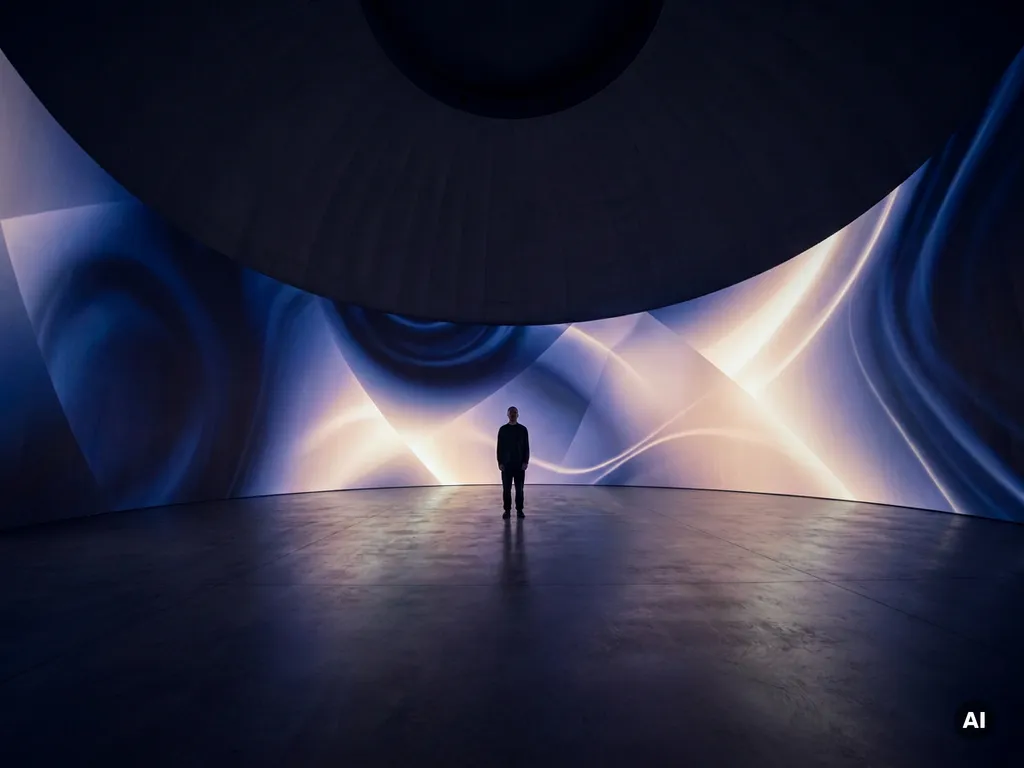
Immersive virtual reality examples include educational simulations that place students inside historical events, museum experiences that bring artifacts to life, brand activations that let consumers explore products in 3D environments, and location-based VR installations that transport entire groups to distant or imagined worlds. The defining quality across all of these is presence, the feeling of genuinely being somewhere else. Below, we unpack the most compelling categories of immersive VR experiences and what makes each one work.
What makes a virtual reality experience truly immersive?
A virtual reality experience becomes truly immersive when it convinces the brain that the simulated environment is real, not just visually, but across multiple sensory channels. This requires a combination of high-fidelity visuals, spatial audio, responsive interaction, and physical feedback that work together to create what researchers call a sense of presence. When any one of these elements breaks down, the illusion collapses.
The most effective immersive VR experiences share several core qualities. First, they minimize latency, the delay between a user’s movement and the environment’s response. Even a fraction of a second of lag can trigger disorientation and pull people out of the experience. Second, they use spatial audio that shifts with head movement, making sound feel directional and grounded in the virtual space. Third, they give users agency, something to do, choose, or affect, rather than simply placing them in a passive scene.
Beyond the technical, truly immersive virtual reality is built on strong storytelling. The environment must have internal logic, emotional stakes, and a reason for the user to care. A photorealistic forest rendered in Unreal Engine is impressive; a forest where your choices determine the survival of an ecosystem is immersive. The technology serves the narrative, not the other way around.
Physical elements also play a growing role. Haptic feedback, temperature shifts, scent, and even wind can deepen the sense of embodiment. At Rooftop Immersive, we design with all the senses in mind precisely because the most memorable experiences are the ones that reach beyond what a screen can deliver.
What are some real-world examples of immersive VR in education?
Immersive VR in education takes learners out of the classroom and into the subject itself. Real-world examples include virtual field trips to ancient civilizations, medical training simulations where students practice procedures without risk, safety training for industrial environments, and empathy-building experiences that place learners inside the perspective of someone facing social hardship. Each of these uses VR to make abstract or inaccessible content tangible.
One of the most powerful educational applications is perspective-taking. VR can place a student inside the experience of a refugee navigating displacement, a patient receiving a difficult diagnosis, or a worker in a hazardous environment. This kind of experiential learning produces deeper retention and stronger emotional engagement than reading or video alone, because the learner is not observing, they are participating.
Language learning is another growing area. Immersive VR environments simulate real conversational contexts, a marketplace, a doctor’s office, a business meeting, allowing learners to practice in conditions that mirror actual use. The stakes feel real even when the consequences are not, which accelerates skill development.
We have developed custom immersive education experiences for institutions including UvA and Yuverta, combining VR environments with AI-driven personalization so that each learner moves at their own pace and receives content adapted to their learning style. The result is a learning tool that scales without losing depth.
How is immersive VR used in museums and cultural institutions?
Museums and cultural institutions use immersive VR to bring collections to life, reconstruct lost or fragile heritage, and attract audiences who might not engage with traditional exhibition formats. Examples include virtual reconstructions of ancient sites, VR experiences that place visitors inside a famous painting, and interactive tours of locations that are physically inaccessible. These applications extend what a museum can offer without replacing its physical collection.
One compelling use case is heritage reconstruction. Sites damaged by conflict, erosion, or time can be digitally restored and experienced in full spatial detail. Visitors can walk through a Roman forum as it stood two thousand years ago, or explore an archaeological site that exists today only in fragments. This transforms the museum from a place of preservation into a place of active discovery.
Cultural institutions also use VR to reach new demographics. Younger audiences who grew up with interactive digital media often find traditional exhibition formats passive. An immersive VR layer, whether accessed through a headset in the gallery or via an AR-enabled smartphone, creates an entry point that speaks their language while still serving the institution’s educational mission.
Our VR Art Alive concept is a direct response to this need: visitors step inside a painting or artwork and experience it from within a fully realized virtual environment. The technology amplifies the story behind the work rather than replacing it, which is the distinction that matters most to curators and exhibition directors.
What are examples of immersive VR for brand experiences and marketing?
Immersive VR brand experiences include virtual product showrooms where customers configure and explore products in 3D, VR activations at trade shows and events that generate shareable moments, and branded narrative experiences that place consumers inside a story connected to the brand’s values. These examples share a common goal: replacing passive advertising with active participation that builds genuine emotional connection.
Product launches are a natural fit. Rather than showing a new vehicle, piece of architecture, or consumer product through a video or static display, VR allows potential customers to sit inside it, walk around it, or see it in context. The sensory engagement creates a memory that a billboard cannot replicate.
Brand storytelling in VR goes further. A fashion label can transport viewers to the origin of its materials. An energy company can place stakeholders inside a renewable installation. An NGO can show donors the direct impact of their contribution in a way that statistics alone cannot convey. In each case, the experience does what traditional media cannot: it closes the distance between the brand’s message and the audience’s felt reality.
We have delivered immersive brand activations for clients including Porsche and Unilever, designing experiences that combine cinematic quality with interactive depth. The measure of success is not just engagement in the moment, but the emotional residue that shapes brand perception long after the headset comes off.
How does location-based VR differ from at-home VR experiences?
Location-based VR takes place in a dedicated physical space, a venue, museum, event, or installation, where the environment, hardware, and content are purpose-built to work together. At-home VR uses consumer headsets in personal spaces, with content designed for individual use. The key difference is scale, sensory depth, and the social dimension: location-based VR can accommodate groups, use physical props, and integrate environmental effects like scent, wind, and haptics that home setups cannot replicate.
At-home VR has expanded enormously and delivers real value for individual entertainment and learning. But it operates within significant constraints. Consumer headsets must be affordable, portable, and self-contained. The physical environment is unpredictable. Content must work across a wide range of hardware configurations. These constraints shape what is possible.
Location-based VR removes those constraints. A custom installation can synchronize dozens of headsets for a shared group experience, surround participants with physical set design that reinforces the virtual world, and deliver environmental effects timed precisely to the narrative. The result is a level of immersion that home setups simply cannot match.
Our VR Cinema and SDG Pod installations are designed specifically for this format, group experiences that combine synchronized headsets with physical environments, used in settings ranging from international exhibitions to educational programs. The shared experience also creates a social dimension that deepens impact: people process what they have seen together, which amplifies retention and emotional resonance.
What is the difference between interactive VR and passive VR?
Passive VR places the user in a pre-rendered environment where they can look around but cannot meaningfully affect what happens. Interactive VR gives users agency, choices, actions, and consequences that shape the experience. The difference is not just technical; it changes the psychological relationship between the user and the content. Passive VR is closer to watching a film; interactive VR is closer to living inside one.
Passive VR, particularly cinematic 360-degree video, has genuine strengths. It delivers high production quality, consistent narrative control, and emotional impact through pure visual and audio storytelling. For empathy-building campaigns, documentary-style content, or brand films, passive VR can be deeply effective precisely because it directs attention without distraction.
Interactive VR introduces variables. Users make decisions, explore freely, or complete tasks. This creates stronger engagement and better retention, particularly in educational or training contexts where the learner needs to practice a skill or internalize a process. The trade-off is greater development complexity and less narrative control.
Many of the most effective immersive VR experiences blend both modes. A narrative arc delivered passively can be punctuated by moments of genuine interactivity, a choice point, a task, a puzzle, that give the user a sense of ownership over the outcome. This hybrid structure captures the emotional power of cinematic storytelling while delivering the retention benefits of active participation.
How is AI changing immersive virtual reality experiences?
AI is transforming immersive virtual reality by making experiences adaptive, conversational, and personalized in real time. Instead of a fixed sequence of events, AI-powered VR can respond to a user’s choices, language, pace, and emotional state, adjusting the narrative, difficulty, or content accordingly. This shifts VR from a broadcast medium into a genuinely responsive one.
The most visible application is AI-driven characters. Non-player characters in VR environments have traditionally followed scripted paths. With large language models and real-time voice processing, these characters can now hold open-ended conversations, answer unexpected questions, and respond to the specific context of each interaction. A virtual museum guide, a training scenario facilitator, or a branded virtual host can engage naturally rather than cycling through pre-written responses.
AI also enables personalization at scale. A VR learning module can assess a student’s comprehension in real time and adjust the complexity of subsequent content. A brand experience can tailor its narrative based on the preferences a user expresses during the interaction. This means a single experience can serve a wide range of audiences without requiring separate versions for each.
We integrate AI avatars and adaptive personalization into our immersive experiences precisely because the future of VR is not one-size-fits-all. The most impactful experiences will be the ones that feel like they were made for the individual standing inside them, responsive, intelligent, and genuinely attentive to who is there.
Immersive virtual reality is no longer a single technology or a single type of experience. It is a spectrum of tools, formats, and approaches that share one ambition: closing the gap between a person and the thing they need to understand, feel, or remember. Whether you are designing an educational program, a cultural installation, or a brand activation, the question is not whether VR can serve your goals, it is how to design it so that it does. If you are ready to explore what immersive VR could look like for your project, we would welcome the conversation. Contact us to start building something that genuinely moves people.
Gerelateerde artikelen
- What is an example of immersive experience?
- What exactly is experiential marketing?
- What are the disadvantages of augmented reality?
- What are the benefits of multisensory learning?
- What is an example of VR in retail?
- What are the types of immersive experience?
- How do immersive experiences work?
- How to create immersive content?
- How to create an immersive experience?