
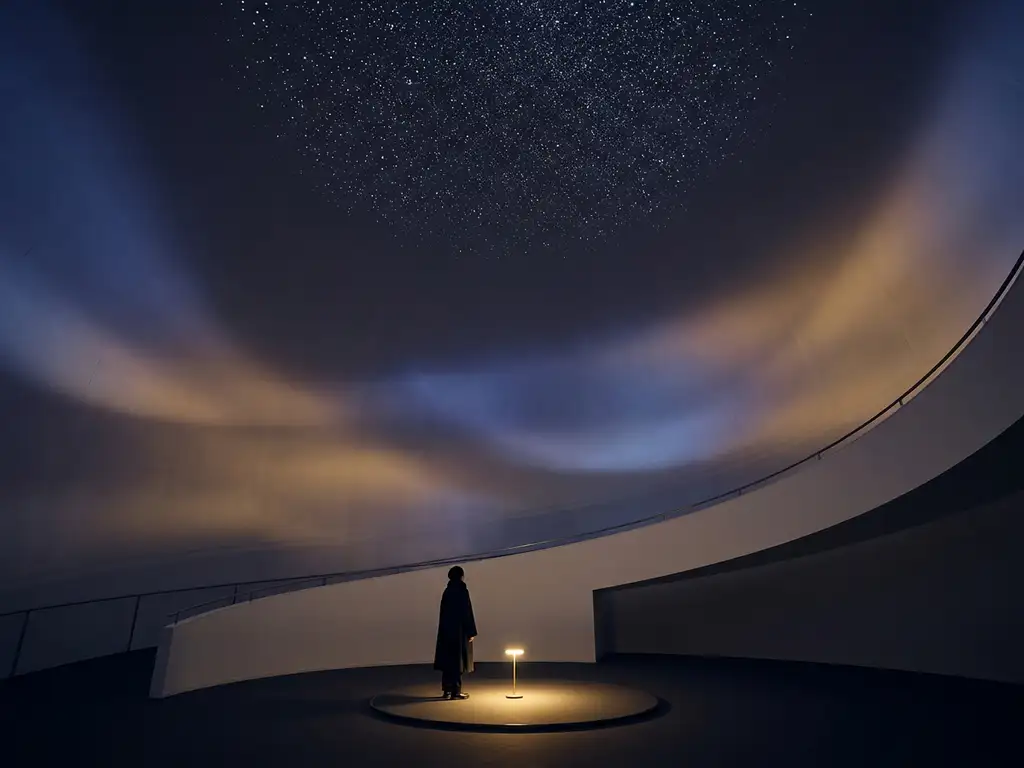
Dome installations create immersive experiences by surrounding audiences with continuous 360° projected imagery and spatial audio, eliminating the visual boundaries that remind viewers they are watching a screen. The result is a sense of total environmental presence, the brain processes the dome’s curved surface as a horizon rather than a display, triggering a deeper level of perceptual and emotional engagement than flat-screen formats can achieve. The questions below unpack exactly how that works, from the underlying technology to practical decisions about scale, content, and audience capacity.
What technology powers a 360° dome projection?
A 360° dome projection system relies on a network of high-resolution digital projectors whose outputs are precisely blended and warped to cover a curved interior surface without visible seams or distortion. The core components are edge-blending software, a central media server, and a calibrated projection geometry that maps flat digital content onto a spherical or geodesic structure. Together, these elements produce a single, seamless visual field that fills the viewer’s entire peripheral vision.
The projection geometry is the most technically demanding element. Because a dome surface curves in every direction, standard rectangular projector outputs must be mathematically warped before they reach the screen. Specialist software handles this in real time, adjusting each projector’s output so that straight lines remain straight and colors remain consistent across the full surface. The number of projectors varies by dome size, but even compact installations typically require at least four to six units to achieve true seamlessness.
Spatial audio is the second pillar of the technology stack. Dome experiences pair the visual envelope with multi-channel or object-based audio systems, often using formats like ambisonics or Dolby Atmos in a dome-adapted configuration, so that sound appears to move through three-dimensional space in sync with the imagery. When a visual element sweeps overhead, the corresponding sound follows the same arc. This audiovisual coherence is what transforms a large projection into a genuinely immersive environment.
Interactive dome systems add a further layer: real-time rendering engines such as Unreal Engine or Unity replace pre-rendered video with live, responsive environments. Sensor inputs, audience interactions, or external data feeds can then alter what appears on the dome surface in real time, making the experience dynamic rather than fixed.
How does a dome environment affect audience perception?
A dome environment affects audience perception by removing the visual frame that normally separates a viewer from a display. When imagery extends beyond the natural field of view in every direction, including overhead, the brain’s spatial orientation systems interpret the content as an environment rather than a representation. This perceptual shift produces a measurable sense of presence, the feeling of actually being somewhere rather than watching it.
This effect is closely tied to peripheral vision. Human peripheral vision is highly sensitive to motion and spatial context, even though it lacks the detail resolution of central vision. Flat screens, regardless of size, leave the periphery exposed to the real room. A dome fills that peripheral field entirely, which is why audiences instinctively reach out, lean back, or physically react to content that they would observe passively on a conventional screen.
The overhead dimension is particularly powerful. Most display formats operate within a horizontal band of vision. When imagery extends directly above the viewer, the vestibular system, which governs balance and spatial orientation, becomes engaged alongside the visual cortex. This is why dome content featuring aerial perspectives, falling sequences, or open skies produces a visceral physical response in ways that identical content on a flat screen does not.
For organizations focused on education, behavioral change, or emotional storytelling, this perceptual engagement has direct practical value. Experiences that activate the body’s spatial awareness systems are processed and retained differently than passive viewing. The dome format is not simply a larger screen; it is a fundamentally different perceptual context.
What types of content work best inside a dome?
Content that works best inside a dome is content that benefits from spatial scale, environmental immersion, or a sense of being physically transported. The most effective categories include natural environments, astronomical and scientific visualizations, abstract visual journeys, cultural heritage reconstructions, and narrative experiences built around perspective shifts. Content that relies on fine typographic detail or complex UI elements, by contrast, tends to lose legibility on a curved surface.
Environmental and scientific visualization
Planetarium-style astronomical content is the canonical dome application for good reason: the night sky is a natural dome. But the same logic extends to any environment defined by a horizon and an overhead expanse: ocean floors, rainforest canopies, arctic landscapes, volcanic interiors. Scientific data visualization also performs exceptionally well, particularly when the goal is to convey scale relationships that flat charts cannot communicate, such as the relative sizes of cells, geological formations, or climate systems.
Narrative and experiential storytelling
Narrative content works in a dome when the story benefits from placing the audience inside the world rather than in front of it. Documentary journalism, heritage reconstruction, and social impact campaigns that aim to build empathy are strong candidates. When an audience is surrounded by a displaced community’s environment rather than watching footage of it, the emotional register of the experience shifts fundamentally. This is where dome installations intersect directly with behavior-change storytelling and educational impact work.
How large can a dome installation be?
Dome installations range from portable inflatable structures as small as four to five meters in diameter, suitable for a few dozen viewers, up to permanent architectural domes exceeding thirty meters across that can accommodate hundreds of people simultaneously. The practical upper limit is determined by projection technology and structural engineering rather than any inherent ceiling of the format itself.
At the smaller end, inflatable domes between six and twelve meters in diameter are the most common choice for touring exhibitions, brand activations, and festival environments. They can be erected and dismantled in hours, transported in standard vehicles, and powered by equipment that fits in a modest production footprint. These structures typically seat between thirty and one hundred people per session, depending on configuration.
Larger permanent or semi-permanent domes, found in science centers, dedicated immersive venues, and major exhibition halls, operate at a different scale entirely. A twenty-meter dome can seat several hundred viewers in tiered configurations, and the projection systems required to fill that surface demand significantly more hardware, calibration time, and technical expertise. For organizations planning flagship installations or long-running exhibitions, this scale delivers an architectural presence that becomes a destination in its own right.
What’s the difference between a passive and interactive dome experience?
A passive dome experience delivers pre-rendered content to a seated audience, much like a cinema with a spherical screen. An interactive dome experience responds to audience input in real time, allowing individuals or groups to influence what appears on the dome surface through touch interfaces, motion sensors, spatial tracking, or networked devices. The fundamental difference is agency: passive experiences are authored in advance; interactive experiences are co-created in the moment.
Passive dome experiences excel when the goal is a controlled, high-impact narrative, a documentary, a brand story, a scientific journey with a defined arc. The production quality ceiling is higher because content can be rendered at maximum resolution without the computational constraints of real-time generation. For audiences who are there to witness and absorb, passive delivery is often the right choice.
Interactive dome experiences introduce a participatory dimension that changes the social dynamic of the space. When audience members can collectively steer a visualization, vote on narrative paths, or trigger environmental changes through movement, the dome becomes a shared decision space rather than a shared viewing space. This format is particularly effective for education, team engagement, and public campaigns where active participation deepens both understanding and retention.
Many contemporary dome installations blend both modes, beginning with a passive sequence to establish context and emotional tone, then opening into an interactive phase that invites the audience to explore or respond. This hybrid approach captures the narrative clarity of authored content while delivering the engagement depth that interactivity provides.
How many people can a dome installation accommodate?
A dome installation can accommodate anywhere from a handful of viewers in a small immersive pod to several hundred people simultaneously in a large-format structure. Capacity depends on three variables: the diameter of the dome, whether seating is tiered or flat-floor, and the nature of the experience itself, passive screenings allow denser seating than interactive experiences that require movement space.
As a practical reference: a ten-meter dome configured for seated viewing typically holds between fifty and eighty people per session. A fifteen-meter dome can comfortably accommodate one hundred to one hundred and fifty. Structures above twenty meters, with tiered seating, can reach capacities of two hundred to five hundred viewers. For high-throughput event environments, the throughput metric matters as much as the per-session capacity, a compact dome running eight-minute sessions can move a significant audience across a full event day.
For touring or temporary installations, the inflatable dome format offers a particularly useful combination of meaningful capacity and logistical flexibility. A twelve-meter inflatable dome that seats eighty people can be transported, erected, and operational within a single working day, making it viable for festivals, campus activations, trade shows, and public awareness campaigns where the venue changes between engagements.
When should an organization choose a dome over other immersive formats?
An organization should choose a dome when it needs to create a shared, simultaneous immersive experience for a group rather than an individual one. Dome installations are uniquely suited to contexts where collective presence matters, where the fact that an audience experiences something together amplifies the emotional or educational impact. VR headsets deliver deeper individual immersion, but they isolate; a dome immerses a group while keeping them connected to each other and to the shared space.
The dome format is the strongest choice when several of the following conditions apply:
- The content requires environmental scale that no flat screen can provide
- The audience is a group rather than an individual, and shared response is part of the intended outcome
- The installation needs to function as a physical landmark or destination in its own right
- The organization needs a format that works without headsets or wearables, lowering barriers to participation
- The experience addresses topics where spatial presence and emotional immersion are central to the message, such as climate, heritage, or social impact
- High throughput is required across an event day or exhibition run
By contrast, when individual narrative depth, precise haptic feedback, or one-to-one personalization is the priority, VR or mixed reality formats may serve better. When the goal is to reach audiences in their own environments without a physical installation, AR or digital experiences are more appropriate. The dome earns its place when the physical gathering of an audience around a shared sensory environment is itself part of what the experience needs to achieve.
Our Interactive 360 Domes are designed precisely for this intersection of scale, group engagement, and sensory impact, built for organizations that want an experience capable of moving thousands of visitors while maintaining the depth and intentionality that make immersive work genuinely memorable. If you are weighing whether a dome installation is the right format for your next project, we would be glad to think through it with you, feel free to contact us to start the conversation.
Gerelateerde artikelen
- How much does it cost to build an interactive museum?
- What are the benefits of experiential marketing?
- How much do brand activations cost?
- What is the strongest trigger to memory?
- Can AI make AR?
- What are the benefits of immersive learning?
- What is interactive storytelling?
- How do immersive installations work?
- How do you align immersive experiences with brand identity?