
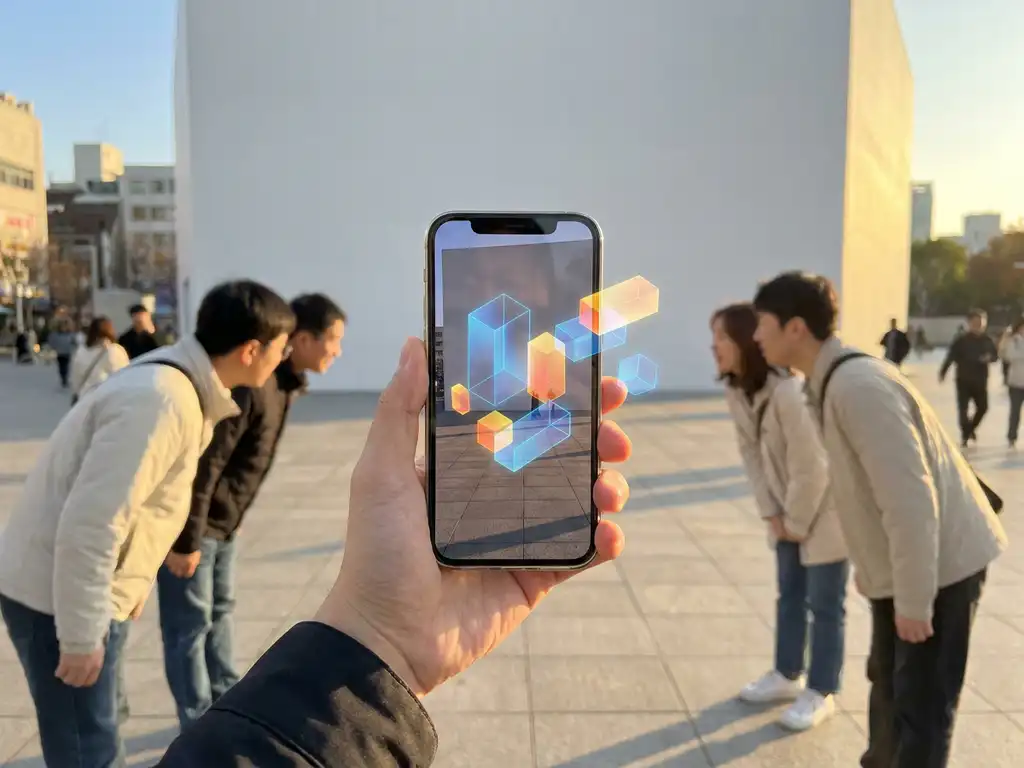
You can create shareable brand moments without requiring app downloads by using WebAR, augmented reality that runs directly in a smartphone browser via a URL or QR code. No installation, no friction, no barrier between your audience and the experience. This approach works for live events, outdoor campaigns, product launches, and social activations alike.
The key driver is accessibility. The moment you remove the download step, participation rates rise dramatically because the path from curiosity to engagement becomes a single tap. The sections below unpack exactly how this works, which formats perform best, and how to design moments people genuinely want to share.
What technologies make brand experiences shareable without an app?
The primary technologies that enable shareable, app-free brand experiences are WebAR, geospatial AR, image tracking, and interactive web experiences delivered through standard mobile browsers. Each of these runs on existing smartphone hardware without requiring a download, making them instantly accessible to any audience member with a phone and a data connection.
WebAR is the most versatile of these. Built on web standards like WebGL and WebXR, it allows 3D objects, animations, and interactive layers to be rendered directly in a browser. A user scans a QR code or taps a link, and the experience opens immediately in Safari, Chrome, or any modern browser.
Geospatial AR takes this further by anchoring digital content to specific GPS coordinates. A brand can place a virtual installation at a festival entrance, a product at the center of a retail space, or a character in a city square, all without any app. Users simply point their phone at the location and the content appears.
Image tracking is another powerful format. A poster, packaging label, or event banner becomes a trigger point. When a user points their phone camera at the image, an AR layer activates, bringing the static surface to life with video, 3D animation, or interactive storytelling. This is the technology behind our AR Posters and AR Activations work, which we deploy for product launches and live events where frictionless engagement is essential.
Beyond AR specifically, interactive web experiences built with responsive design and real-time rendering can deliver immersive brand moments entirely through a browser. These can include 360-degree environments, gamified challenges, and personalized storytelling sequences, all shareable via a single URL.
How does WebAR create shareable moments at live events?
WebAR creates shareable moments at live events by turning any physical touchpoint, a badge, a stage backdrop, a product, a floor sticker, into an interactive experience that attendees can trigger, engage with, and immediately share to social media, all without leaving their phone’s camera app or downloading anything.
The mechanism is straightforward. A brand places QR codes or NFC triggers throughout an event space. An attendee scans one, a branded AR experience opens in their browser, and within seconds they are interacting with 3D content layered over their real environment. Because the experience is visual and novel, the instinct to capture and share it is immediate.
What makes this particularly powerful at live events is the social proof loop it creates. One person shares a video of themselves inside a branded AR portal or holding a virtual product. Their followers see it, arrive at the event already curious, and seek out the same trigger. The experience markets itself organically, extending the brand’s reach far beyond the physical venue.
The shareable output is also designed into the experience from the start. Well-built WebAR activations include a built-in capture mode, allowing users to record a short clip or take a photo with the AR layer intact. That content is then ready to post directly to Instagram, TikTok, or WhatsApp without any additional steps. The brand’s visual identity travels with every share.
What types of brand activations work best without an app?
The brand activations that work best without an app are those built around a single, emotionally compelling moment rather than a deep, ongoing experience. WebAR product reveals, AR portal activations, image-triggered animations, geospatial installations, and gamified treasure hunts all perform exceptionally well in app-free formats because they deliver immediate impact with minimal setup.
Activations built around a single trigger point
Product launches benefit enormously from WebAR. A user scans packaging or a press release and a 3D version of the product appears in their space, rotating, opening, revealing features. The moment is visually striking, immediately shareable, and requires no prior installation. This format works equally well at trade shows, in-store displays, and direct mail campaigns.
AR portals are another high-performing format. A user scans a marker and a virtual doorway appears in front of them. Stepping through it transports them visually into a branded environment, a product world, a destination, a narrative space. The contrast between the real room and the virtual world beyond the portal is inherently dramatic, which drives social sharing.
Activations built around place and discovery
Geospatial AR activations work particularly well for outdoor campaigns, city activations, and festival environments. Placing virtual content at specific GPS coordinates turns a location into a destination. Audiences move through physical space to discover digital content, creating a sense of adventure and exclusivity that static advertising cannot replicate.
AR treasure hunts extend this further by building a narrative across multiple locations. Each stop reveals a new piece of content, a clue, or a reward. This format works for brand campaigns, educational programs, and team-building events alike, and because each stage is triggered by a URL or QR code, the entire experience remains app-free.
How can brands measure the reach of app-free immersive experiences?
Brands can measure the reach of app-free immersive experiences through URL analytics, QR code scan data, session tracking, social listening, and conversion events, the same measurement infrastructure used for any web-based campaign, but applied to immersive interactions. Because WebAR runs in a browser, every engagement generates trackable data without requiring any special analytics setup.
At the most basic level, each WebAR experience has a URL. That URL can carry UTM parameters, be wrapped in a tracked short link, or be embedded in a QR code that logs every scan. This gives brands a clear picture of where engagement is happening, at what times, and from which physical locations if geofencing is applied.
Session data reveals how long users spend inside the experience, which interactions they complete, and where they drop off. This depth-of-engagement data is often more meaningful than raw reach figures because it shows whether the experience actually held attention, a key indicator of whether a brand moment was genuinely immersive or merely glanced at.
Social reach can be tracked through branded hashtags, watermarked capture outputs, and social listening tools. When users share their AR content, the brand’s visual identity travels with it. Monitoring the volume and sentiment of those shares gives a qualitative layer to the quantitative session data.
For campaigns with a conversion goal, a product purchase, a sign-up, a donation, the WebAR experience can include a direct call-to-action button that routes users to a conversion page. This closes the loop between immersive engagement and measurable business outcome, making it straightforward to calculate return on experience investment.
What’s the difference between WebAR and native AR apps for brand campaigns?
The core difference between WebAR and native AR apps is friction versus fidelity. WebAR requires no download and runs instantly in any browser, making it far more accessible for one-time or campaign-driven brand activations. Native AR apps offer richer graphics, persistent data, and deeper device integration, but they require installation, which significantly reduces participation rates in casual or public settings.
For brand campaigns where the goal is maximum reach and spontaneous engagement, a festival activation, a product launch, an outdoor installation, WebAR almost always outperforms a native app. The barrier of downloading an app is enough to lose a large proportion of potential participants, particularly in high-traffic, time-pressured environments.
Native AR apps make more sense when the experience is designed for repeat use, requires access to device features like persistent world anchoring or advanced haptics, or is part of a loyalty or utility platform that users will return to regularly. A retail brand building a virtual try-on tool embedded in their existing shopping app, for example, benefits from the native environment.
For most experiential marketing campaigns, WebAR is the more strategic choice. It reaches everyone, requires no prior commitment from the audience, and can be deployed and updated rapidly. The technical gap between WebAR and native AR has also narrowed considerably, modern WebAR experiences can deliver high-quality 3D rendering, face tracking, surface detection, and real-time interaction entirely within a browser.
How do you design a brand moment that people actually want to share?
A brand moment people want to share must do one of three things: make them look interesting, make them feel something, or give them something genuinely useful to pass on. The best shareable activations do all three simultaneously. The design starts not with the technology, but with the social motivation, why would someone show this to another person?
Novelty is the most reliable driver. When someone sees an AR portal appear in a physical space, or a 3D version of a product materialize on their table, the instinct to capture and share it is almost automatic. The experience is surprising enough to feel worth documenting. This is why first impressions matter so much in immersive design, the moment of reveal must be visually arresting.
Personal presence amplifies shareability. An experience that places the user inside the content, as a character, as a participant, as someone visibly interacting with something extraordinary, creates social currency. A video of someone walking through a virtual portal is more compelling than a video of a screen playing back content. The person is the story.
Ease of capture must be designed in, not left to chance. If a user has to exit the experience, open their camera app, return, and try to frame the shot, most will not bother. The best immersive activations include a built-in record or screenshot function that captures the AR layer with the user in frame, producing a ready-to-share asset in a single tap.
Finally, the experience must feel complete at a short duration. Shareable moments are not long experiences, they are peaks. A ten-second reveal, a fifteen-second animation, a thirty-second interaction. Design for the highlight, not the marathon.
When should a brand choose an app-free experience over a dedicated app?
A brand should choose an app-free experience whenever the audience is broad, the context is public or time-limited, and the goal is immediate engagement rather than ongoing utility. If you cannot guarantee that your audience will download something in advance, an app-free format is the strategically correct choice. This covers the vast majority of experiential marketing, live events, outdoor campaigns, and product launches.
The practical test is simple: will the people you want to reach have your app installed before they encounter the activation? For most brand campaigns, the honest answer is no. A passerby at a street activation, an attendee at a trade show, a consumer picking up a product in a store for the first time, none of these people have your app. An app-free experience meets them where they already are.
There are situations where a dedicated app is the right answer. If you are building a persistent loyalty experience, a retail tool with deep device integration, or an internal training platform that employees will use repeatedly over time, the investment in a native app is justified. The ongoing utility offsets the friction of installation.
For everything else, campaign activations, event experiences, product reveals, public installations, educational pop-ups, app-free is faster to deploy, cheaper to distribute, and more accessible to a wider audience. The technology has matured to the point where app-free no longer means technically limited. It means strategically smart.
If you are exploring how to build a shareable, app-free brand experience that genuinely moves people, we would be glad to help you find the right format for your goals. Feel free to contact us to start the conversation.
Gerelateerde artikelen
- Which questions should you ask an immersive agency?
- How do you design an immersive installation for public spaces?
- Why do people like immersive experiences?
- What is an immersive art installation?
- How is augmented reality used in marketing?
- What are the challenges of spatial computing?
- What is an immersive brand experience?
- What are the three levels of immersion?
- How to create an immersive room?